With the increasing dominance of global hyperscalers in the cloud world, Europe faces a challenge: to remain competitive with innovative cloud and AI solutions. Control over critical data or technological sovereignty should not be lost in the process. SAP’s solution: Sovereign Cloud.
What was long considered an urgent demand from DSAG is now becoming a reality. SAP presents a comprehensive, EU-compliant cloud offering. It enables the public sector and highly regulated industries to utilize innovative technologies such as AI, without compromising data protection, security, or regulatory control.
New Options for Critical Infrastructures
A significant advance: For the first time, on-premises customers now also gain access to key innovations such as SAP Business AI. This addresses the long-standing criticism that new functionalities were exclusively provided in the public cloud. Companies and public authorities that previously relied on local systems due to regulatory reasons are thus no longer cut off from technological progress.
“The fact that SAP consistently relies on sovereign cloud offerings is a major achievement – especially for critical infrastructures such as public administration, energy, or healthcare,” explains Hermann-Josef Haag, DSAG Board Member for Human Resources & Public Sector. The new on-site option, which allows customers to operate the SAP infrastructure in their own data center, is particularly regarded as a milestone.
SAP Sovereign Cloud: Variety for the Most Demanding Requirements
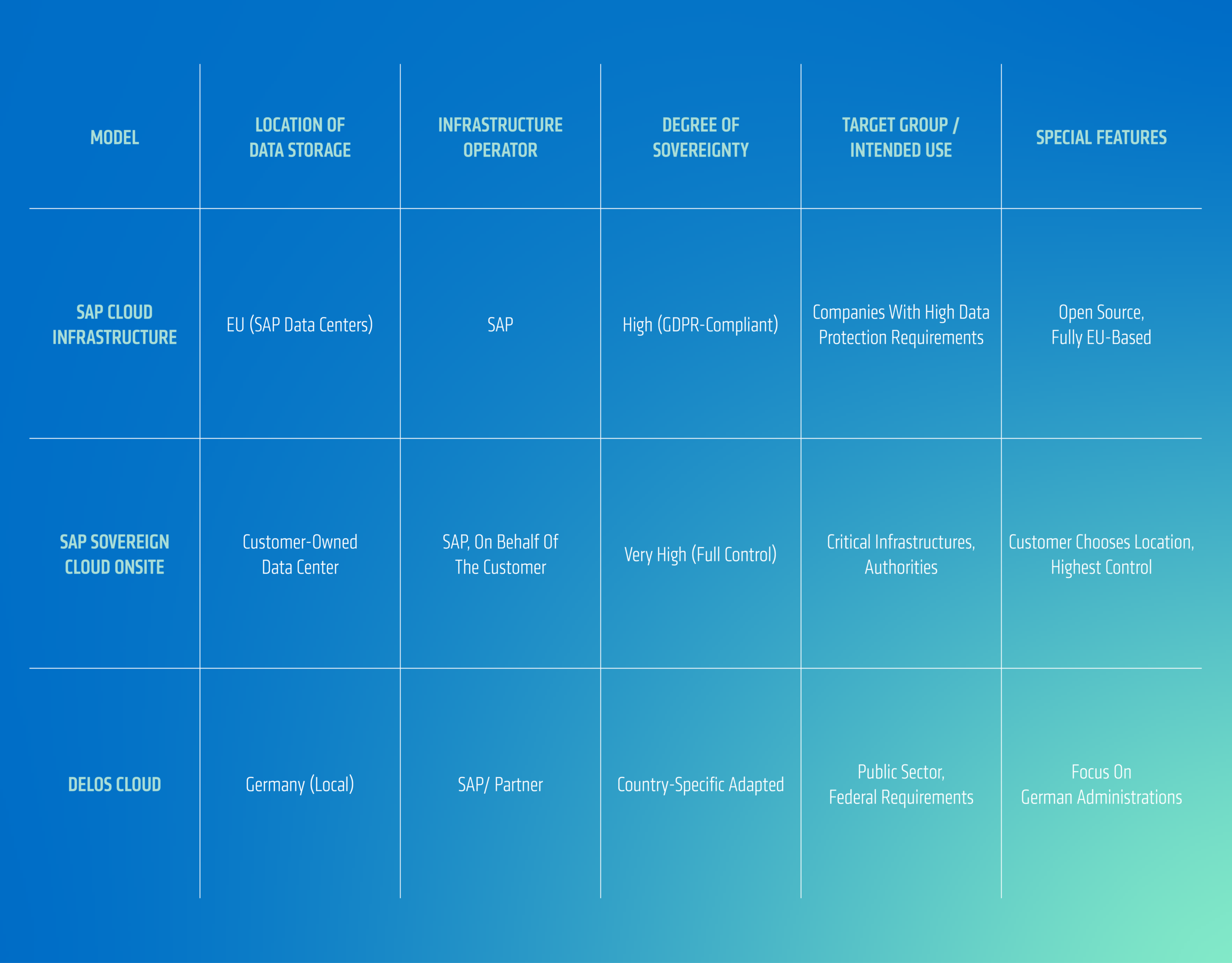
The new SAP offering is more than just a technology update. It is a strategic investment in Europe’s digital future. The technology stack includes SAP Cloud Infrastructure, SAP Sovereign Cloud On-Site, and Delos Cloud. SAP thus offers tailored deployment models for various security and compliance requirements:
- SAP Cloud Infrastructure: SAP’s IaaS platform is based on open-source technologies, runs within the SAP data center network, and stores all data exclusively within the EU in accordance with data protection regulations.
- SAP Sovereign Cloud On-Site: The SAP-operated infrastructure runs from a customer-selected data center, for example, the customer’s own data center. This enables the customer to meet the highest sovereignty requirements regarding data, operations, technology, and legal aspects.
- Delos Cloud: SAP offers a sovereign cloud in Germany, thereby actively supporting the transformation of the public sector while taking country-specific sovereignty requirements into account.
First Implementation in Practice: The Federal Employment Agency will be the first federal authority to become a pilot customer of Delos Cloud. As part of a proof of concept, migration concepts, performance, and data protection requirements, among other things, will be examined. The goal is to make the agency’s IT landscape more resilient and future-proof. This is a strong signal for cloud transformation in the public sector.
Another key advantage: The new models enable organizations to transfer the operation of their data centers, in whole or in part, to SAP without relinquishing data sovereignty. This helps counteract the acute staff shortage in the public sector while simultaneously strengthening IT security. Professionally operated infrastructures can more effectively ward off cyberattacks. This is a critical point given the increasing attacks on cities, districts, and public institutions, which have repeatedly been paralyzed for weeks in the past. This variety allows companies to comply with local laws, implement regulatory requirements, and simultaneously realize scalable innovations, including the SAP Business Technology Platform and SAP Business AI.
20 Billion Euros for Digital Resilience – A Long-Term Investment in Europe
In a time when geopolitical tensions, cyber risks, and regulatory complexity are increasing, the concept of digital resilience is gaining increasing importance. It is not just about the ability to operate technologies securely, but also about remaining independent, innovative, and legally capable as an economic hub. With its long-term investment of over 20 billion Euros in sovereign cloud infrastructures and digital innovations, SAP is sending a clear signal for the future of Europe.
“The new sovereign cloud offerings are not just a national response, but an all-European foundation,” explains Walter Schinnerer, DSAG Board Member Austria. This not only strengthens digital sovereignty but also Europe’s position as an economic hub in global competition. Markus Bierl, DSAG Board Member Switzerland, also sees great added value for Swiss companies that benefit from high data security and transparency. These two aspects are central prerequisites for highly regulated industries such as public administration, finance, or healthcare.
Clarity Required: Licensing of Hybrid Scenarios
Despite these advances, DSAG still sees a need for clarification. Particularly with regard to the licensing of hybrid IT landscapes: “If on-premises, public cloud, and sovereign cloud are used in parallel, licensing models must be designed to be transparent, fair, and future-proof,” says Haag. Furthermore, questions regarding the individual options remain open. According to Haag, an on-site option with high regulatory requirements must be designed to be end-to-end deployable.
SAP Sovereign Cloud: A Conclusion
With its new Sovereign Cloud portfolio, SAP is opening a new chapter for highly regulated industries and public administrations that want to shape innovation responsibly. AI-driven processes and cloud technologies thus become usable despite high security requirements and strengthen Europe’s position as an economic hub in global competition. Even if details regarding the licensing and technical design of the individual options still need to be clarified, one thing is already clear: Digital sovereignty is no longer a vision, but is becoming a reality.