SAP Business AI opens up new opportunities for companies to support processes and make work more efficient. But successfully implementing SAP Business AI requires more than just the technology itself. It is crucial that SAP Business AI aligns with the company’s specific requirements, is embraced by employees, and that business units and IT work together on implementation.
This year’s DSAG Annual Congress also demonstrated just how varied perspectives on successful AI implementation can be. There, we asked what hurdles companies still see on the path to successfully implementing AI. It was particularly interesting to note how differently these challenges are assessed from a business versus an IT perspective.
It is precisely this shift in perspective that leads to a crucial question: What is needed to ensure that technological possibilities actually generate added value in day-to-day work? This is exactly where the “Human Factor in SAP Business AI” comes into play.
Two Perspectives, One Challenge
In our discussions with customers, it becomes clear time and again that business units and IT often view the use of AI from different perspectives.
- The business department wants to know: How exactly does SAP Business AI support me in my day-to-day work? It’s often difficult to answer this question unless the possibilities are translated into the specific work context.
- IT is concerned with other questions: What technical requirements must be met? What expertise is still lacking? And how can we foster acceptance within the company?
Both perspectives are necessary to ensure a successful implementation of SAP Business AI. If they are not aligned early on, misunderstandings can easily arise. It is therefore crucial to align both perspectives toward a common goal from the outset. Even before discussing specific AI functions, it should be clear what problem needs to be solved, how the solution can contribute to the company’s goals, and how success will be measured later on.
How this might look in everyday practice – two scenarios
A business unit wants support with a recurring, time-consuming task and expects a quick solution. IT is generally willing to agree but must first review permissions, data access, and licensing issues. What the business unit perceives as a delay, IT views as necessary due diligence.
IT sometimes implements features that are technically interesting but do not offer any real added value in the department’s day-to-day work. Even if they are well thought out and function smoothly, they do not meet the actual needs.
Successfully Implementing SAP Business AI: From Technical Readiness to Tangible Benefits
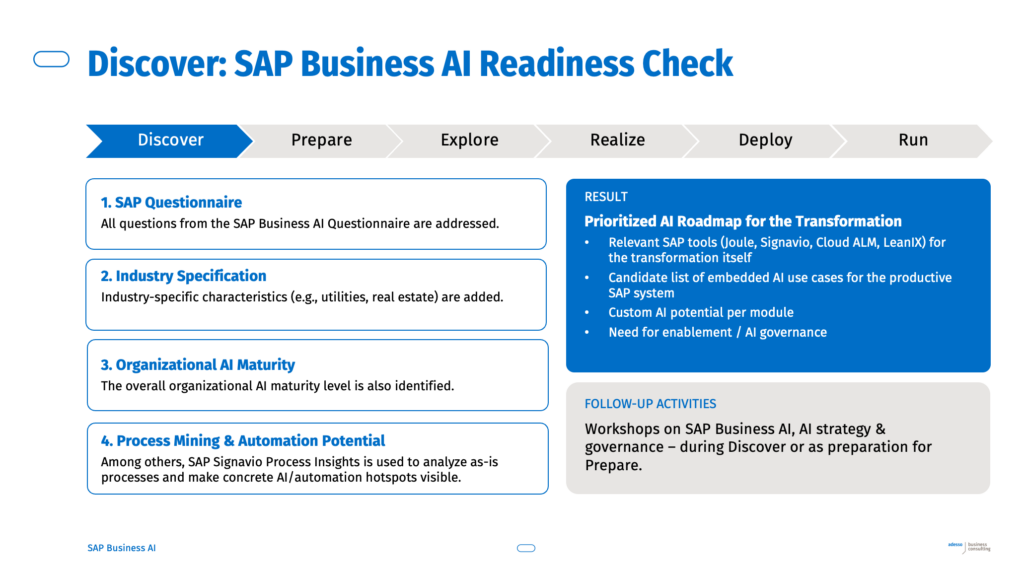
To bring both sides together, a realistic assessment of the current situation is needed first. In our adesso SAP Business AI Readiness Check, we begin by determining whether the SAP landscape is technically ready. We evaluate performance, data access, permissions, and security; identify gaps and risks; and translate them into prioritized actions.
However, this does not yet clarify where SAP Business AI will deliver the greatest value. To do that, we need to examine processes, tasks, and the people who will eventually work with the solutions. In the Discovery Workshop, we jointly develop and evaluate potential use cases:
- What challenges need to be solved?
- Who will benefit?
- Is SAP Business AI the right approach for this?
This transforms the general question “What can AI do?” into a concrete one: “Which use case do we want to improve, and how do we measure success?”
Potential use cases should not be evaluated solely based on their technological potential. Equally important are expected business value, technical and organizational feasibility, and a measurable success criterion. This allows us to prioritize use cases where benefits and feasibility align.
Creating the Conditions for Implementation
A meaningful use case does not automatically deliver value. Employees must understand how AI can support them and where its limitations lie. This also means taking skepticism seriously: Anyone who doesn’t trust AI’s results or has concerns about their own role won’t use the solution, no matter how well it works technically.
Three Questions to Ask Before the First Pilot Project
- Are the future users involved from the very beginning?
Requirements and acceptance should not be assessed only after technical implementation. - Is success defined in measurable terms?
From the start, it should be clear what improvements are expected – for example, time savings, quality, or a specific process KPI. - Have the prerequisites been clarified?
Data access, permissions, security, licenses, architecture, and the necessary expertise should be transparent before implementation.
Business units and IT should therefore work on implementation together, rather than one after the other. The business unit contributes its knowledge of tasks and challenges. IT ensures that this is transformed into a solution that is technically and organizationally feasible. Working together allows them to identify early on what is realistic, which questions remain unanswered, and what the next logical steps should be.
How SAP Business AI Delivers Tangible Value
Technology is an important building block for implementing SAP Business AI, but it is only one of many. Implementation is successful where technical requirements, specific use cases, and the perspectives of the people in the company come together.
One possible path to achieving this involves three steps:
1. Assess the current situation: Examine technical and organizational prerequisites and identify existing gaps.
2. Discover and prioritize potential: Work with business units and IT to identify relevant use cases and evaluate them based on benefit, feasibility, and measurable success criteria.
3. Empower, test, and scale: Involve employees early on, implement a clearly defined use case, measure results, and gradually expand successful approaches.
How adesso business consulting supports you
At adesso business consulting, we guide companies on their SAP Business AI journey – from the very first step through to implementation. We help clarify the current situation, uncover concrete opportunities, and develop suitable use cases. At the same time, we help empower business departments for SAP Business AI and involve IT in addressing questions regarding licenses, expertise, and architecture.
Successful implementation begins not only with the technology, but with a shared understanding of what truly drives progress for people and organizations.
Would you like to find out where SAP Business AI can provide meaningful support in your company? Visit our SAP Business AI website or contact us directly. Together, we’ll assess your current situation, identify specific opportunities, and develop the next steps – from a readiness check to implementation.