With the release of SAP S/4HANA Cloud Public Edition 2502, SAP is setting new standards in public sector management. This update includes numerous innovations and improvements, finally enabling the rollout of artificial intelligence aspects for public administration.
Integration of Joule – the AI co-pilot
One of the most outstanding new features in SAP S/4HANA Cloud Public Edition Release 2502 is the introduction of Joule, SAP’s AI co-pilot. Joule uses generative AI to support users in their daily tasks, offering fast navigation, instant insights into business data, and personalized assistance. For the public sector, this translates into a significant simplification of financial administration, as Joule revolutionizes the user experience and increases efficiency.
Joule understands industry-specific language, enabling users to complete tasks faster and achieve better results in a regulatory-compliant manner. By rapidly analyzing and interpreting data, Joule delivers smarter insights. Users can ask Joule questions or describe a problem in natural language. Joule then provides understandable answers drawn from a wealth of historical data while preserving context. This allows users to receive personalized, data-driven recommendations, freeing them to focus more on strategic decision-making.
Joule also recognizes the role of the user and suggests appropriate task-related solution options.
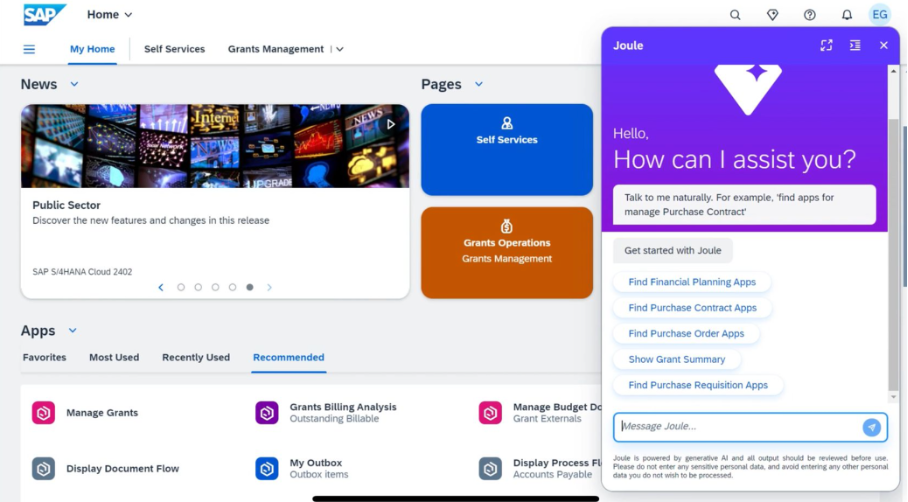
Examples of Joule’s applications include questions like “Where can I create a funding program?” or “Show me a budget overview.” Integrating Joule into SAP S/4HANA Cloud Public Edition enables public institutions to optimize their financial processes and accelerate decision-making.
Enhanced functions in grant and budget management
Release 2502 also provides a solid selection of features in the area of grant and budget management, specifically designed for public institutions. The integration of operational and accounting processes enables seamless grant management. Real-time budget controls help to manage funds effectively. These functions are based on the unified storage of PSM account assignment objects and attributes in the Universal Journal, which forms the basis for budget execution and reporting.
Remaining grant budgets can be more easily carried over to the next fiscal year, and cross-year reporting has been improved for this purpose. This optimizes resource allocation and prevents the loss of unspent funds.
Digital version of a document for earmarked funds
Designated funds are a key feature for the early allocation of budgetary resources. With the new output services, these documents can now be exported as standardized PDFs, including all relevant approvals and timestamps. This not only improves traceability but also ensures secure, audit-proof archiving. Furthermore, processing becomes more efficient and digital thanks to predefined formats and the option of email delivery.
More flexible budget use through due date
Previously, budget allocations were based on the booking date by default. With the new enhancements, the due date can now be used as the expenditure date instead. This allows for more accurate planning and better control of funds. If no due date is specified, the booking date remains relevant. Changes made before the budget expenditure date still use the original date, while later adjustments are dynamically reconciled using new booking logic.
Enhanced Availability Control (AVK) with SAP Concur integration
Availability Control (ACC) compares spent resources with the available budget, giving customers greater control over their finances. A new feature is the ability to precisely define at which levels the budget is checked and how the system reacts to overruns. Particularly relevant for public sector organizations: New ACC activity groups for travel requests and expense reports enable seamless integration with SAP Concur. This improves budget control for business trips and makes expense obligations more transparent.
Planned expansions in budget management from Q2 2025
For the second quarter of 2025 and beyond, SAP is planning further optimizations in budget management, specifically relevant to the German public sector. These future changes aim to further increase efficiency and transparency in budget management.
- Enhanced integration of AI-powered tools: The use of artificial intelligence is being further expanded to improve forecasting and analysis in budget management. This enables more precise prediction of budget requirements and early identification of deviations.
- Improved user interface: The user-friendliness of the budget management system is enhanced through an optimized interface. Intuitive dashboards and customizable reports facilitate access to relevant information and support efficient decision-making.
- Enhanced compliance features: New regulatory compliance functions are being implemented to ensure all budget processes comply with current legal requirements. This includes automated audits and reports that increase transparency.
- Integration of mobile applications: The ability to manage budget processes via mobile devices is being introduced. This enables flexible management and monitoring of budgets, regardless of the location of those responsible.
Outlook
These current and planned enhancements underscore SAP’s commitment to equipping public institutions in Germany with modern tools that meet the demands of digital administration. Continuous improvements in budget management enable streamlined processes and optimal resource allocation.
If the innovations have sparked your interest, you have the opportunity to test < 0 >budget and grant management in the public cloud free of charge for two weeks to get an impression of the many advantages for yourself.