The migration from SAP Process Integration/Process Orchestration (PI/PO) to SAP Cloud Platform Integration (CPI) – as a central component of the SAP Integration Suite (IS) – is far more than just a technological upgrade. It is a strategic shift on the path to digital transformation. Companies that take this step actively invest in flexibility, scalability, and a future-proof integration landscape. A successful migration requires a clear strategy, precise planning, and a disciplined approach. In the following, we systematically present all relevant migration phases and explain why and how they should be implemented.
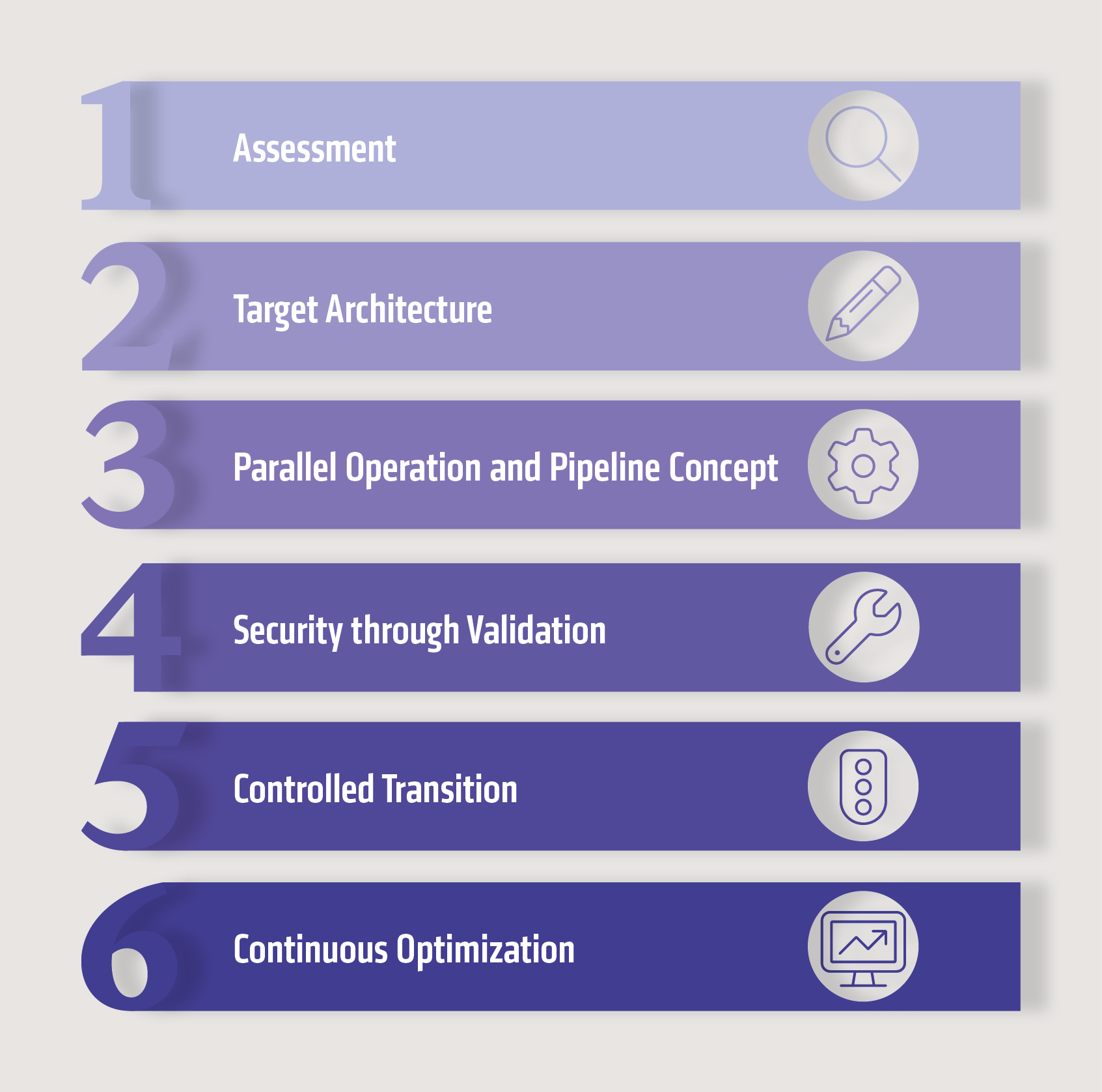
1. Assessment
Why is this phase essential?
The foundation of every migration should be a comprehensive assessment. A complete understanding of the existing integration landscape simplifies making the right decisions and minimizing risks.
What does this phase entail?
- Inventory of all current interfaces: Which interfaces exist? What type of data is being transferred? Are they A2A (Application-to-Application), B2B/EDI, or BPM-based processes?
- Classification by effort and complexity: Not all interfaces are equal. Some are easily migratable, others require extensive re-design.
- Analysis of dependencies: Many integrations are interconnected. Changes to one interface can have far-reaching effects on other processes.
- Review of reusability: Existing artifacts and SAP’s pre-built content can significantly shorten migration time.
This thorough analysis forms the basis for prioritizing and planning the subsequent steps.
2. Future Architecture
What is meant by this?
In this phase, the future, cloud-based integration architecture is designed, which builds upon the insights from the first phase.
Important Considerations
- Mapping to CPI standards: Matching the old interfaces with the available CPI standard connectors or templates.
- Utilization of modern IS services: Integration of additional SAP IS services such as API Management, Event Mesh, or Open Connectors to ensure flexibility, scalability, and extensibility from the outset.
- Definition of governance rules: How should interfaces be named, documented, monitored, and maintained in the future? Clear standards ensure long-term maintainability and quality.
The goal is a detailed architectural design that lays the technological foundation for a stable, scalable, and maintainable cloud integration.
3. Parallel Operation and Pipeline Concept
During migration, the parallel operation of both systems – old PI/PO and new CPI – is key to minimizing risk. Ongoing business operations remain undisturbed while the new environment is gradually built, tested, and optimized.
The Role of the Pipeline Concept
In the PI/PO environment, pipelines are central building blocks for message processing. In CPI, this concept is modernized so that integration scenarios are based on modular, flexible flows. SAP offers standardized Pipeline Templates and Packages in CPI, specifically designed to facilitate migrations. These templates allow typical PI/PO pipeline structures (e.g., sender/receiver logic, routing, transformation) to be efficiently mapped in the cloud. They significantly shorten migration time as they contain reusable patterns and scripts (e.g., for partner determination or error handling).
How is this implemented?
- The migration ideally takes place in small, manageable sprints, and agile methods ensure rapid feedback cycles.
- Existing logic is refactored to benefit from cloud advantages such as scalability and resilience.
4. Security through Testing
Security and stability are top priorities. The prerequisite for the productive release of the interface is passing all tests.
What needs to be tested?
- End-to-end functional tests to ensure that processes run as planned.
- Regression tests to prevent changes from having unintended side effects on existing applications.
- Performance tests for checking throughput, latency, and stability under load.
- Error and exception handling tests so that potential sources of error are identified early and handled reliably.
5. Controlled Transition
The cutover process must be planned and executed gradually.
- A gradual switchover of productive interfaces from PI/PO to CPI is planned.
- Monitoring tools within CPI support real-time monitoring of ongoing integration processes.
- Final decommissioning of the old platform only occurs when the new environment operates consistently and stably and meets all operational requirements.
This controlled transition avoids system outages and ensures smooth operation.
6. Continuous Optimization
The migration is not an end, but the beginning of a sustainable optimization phase. The use of modern analytical tools, AI-supported monitoring, and event-driven automation creates a self-optimizing landscape.
What is currently possible?
- Regular performance and error analyses.
- Automated scaling with increased usage.
- AI-based detection and remediation of anomalies.
- Use of event-driven architectures for flexible integration expansion.
These measures make the integration architecture resilient and future-proof.
Unlock the Cloud Benefits Now
The transition from SAP PI/PO to SAP CPI, and thus to SAP IS, is a demanding task that requires careful planning, the use of modern Pipeline Templates, and comprehensive testing. Through a structured, phase-oriented approach, you secure the stability, performance, and future viability of your integrations and simultaneously unlock the unbeatable advantages of the cloud: agility, scalability, and a reduced Total Cost of Ownership (TCO). Are you ready to make your integration landscape cloud-native? We can help you!