In addition to the major changes brought about by the 24-hour supplier switch on June 6, 2025, which is currently keeping energy companies busy, further changes are already on the horizon for October 1. The most important points are summarized below:
These versions will be binding from 1 October 2025 for all market participants who are required to implement them in accordance with the provisions on market communication.
“Due to the adjustments in the MsbG, which affect the POG article ID, it was determined that the code list of article numbers and article IDs must be implemented by September 1, 2025. […]”
Source: Bundesnetzagentur
1. New AHB structure: Uniform, clear, consistently separated
With MaKo 10/25, the structure of the application manuals (AHBs) is being revised. Going forward, each AHB will contain only use cases for a single message type, including all related explanations.
Specifically, this means that mixed documents are a thing of the past. Message types such as APERAK and CONTRL, REMADV and INVOIC, or UTILMD and UTILTS are now consistently separated and documented in their own AHBs (Additional Terms of Use).
2. Processes for changing technology at locations – new application guide
The new application guide from the BDEW fundamentally restructures the processes for modifying technical equipment at metering points. It replaces and supplements the previous specifications from WiM Strom (BK6-24-174), thus creating a clear and comprehensible structure for all market participants.
The focus is on the two standardized use cases:
- Change of measurement location by the network operator (NO)
- Change of measurement location by the supplier (SF)
- each in the direction of the responsible metering point operator (MSB).
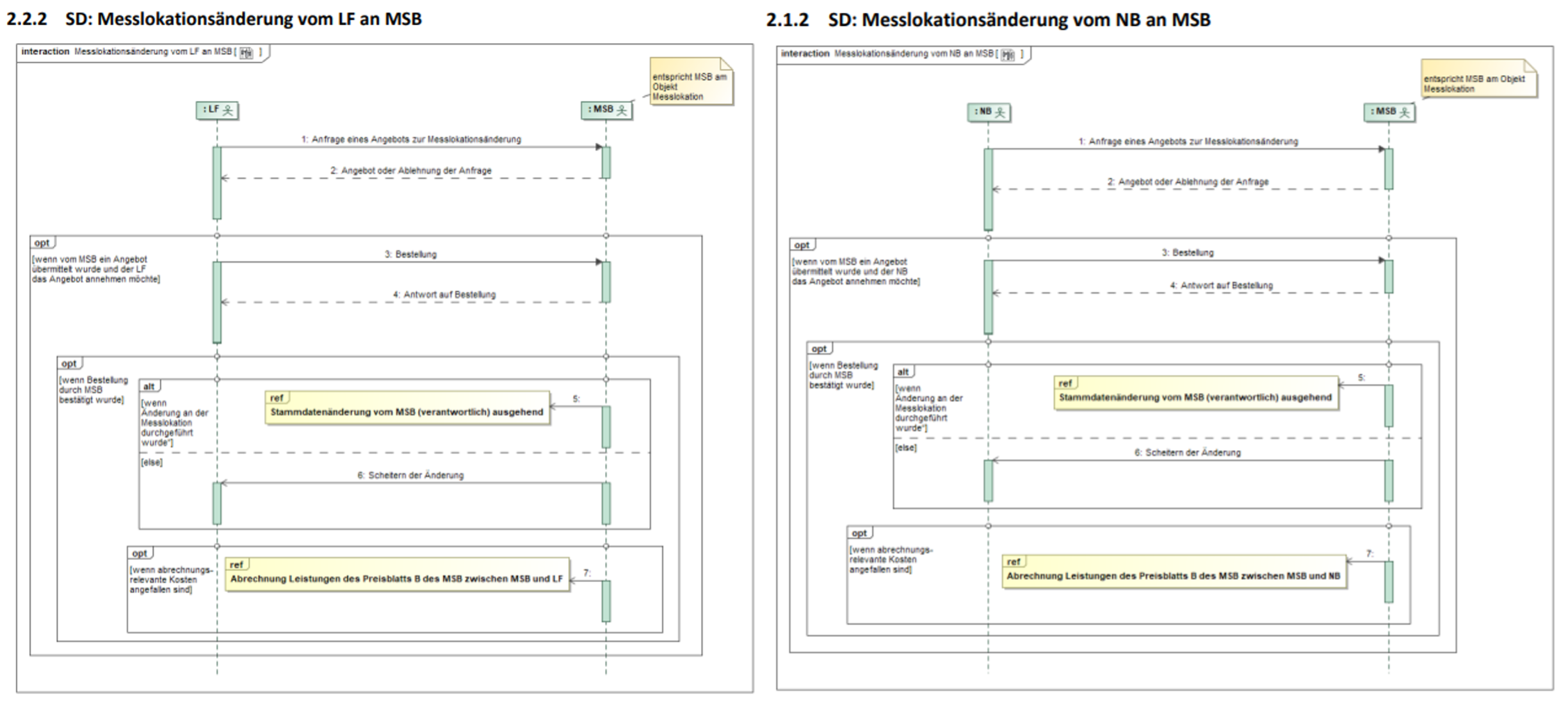
The process is consistently uniform: Inquiry → Offer → Order → Execution or feedback → Invoicing.
Billing is based exclusively on the electronic price list B, which contains only services with predefined item IDs. Use of this code list is mandatory; individual extensions are not permitted.
In addition to transparency, the application guide also brings commitment and reliability: deadlines for responses to offers and orders are clearly regulated, as is the handling of complaints – according to the well-known “all-or-nothing principle”.
The specification of these processes is one of the main drivers for the upcoming format changes.
3. Which formats are changing? – an overview
The implementation of the new processes for technical changes at locations is reflected in numerous news types. In addition to editorial corrections, many formats have been expanded or structurally adapted. Here is an overview of the most important changes:
New Use Cases & EBDs
- COMDIS, QUOTES, REQOTE, ORDERSP, REMADV, and others were supplemented with new EBDs to implement the application guide.
- The focus is on handling and feedback regarding technical changes.
- Verification of correct cancellation amounts including sign.
- Compliance with the requirements of §14 Abs. 4 UStG
- Removal of the right to vote as a basis for forecasting at iMS measurement locations
- Reversal of faulty change IDs to ensure verification of interim invoices
- General clarifications in test steps
IFTSTA & ORDERS
- Expansion to include new segments for transmitting the metering point conversion status
- Addition of segments for controllability and delivery direction
- In the future, controllability will only be possible at the level of the controllable resource (SR), analogous to network location.
Invoice formats: INVOIC & REMADV
- Cancellation invoice restored, new invoice type TEC for technical billing, special invoice type Z10 for concession fees added.
- Clarifications regarding the rejection of cancellation invoices, including information on Section 14 of the German VAT Act (invoice requirements)
Price list & offer: PRICAT & QUOTES
- Introduction of the new Z94 price list (technical specifications)
- New chapters on offering and requesting technical modifications; clear separation between quantity (for standard services) and price/quantity (for customized offers).
APERAK & CONTRL
- Standardization of the rules of engagement and level of detail
- Receiver/sender logic for cross-sector exchange clarified
What happens after MaKo 10/25?
Following the adjustments made during the supplier changeover within 24 hours, format changes in October will be kept to a manageable level. This time, the focus is clearly on structure, consistency, and technical details, rather than revolutionary process changes.
Work on MaKo 2026 is already underway behind the scenes. And those who are listening closely know that the 24-hour switchover is also drawing ever closer in the gas sector. A corresponding adjustment of market processes is likely to be on the agenda in the medium term..