In SAP transformation projects such as migrating to SAP S/4HANA or introducing new cloud solutions, test management is crucial for ensuring smooth implementation and high quality. Faulty systems can have serious consequences during operation. This is where SAP Cloud Application Lifecycle Management (ALM) comes in. SAP Cloud ALM offers comprehensive, centralized test management, enabling companies to efficiently control the entire testing process. In this article, we focus on the advantages of test management with SAP Cloud ALM. We also take a look at useful additional integrations such as Signavio and Tricentis Tosca, which can further enhance the testing process.
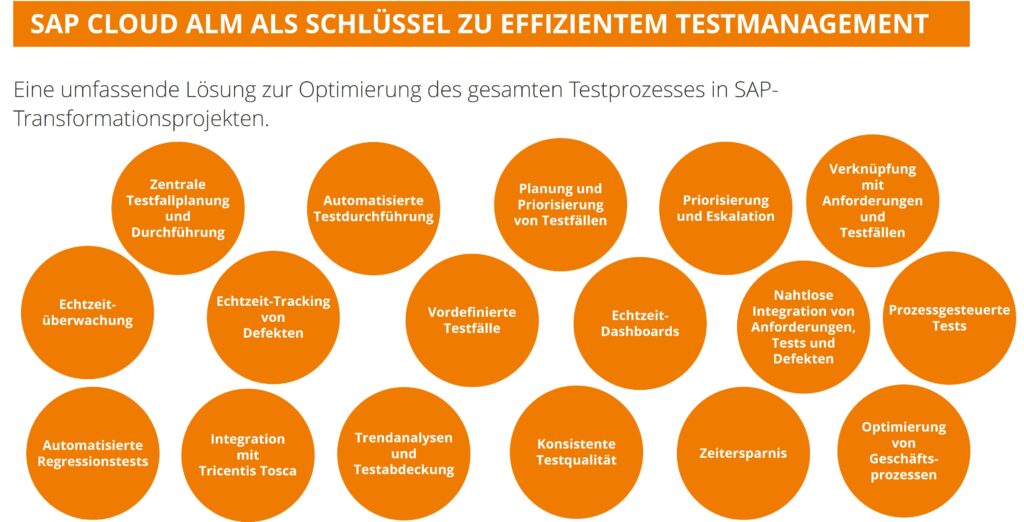
Integrated test management: Centralization and efficiency
A key advantage of SAP Cloud ALM is the ability to centralize the entire testing process on a single platform. This means that all tests – whether manual or automated – can be planned, documented, and monitored in one place. This centralized environment delivers significant efficiency gains:
- Centralized test case planning and execution: All test activities are integrated on one platform, enabling seamless collaboration between teams.
- Real-time monitoring: The status of each test can be viewed transparently at any time, making it easier for project teams to track progress and ensure the timely testing of all relevant processes.
- Automated test execution: The platform enables the execution of automated tests and supports the integration of tools such as Tricentis Tosca for advanced test automation (more on this below).
Centralizing testing activities not only reduces the effort required to coordinate teams and processes, but also ensures that no important tests are overlooked.
End-to-end test management: Seamless coverage of the entire project lifecycle
SAP Cloud ALM covers the entire lifecycle of a transformation project, from test design to implementation and evaluation. This end-to-end approach ensures efficient test planning and execution while simultaneously covering all relevant business processes.
- Test case planning and prioritization: Tests are defined and prioritized based on project requirements. This means prioritizing critical tests and continuously updating tests as new requirements or changes arise.
- Seamless integration of requirements, tests and defects: Test cases can be derived directly from business requirements and any defects that occur can be seamlessly fed back into the development process to enable rapid corrective action.
This consistent approach guarantees the avoidance of testing gaps and the thorough testing of all project aspects.
Test automation: Increased efficiency and error reduction
Test automation is a crucial aspect of modern test management, especially in large-scale transformation projects such as the implementation of SAP S/4HANA. SAP Cloud ALM supports both manual and automated testing and allows for the efficient automation of recurring testing tasks. Benefits include:
- Automated regression tests: These make it possible to test new system changes without having to perform manual tests each time. This is particularly useful for ensuring that existing business processes continue to function stably after system updates.
- Integration with Tricentis Tosca: For advanced test automation, SAP Cloud ALM can be combined with Tricentis Tosca, a leading tool for continuous test automation. Tosca automates functional and non-functional tests and offers high scalability. This integration ensures seamless test automation of SAP processes and saves significant time and resources.
Automation minimizes human error and significantly accelerates the testing process, which improves the quality and reliability of SAP systems.
Defect management and rapid problem solving
Errors occurring during the testing process can be efficiently tracked and managed in SAP Cloud ALM. The integrated defect management makes it possible to identify problems directly and accelerate their resolution.
- Real-time defect tracking: All detected errors are immediately recorded and tracked, enabling teams to quickly analyze and resolve them.
- Linking to requirements and test cases: Defects can be seamlessly linked to the underlying requirements and test cases. This facilitates root cause analysis and understanding of the error in the context of the affected business process.
- Prioritization and escalation: Defects are prioritized according to their criticality, and escalation mechanisms can be initiated as needed to quickly resolve critical problems.
These functions enable the rapid detection and correction of errors before they have a major impact on the project or ongoing operations.
Integration of Scope Items: Standardized Tests for Business Processes
The use of scope items in SAP Cloud ALM is a significant advantage for test management, especially in transformation projects. Scope items are predefined scenarios that cover typical SAP business processes and already include standardized test cases. Key benefits include:
- Predefined test cases: Companies do not need to develop their own test cases, but can rely on a comprehensive library of standardized test cases.
- Consistent test quality: The use of scope items ensures that tests are performed according to SAP best practices. This minimizes the likelihood of test gaps or incorrectly configured tests.The use of scope items ensures that tests are performed according to SAP best practices. This minimizes the likelihood of test gaps or incorrectly configured tests.
- Time savings: Using predefined test cases saves time and resources in test planning and allows teams to focus on specific adjustments instead of redefining the basics.
The integration of scope items into the test process ensures that the most important SAP processes are thoroughly tested and that the tests are carried out consistently and in a standardized manner.
Extension through Signavio: Support for process modeling
In addition to test automation and scope items, SAP Cloud ALM also offers the option of extension with SAP Signavio, a powerful tool for process modeling and optimization. This has the following advantages:
- Process-driven testing: By modeling business processes in Signavio, tests can be even better aligned with the company’s real-world requirements. This ensures that test cases precisely match critical business processes, increasing the relevance and efficiency of the tests.
- Business process optimization: Signavio allows bottlenecks and optimization potential in business processes to be identified and modeled early on. This not only improves the testing process but also contributes to the optimization of overall business operations.
The integration of Signavio helps to pursue a test-driven approach based on clearly defined and optimized processes.
Transparent reporting and analysis
SAP Cloud ALM offers comprehensive reporting and analysis functions that enable continuous monitoring of test progress and test quality:
- Real-time dashboards: All relevant information on test progress, success rates, and defects is provided in clear dashboards that are accessible to all stakeholders. This increases transparency and enables informed decisions based on current data.
- Trend analysis and test coverage: SAP Cloud ALM enables the identification of trends and an understanding of how well business processes are covered by tests. This allows potential weaknesses to be identified in a timely manner.
Thanks to comprehensive transparency and reporting, project participants always have an overview of the current status of the tests and can address potential risks early on.
Conclusion: SAP Cloud ALM as the key to efficient test management
SAP Cloud ALM offers companies a comprehensive solution for optimizing the entire testing process in SAP transformation projects. From centralizing testing activities and automating them to efficient defect management, the platform provides the necessary tools to ensure implementation quality and minimize risks. The integration of Tricentis Tosca and SAP Signavio further expands the possibilities for making testing more efficient and optimally supporting business processes.
For companies that want to successfully complete SAP transformation projects, SAP Cloud ALM is therefore an indispensable tool that reduces time, costs and risks while ensuring the quality and stability of the new system landscape.