The digitization of financial and tax processes has gained momentum worldwide, and Singapore became the center of this development during this period at the E-Invoicing Exchange Summit on 25. November 25 & 26, 2025, and the APAC Peppol Day on November 27, 2025. Three days full of ideas, figures, examples, and discussions made it clear that e-invoicing is no longer just an IT project. It is a global change that is redefining business models, government structures, and international cooperation.
I had the privilege of representing adesso business consulting AG at these conferences and would like to share my insights from this dynamic environment in this blog post.
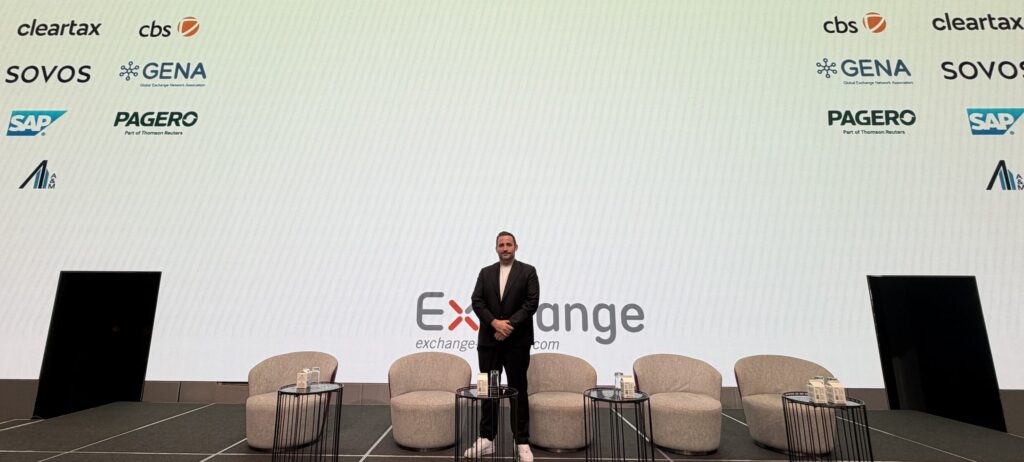
Networking before the starting signal
The icebreaker event on November 24 already showed what will be important in the future: exchange. Participants from 22 countries used finger food and drinks to build initial bridges, setting the tone for the following days. After all, hardly any other topic is currently as globally interconnected as e-invoicing and e-reporting.
Days 1 and 2: The world map of e-invoicing mandates is constantly expanding
Regulatory storm and growing complexity
Over 25 new national mandates are expected in the next 2-3 years. And yet, the path to implementation is different everywhere. While some countries are building deeply integrated platforms with a clear roadmap, others are still grappling with fundamental questions.
One thing became clear: the real challenge does not begin with the mandate – it begins afterwards. Systems must scale, data quality must be right, and companies must rethink their processes. Otherwise, they run the risk of suffering serious losses in competitiveness.
APAC as the engine of the global value chain
The Asia-Pacific region is strongly committed to cross-border interoperability. However, international standards and harmonized legal frameworks are still lacking in many places and are currently being implemented bilaterally with . The result: enormous complexity and a patchwork quilt that is increasingly burdening globally active companies.
Best practices: From simplification to AI use
- With its network, Singapur is demonstrating very impressively how a simple, user-oriented ecosystem can lead to high market confidence. Numerous guides and YouTube videos are used to familiarize businesses with national e-invoicing and its associated benefits. The platform offers a central portal, supports C2B and B2B payments, and is continuously being expanded (Corner 6 is live, Corner 7 will follow next year). The clear motto is: “KISS – Keep It Simple and Sharp” – the solution should create added value for companies, not additional tasks.
- With its 5-corner model, Malaysia wants to combine Peppol standards with clear savings potential for businesses. The country is pursuing a strategy to become an AI nation by 2030. According to its own statements, the use of standardized documents and automated processes can reduce costs by more than 60% and speed up accounts receivable and accounts payable processes from 20 to 2 minutes.
- India is proving that its AI approach can check billions of transactions in real time and is capable of identifying and closing VAT gaps. According to its own statements, an estimated 75% of global B2B transactions will be processed electronically by 2030. This is an enormous lever for closing tax gaps.
These examples prove that digitalization is not just about compliance—it creates quantifiable added value.
The downside: lack of communication and technical uncertainties
Some countries lack clear guidelines, sanctions, or uniform terminology. Many companies are faced with the problem that their supposed e-invoices are not valid. Standards alone are not enough—there needs to be a common understanding of what is required and what needs to be done.
This is the conclusion drawn by the VeR (Association for Electronic Invoicing) after the first eleven months of mandatory invoice receipt in Germany. Only about 20% of all companies send electronic invoices, most of them in EDI format and not in the XRechnung or ZUGFeRD standard. Companies see the introduction of e-invoicing as a mere obligation and not as an opportunity.
Day 3: APAC Peppol Day – Peppol on the rise
Peppol is growing rapidly. New jurisdictions, millions of additional participants, and the continuous expansion of PINT show that the world is moving toward a common, interoperable foundation.
The trend is clearly moving toward CTC (Continuous Transaction Control) – i.e., the direct linking of invoice transmission and tax reporting within the framework of the 5-corner model. This also puts the focus on infrastructure: scalability, security, certification, and reliable governance are becoming prerequisites for the next stage of evolution.
Peppol is increasingly becoming the preferred platform for mandates, both for B2G and B2B processes. OpenPeppol presented impressive figures: 25% growth in the number of Peppol Authority jurisdictions, 36% more Peppol members, and a massive 67% increase in participants in the Peppol network. A total of almost 2.5 million Peppol IDs are now registered. The background to this is clear: regulations are forcing companies to adapt to new electronic standards. You can find more information about Peppol here in another blog post from us.
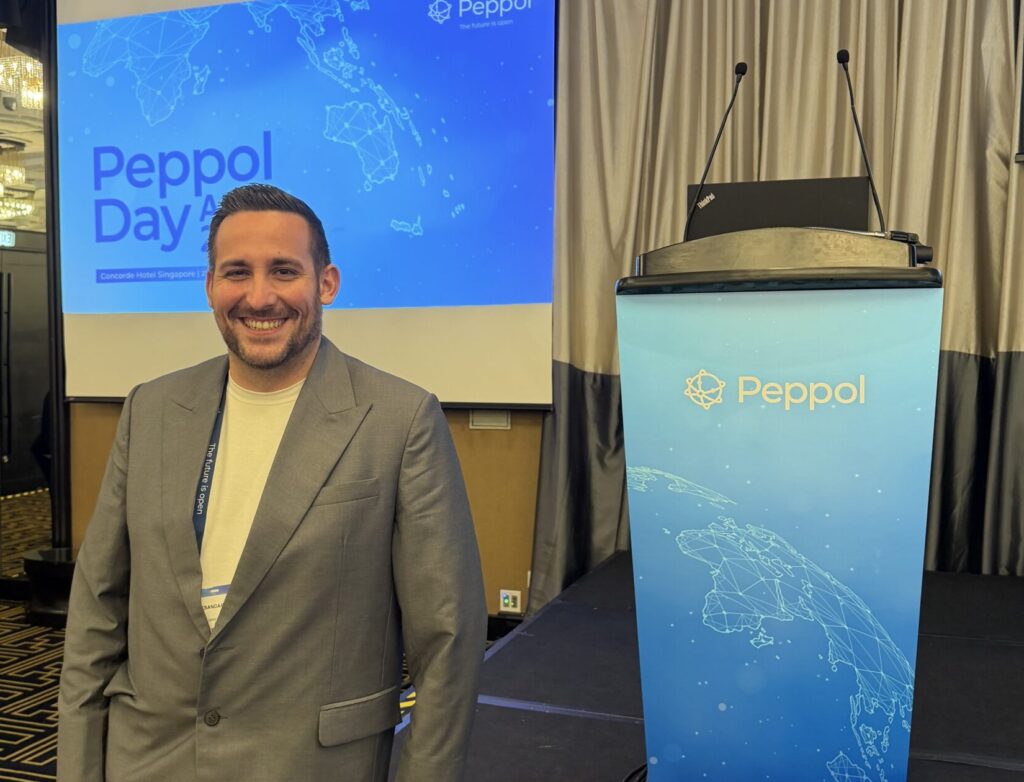
The future works in 5-corner models
APAC thinks ambitiously, pragmatically, and data-driven. Whether in Singapore, Malaysia, or the United Arab Emirates, the region relies on 5-corner models, clear timelines, and high transparency for companies. Belgium will also be the first European country to implement the 5-corner model starting in 2028. The mandates are being prepared with clean data models based on European Standard 16931.
The region is committed to uniform standards: Peppol is evolving from a pure e-invoicing network into a comprehensive tool for e-reporting. This is particularly evident in the ambitious implementation project in the United Arab Emirates, where a 5-corner model combining e-invoicing with e-reporting is being implemented. This model requires ASPs (Accredited Service Providers) to submit all invoices to the tax authority. From January 2027, this approach will become the new standard for all large taxpayers.
E-invoicing is also coming to Australia and New Zealand. From July 2026, 30% of all invoices in Australia in the B2G sector are to be received electronically. The aim is a seamless process in which tax liability and payment are to be handled in a single transaction (“Tax 3.0”). In New Zealand, from January 2026, companies that issue more than 2,000 invoices per year will be required to use electronic invoices. Of these, 95% of invoices must be paid within five business days.
Focus on technological infrastructure
Peppol is continuously working to improve its network architecture. The SML (Service Metadata Locator) is now hosted centrally by the European Commission, while migration and operation are increasingly insourced. In the medium term, a federal SML model is intended to increase security and scalability. Long-term visions envisage the integration of blockchain, AI, and data rooms to further enhance the authenticity, integrity, and confidentiality of transactions.
In addition, the new Peppol International (PINT) model will be published shortly after the release of the new EN 16931, which will result in Peppol BIS 4.0 as a new invoice syntax and semantics.
Challenges for companies
However, feedback from the tax authorities present also showed that data quality remains the biggest hurdle for companies. Only with clean master data can clean electronic invoices be generated, as they now form the basis for electronic invoicing without exception. Companies in the United Arab Emirates, for example, must adapt to EN 16931 and from now on use the mandatory fields “address” or “house number.” What sounds obvious and trivial from a German perspective is a serious problem in Dubai or Abu Dhabi, where it is not so much the address that matters as the name of the villa and the floor. All companies must now face these challenges.
Conclusion: Collaboration is the new competitive advantage
E-invoicing, e-reporting, and therefore incoming tax compliance are not isolated projects. They are a global network of standards, data quality, collaboration, and technology. The future depends not only on technology, but also on close cooperation between authorities, service providers, and companies. Standards, data quality, and clear rollout plans are the key to making the vision of a globally interoperable network a reality. This results in regular changes.
Whether in Europe, Asia, the Pacific, or the Middle East, the goals are similar, but the paths are always different. But one thing is clear: the future belongs to those who harmonize early, keep data clean, and engage in regular exchange. Because e-invoicing is not just a trend—it is the new infrastructure of the digital economy.
At adesso business consulting AG, we can advise you with our expertise in e-invoicing and e-reporting. We use our experience to help you navigate the e-invoicing jungle and support you in finding the right e-invoicing solution for your IT system landscape that meets your requirements.
Feel free to contact us for an initial meeting—we look forward to hearing from you!