In the rapidly changing world of utilities, SAP Business Technology Platform (BTP) opens up entirely new horizons. SAP BTP combines business planning, process automation, analytics, data management, application development, and artificial intelligence in an integrated cloud environment, enabling companies to drive innovation faster and more efficiently. As an integration platform, it creates seamless connections between a wide variety of systems and data sources, enabling smooth and effective business processes. For utilities, this not only offers the opportunity to modernise their IT landscape, but also to position themselves for the future and meet the growing demands of the industry.
What is SAP BTP?
SAP Business Technology Platform (BTP) is a comprehensive platform-as-a-service solution that helps companies accelerate their digital transformation. As a central building block for application development, data management, integration, and analysis, SAP BTP offers a flexible, cloud-based environment designed to optimise business processes and promote innovation.
Essentially, SAP BTP enables companies to modernise their IT infrastructure by supporting a wide range of programming languages and development tools. The Cloud Foundry environment gives developers the freedom to use their preferred technologies to create customised applications that are tailored precisely to the specific requirements of the company. Thanks to low-code/no-code development approaches, business users can also create innovative applications and automated workflows. The platform thus promotes not only agility and creativity in the development process, but also the scalability and efficiency of the resulting applications.
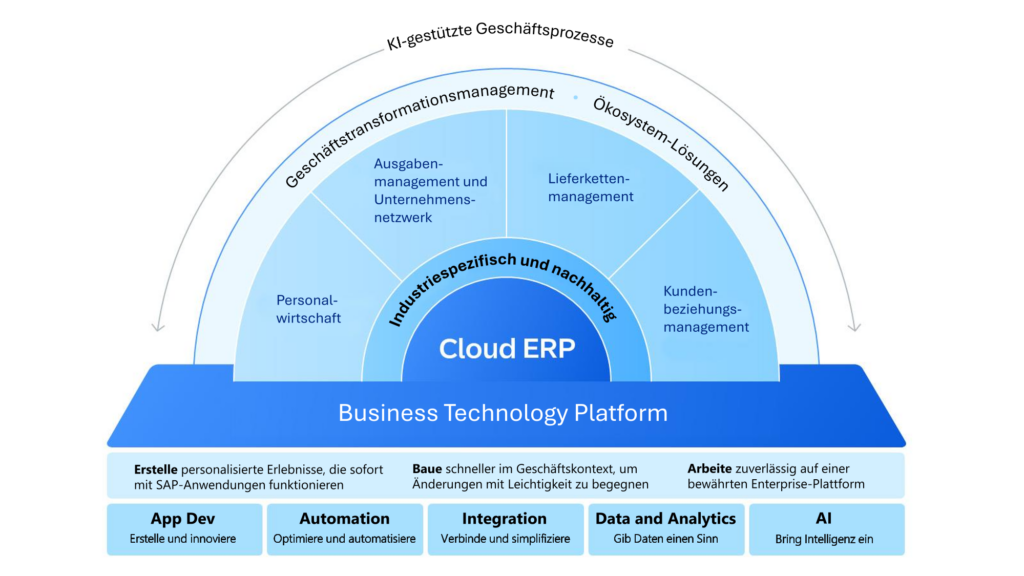
SAP BTP also offers specialised tools for data-driven decisions and artificial intelligence. This enables companies to analyse large amounts of data in real time in order to make informed decisions and respond proactively to market changes. These functionalities make BTP a powerful tool for companies that want to secure their competitiveness in an increasingly data-driven world.
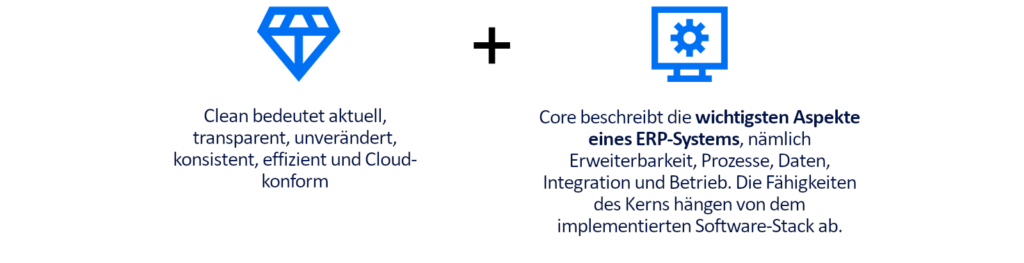
In addition, SAP BTP enables the expansion and customisation of existing standard software through side-by-side developments without affecting the core of the enterprise software – in line with the keep-the-core-clean approach. This flexibility is particularly useful for companies that need to adapt quickly to changing market conditions and want to prepare for SAP’s long-term cloud strategy and future transformations.
The role of Integration Suite in SAP-World
An essential component of SAP BTP is its comprehensive integration functionality, which enables the connection of heterogeneous IT landscapes and the creation of consistent business processes. With its powerful integration services and interfaces such as the SAP Integration Suite, BTP offers companies the opportunity to efficiently network their systems and harmonise data flows between different applications and cloud environments.
The SAP Integration Suite is an integration platform as a service (iPaaS) that has been specifically developed to integrate SAP and third-party applications, regardless of whether they are operated on-premises or in the cloud. It offers thousands of preconfigured integration flows, connectors and APIs that enable companies to quickly and efficiently establish connections between different systems, significantly speed up the implementation process and reduce operating costs.
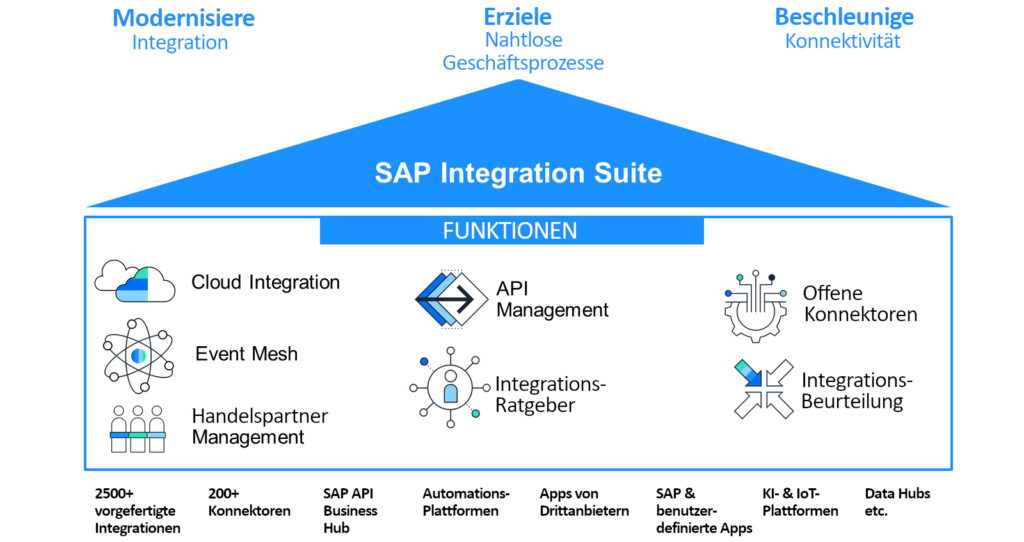
Cloud integration and event mesh capabilities enable organisations to ensure that critical business information and events are communicated immediately to the relevant parties. This promotes efficient collaboration between employees, customers, and partners by providing up-to-date, consistent information across all systems.
In addition, the SAP Integration Suite’s modular functions enable easy adaptation and expansion of the existing IT landscape. With tools for API management and central hubs for access to over 3,800 APIs, companies can drive innovation faster and make the most of their existing investments.
Use cases in the utilities industry
Due to the complexity of their processes, utility companies often have equally complex IT landscapes that include a multitude of systems and data sources. These circumstances present them with specific challenges in terms of integration and data management. The SAP Integration Suite plays a central role in ensuring the smooth operation and efficiency of business processes and enabling the harmonisation of legacy systems with new technologies. SAP BTP with its integration content also forms the cornerstone of the industry-specific SAP Utilities Core solution, as it can be used to serve many use cases.
Access to master data across system boundaries
Various master data such as metering points, connection data, contract accounts and technical equipment must be available in real time not only in S/4HANA, but also in peripheral systems, such as SAP Service Cloud. SAP Cloud Integration offers preconfigured integration flows for this purpose, enabling the smooth integration of data on business partners, contracts and technical master data. This integration ensures that billing, sales and customer service systems are always up to date and that consistent data is available.
Integration of hybrid system landscapes
The multitude of different systems in utility companies often means more individual interfaces, high maintenance costs and increased security and error susceptibility. By seamlessly connecting existing systems with each other and linking them to new systems, the SAP Integration Suite enables the homogenisation of hybrid system landscapes without the need to completely replace the existing infrastructure. The SAP Cloud Connector ensures a secure connection between on-premise and cloud systems.
Real-time data processing and event control
The Event Mesh functions of the Integration Suite enable companies to ensure that critical events such as network disruptions, contract changes or technical maintenance are forwarded to all relevant systems and departments in real time. This ensures a rapid response to disruptions and better coordination between suppliers, network operators, technicians and customer service.
RISE with SAP as Cloud-Enabler
SAP offers many solutions that support companies with integration and transformation. With the SAP Integration Suite as part of the package, the managed cloud service RISE with SAP offers a comprehensive suite of products, tools, and services that support companies in their transition to the cloud. With RISE with SAP, legacy systems can be transferred to a modern IT landscape, technical migrations can be simplified, and intelligent technologies can be implemented. In the utilities industry in particular, this offering helps to implement innovation projects such as the optimisation of consumption data analysis and customer service processes more quickly and efficiently.
Conclusion
The digital transformation in the utilities industry requires flexible, scalable and networked IT solutions. With the SAP Business Technology Platform, SAP offers companies a powerful foundation for mastering the diverse challenges of the industry. The seamless integration of different systems and the standardisation of data via the SAP Integration Suite makes it possible to gradually connect existing legacy systems with modern cloud technologies, thereby promoting efficiency and innovation. With SAP BTP and the integration solutions tailored to it, utility companies are well positioned to
overcome industry-specific challenges, exploit the potential of new technologies such as IoT, smart grids and artificial intelligence, and remain competitive in the long term with the cloud.