Engaging with and understanding the market communication processes (MACO) of the energy industry for the first time can be challenging. Initially, it is difficult to read the individual market news items and energy-related legal texts and to grasp the connections between them.
This article provides an overview of the energy-related and regulatory foundations for market communication between the individual market partners and how they are related.
What market roles exist and how are they regulated?
In 1998, the energy market was liberalized. This meant that companies that previously held all market roles were divided into different market participants and roles. These market roles are: metering point operator (MSO), supplier (SP), distribution network operator (DNO), transmission system operator (TSO), and nowadays also the energy service provider (ESP).
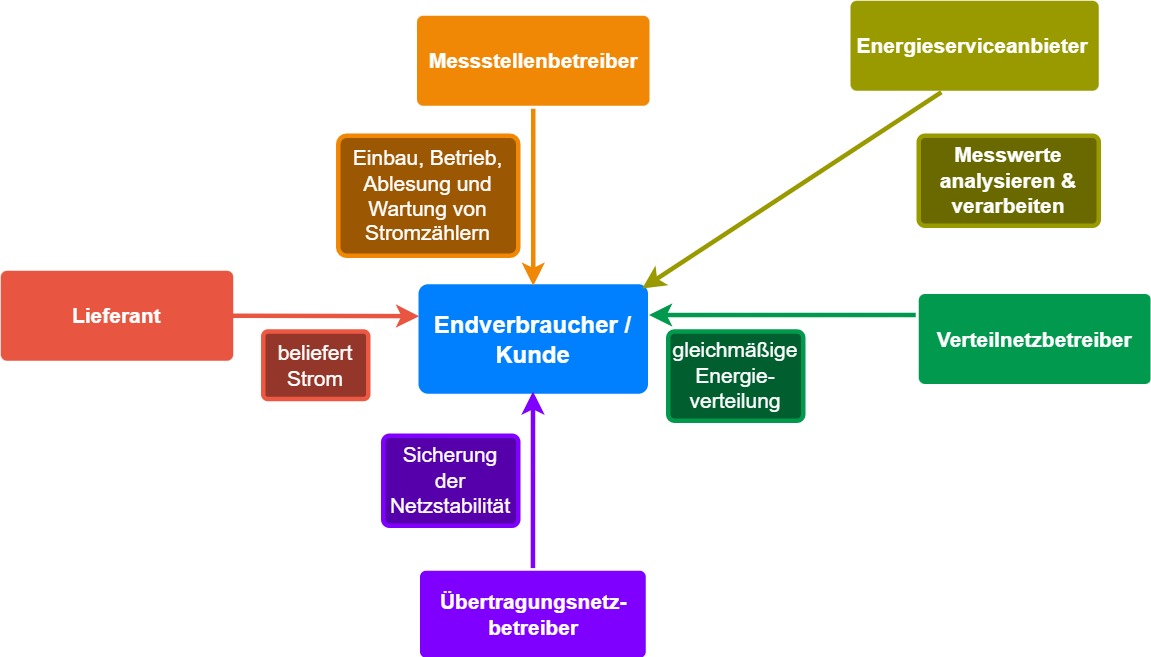
Fig. 1: An overview of the overarching tasks of the market roles (supplier, metering point operator, distribution system operator, transmission system operator and service provider) in relation to the customer/end consumer.
The market participation processes are monitored and controlled by the Federal Network Agency (BNetzA) through regulatory bodies (e.g., GPKE, WiM, MabiS) in consultation with companies and associations. The German Association of Energy and Water Industries (BDEW) updates these processes every six months, in April and October, with new formats to standardize and reach consensus among various associations and market participants.
The BDEW’s formats ensure that current energy market requirements are met. The energy market is dynamic, and experience shows that processes can be continuously optimized and adapted to the new challenges of our time (e.g., the Renewable Energy Sources Act). Furthermore, errors resulting from previous format changes can be corrected, and feedback from market participants is also taken into account.
Where can I find the current regulations for the individual processes?
The German Association of Energy and Water Industries (BDEW) provides an overview of all market processes and their regulations on its website. The BDEW represents the interests of over 2,000 companies and is the representative body for energy and water supply companies. The Federal Network Agency (BNetzA) offers the following website for an overview of market coordination processes.
The following section lists the various draft laws and regulations and provides a brief overview of the respective processes. For each process described in writing, the documents include a use-case diagram and a sequence diagram to illustrate the process graphically.
Business Processes for supplying Electricity to Customers (GPKE)
The current version is available on the BNetzA website. Future versions will also be available there, as the 24-hour supplier switching and other WiM/GPKE processes will be introduced next year. The main part of the GPKE deals with billing and master data changes that directly affect the customer/end consumer.
The Content of the GPKE can be roughly summarized as follows:
- Supplier change: Start and end of electricity supply
- Billing contents: Network usage statement, price lists, delivery notes
- Master data changes/exchange by the respective market partners
- Configuration exchange: Measurement product, control authorization in relation to smart metering system
- Restoration and interruption of connection usage
- Business Data Requests
Business Processes for switching Gas Suppliers (GeLi Gas)
The current version is available on the BNetzA website: GeLi Gas 2.0. A regulatory procedure for GeLi Gas 3.0 already exists, which elaborates on regulations, transparency, fair competition, and binding agreements with all market participants and defines market standards.
The GeLi Gas processes focus on the following key areas (analogous to GPKE):
- Change of Supplier
- Requests/forwarding of measured values
- Master data changes
- Business data request
- Billing: price sheets
- requirement for calorific value and state number
Change processes in electricity metering (WiM Strom)
The switching processes in metering for electricity and gas are described in different documents, but they represent similar processes. For electricity, the switching processes in metering are documented as: WiM Strom.
The WiM Strom (Wireless Management of Electricity) describes the switching processes that are regularly associated with the metering equipment, metering point operation, and related device topics. The first half of the WiM Strom deals with these switching processes and summarizes them in broad terms:
- Start of metering point operation: registration, device handover, initial setup of smart metering system and modern metering equipment
- End of metering point operation: Termination, decommissioning
- Device processes: Changing the measuring device (device change), taking over a measuring device (device takeover)
- Commitment request
- Change of network operator
- Störungsbehebung
- Billing processes between metering point operators and between other market partners
The second half of WiM Strom is assigned to the area of transmitting meter readings or energy quantities and roughly covers these topics:
- Requirements for meter readings, energy quantities, work and performance values, load profile as well as measured and interim reading values
- Transmission of meter readings, energy quantities, work and performance values, load profile as well as measured and interim reading values
- Business Data Requests
- Transmission of previously measured work and performance values
- Transmission of the calculation formula
- Complaint regarding values
The switching processes for WiM Gas are analogous and are also briefly described below.
Change processes in gas metering (WiM Gas)
The current version for the switching processes in gas metering is described in WiM Gas and on the BNetzA website. The document describes the following switching processes:
- Start of metering point operation: Registration and deregistration
- Termination of the metering point operation
- Device exchange processes and device takeover
- Cancellation and correction requests
The processes for transmitting meter readings and load profiles are described in the second half of WiM Gas, analogous to WiM Electricity:
- Change to the setup of the measurement location
- Troubleshooting
- Requesting and providing measurement data
- Lastgangverarbeitung und -reklamation
- Master data changes
- Business Data Requests
- Billing for metering point operation between metering point operators and the supplier
Market processes for generating market locations (electricity) (MPES)
The current version of the MPES can be found here. This document describes the processes for electricity generation at power plants. In summary, the MPES is divided into the following processes:
- Lieferbeginn
- End of delivery, termination
- Master data change
These processes represent change and master data modification processes.
Market rules for the implementation of balancing group settlement for electricity (MaBiS)
MaBiS defines the processes for energy balancing and the associated billing, with the aim of ensuring that the energy data fed in and consumed is correctly recorded in time format.
MaBiS regulates the technical, organizational, and accounting aspects of balancing group management in the electricity market, without having a direct connection to end customers. Its main objective is to ensure balancing group compliance and to support a stable and reliable billing system in the electricity market.
The MaBiS summarizes these processes:
- Rules and management of balancing groups
- Analysis and monitoring of the power grid
- Exchange of profiles (standard load profile)
- Transmission and exchange of aggregated representations of energy quantities
- Billing of aggregated representation of energy quantities, which exactly belong to the respective MP
- Planning for the balance between energy input and output
How do the market partners communicate with each other?
To enable market partners to communicate successfully with each other, there are market messages/formats that clearly describe which process should be initiated with which market partner.
The following market news items are directly linked to regulatory processes and serve as the connection between market participants. The current, future, and archived formats can be found on the edi@energy website, created by the BDEW (German Association of Energy and Water Industries). For a brief overview, some important data formats for GPKE (German Energy Consumption Labeling System) and WiM (German Energy Market Reporting System) are listed below with a short description, defining the standardized data formats for the energy industry:
- ORDERS (Inquiry, order, request for data)
- ORDERSP (Rejection of request, response to ORDERS)
- QUOTES (Request for quotation)
- REQOTE (Request for a quote, request for values, invoicing, etc.)
- MSCONS (Transmission of meter readings, energy quantities, values)
- INVOIC (Invoice for advance payments, network usage, WiM and MSB, other invoices)
- REMADV (Confirmation or rejection of invoices, cancellation)
- COMDIS (rejection of delivery notes, rejection of certain invoices)
- PRICAT (General Price Lists Processes)
- UTILMD STROM (Master data changes of GPKE, MPES, WiM, HKNR processes)
- UTILMD MABIS (Master data changes of MaBiS processes)
- APERAK (Processability error message)
- CONTRL (acknowledgment of receipt including result of syntax check, syntax error message)
These market messages listed above are linked to verification identifiers to precisely describe and name energy industry processes. Verification identifiers consist of five-digit numbers, each uniquely assigning a specific process to a market message; for example, ORDERS 17102 describes the process of requesting values.
The required structure of the market message is detailed in the respective application manuals (AHB) on the edi@energy website. The corresponding syntactic and technical requirements are outlined in the implementation manual (MIG).
How can I stay up-to-date?
This entry summarizes the current processes of the energy industry regulations GPKE, WiM, MPES, MaBiS, and GeLi Gas. The energy industry is constantly evolving, and the regulations change formats every six months. The Federal Network Agency (BNetzA) and the German Association of Energy and Water Industries (BDEW) publish upcoming changes in a timely manner so that market participants can prepare for the next version. Therefore, this entry also describes which websites contain the new information. The future versions of the regulations are already published on the pages under “Future Version” (future GPKE, future WiM, edi@energy).