Scandinavia has long been considered a digital pioneer in Europe. Whether it’s cashless payments, digital government services, or electronic tax returns, the Nordic countries set the standard. Now Norway is finally tightening the reins in the B2B sector. After the country took a pioneering role in the business-to-government (B2G) sector as early as 2012, the logical next step regarding e-invoicing in Norway is now underway.
Norwegian lawmakers have gotten serious: On June 1, 2026, Parliament officially passed far-reaching amendments to the Accounting Act. For businesses, this means the introduction of mandatory B2B e-invoicing and digital accounting is now set in stone. And the timeline is tighter than many initially thought, as the government has actually moved up the start date for sending e-invoices by a full year.
In this article, you can read everything you need to know about what’s in store for your business, the applicable deadlines, and how to prepare.
The Roadmap: The three phases of implementation
The Norwegian government is opting for a phased rollout to ease the transition for businesses. Nevertheless, the acceleration of the timeline in 2026 has put many companies under pressure to act. With the first phase already underway since 2019, the upcoming process is divided into two further key phases:
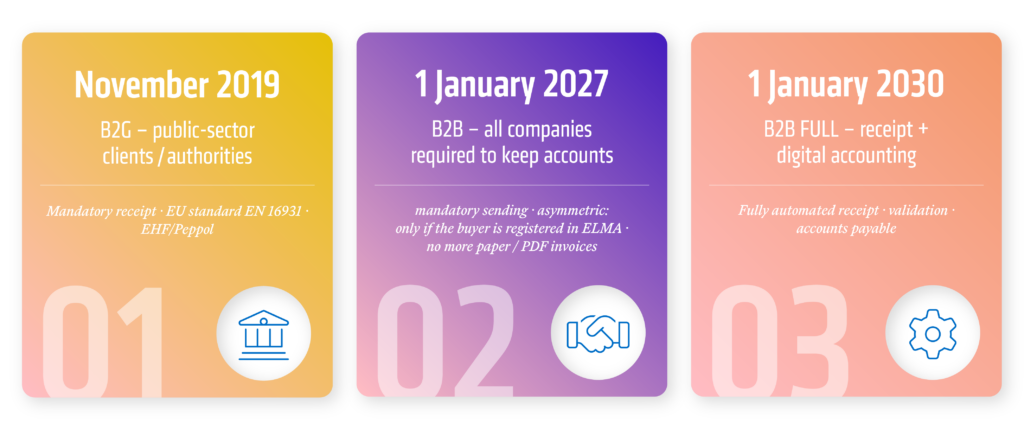
Phase 1: Since November 1, 2019 – The B2G Mandate Based on EU Standards
Norway laid the groundwork for its current digital lead early on: Since November 2019, all public contracting authorities and government agencies (Business-to-Government) have been legally required to receive and process structured electronic invoices. This regulation is based on the implementation of EU Directive 2014/55/EU and the European standard EN 16931. Since then, the EHF (Elektronisk Handelsformat) and Peppol formats have become the de facto standards in the public sector and have been seamlessly integrated into the country’s technical infrastructure.
Phase 2: Effective January 1, 2027 – The Issuance Mandate
Starting in early 2027, all businesses in Norway subject to accounting requirements must be able to issue and send structured electronic invoices in the B2B sector. This marks the definitive end of the traditional paper invoice and, to the surprise of many, also of the simple PDF invoice sent via email.
The system is structured asymmetrically in this phase: Sellers are required to send an e-invoice as soon as buyers are registered in the national recipient registry and are ready to receive them.
Phase 3: Starting January 1, 2030 – The Obligation to Receive and Record Invoices (Digital Bookkeeping)
It will not be until three years later that the other side of the coin becomes mandatory. Starting January 1, 2030, companies must not only be able to receive e-invoices but are also required to use a fully digital accounting system. This system must be capable of automatically receiving and validating incoming structured e-invoices and entering them directly into accounts payable.
Who is affected? The scope of application
The new e-invoicing rules in Norway apply to all companies required to maintain accounting records under Norwegian law.
There is one crucial detail for international corporations: the company’s physical location is irrelevant. If a foreign company (for example, from Germany, Austria, or Switzerland) is registered for value-added tax (VAT) in Norway, it is automatically subject to the Norwegian Accounting Act. Consequently, foreign companies with a Norwegian tax ID number must also comply fully with the e-invoicing requirements starting in 2027.
Exceptions and Outlook
The current focus is solely on domestic B2B transactions. The B2C sector and cash-only sales are excluded for the time being. However, the Ministry of Finance has already tasked the tax authority with assessing, by the end of December 2026, whether and how the system can be expanded to include B2C invoices and digital cash register receipts in the future. Depending on revenue thresholds, micro-enterprises may be subject to separate transition periods, which will be finalized in the upcoming implementing regulations.
The technical foundation: EHF and the Peppol Network
Technically speaking, Norway isn’t reinventing the wheel but is building on a proven and highly developed infrastructure. The country relies on the post-audit model. Unlike in countries such as Italy or Turkey, invoices do not first have to be approved by a government platform. Instead, they flow directly between the parties, while the tax authority reviews the data afterward.
- The format: The national standard is EHF (Elektronisk Handelsformat), specifically EHF Billing 3.0. This format is based entirely on the international standard Peppol BIS Billing 3.0 and complies with the European standard EN 16931.
- The network: The exchange of structured XML data takes place via the international Peppol network.
- The registry: To determine who can receive digital invoices, the system accesses the central Norwegian recipient registry, ELMA (Elektronisk mottakeradresseregister).
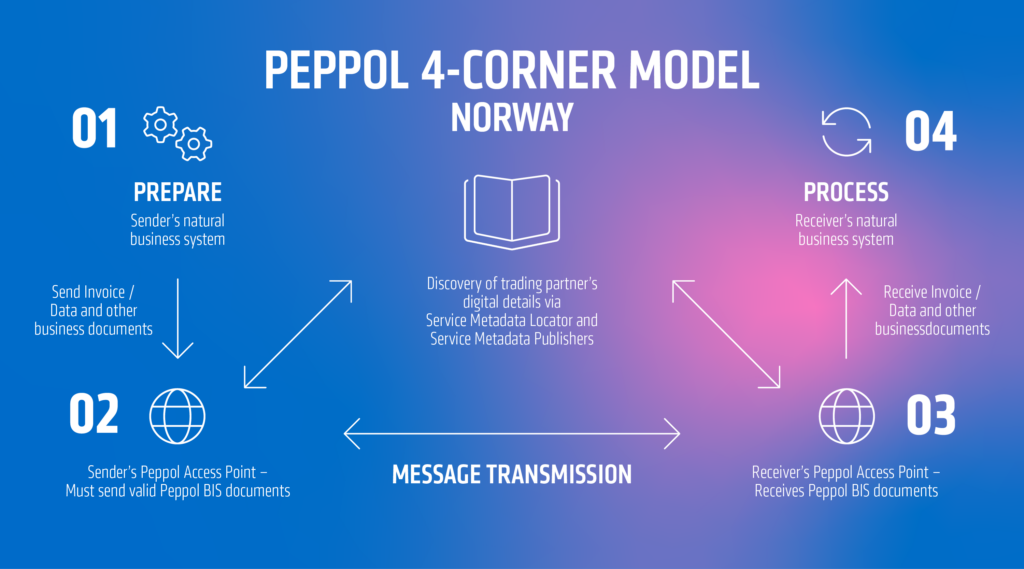
The diagram illustrates the Peppol 4-Corner Model for Norway:
- Under 01 “Prepare,” the invoice is created in the sender’s ERP system, validated, and structured in the required XML format.
- Under 02, the system transfers the data to its own Peppol access point for transmission.
- After automatic address determination, the message is transmitted over the network to Corner 03, the recipient’s access point.
- This Access Point then forwards the e-invoice to Corner 04, where it is processed and posted fully automatically in the customer’s business system.
Focus on SAP Architecture: Does SAP DRC support the Norwegian EHF format?
For companies using an SAP system landscape such as SAP ECC or SAP S/4HANA, the urgent question of technical implementation now arises. The answer lies in SAP’s strategic standard solution: SAP Document and Reporting Compliance (DRC).
Since the Norwegian EHF format is technologically based directly on the global Peppol BIS Billing 3.0 standard, SAP DRC leverages its integrated cloud capabilities here. Through the so-called eDocument Cockpit in the SAP backend, invoice data (e.g., from SD or FI) is automatically extracted and transformed into the required structured XML format. The SAP Business Technology Platform (SAP BTP) seamlessly functions as a certified Peppol Access Point. It handles validation, verification against the ELMA registry, and legally compliant transmission to recipients.
With SAP DRC, companies thus kill two birds with one stone: they comply with Norwegian laws out of the box while simultaneously ensuring a globally harmonized e-invoicing strategy.
Strategic preparation: How adesso business consulting supports you
However, the technical activation of SAP DRC is only half the battle. The implementation of e-invoicing mandates requires far-reaching adjustments to existing business processes, interfaces, and master data. It is precisely at this intersection of IT architecture and business transformation that adesso business consulting supports you.
Our holistic consulting approach guides you step by step through the regulatory changes:
- Preliminary Analysis & Scope Assessment: We review your international organizational structures and company codes to determine which subsidiaries or VAT registrations are specifically subject to the Norwegian deadlines.
- Process and Master Data Cleansing: E-invoicing tolerates no errors. Missing VAT IDs or incomplete ELMA recipient data result in immediate rejections in the Peppol network. We optimize your accounts receivable and accounts payable processes in advance.
- SAP DRC Roadmap & Implementation: Together with your IT teams, we design the rollout of SAP DRC. We support the customization, the integration with SAP BTP as a Peppol Access Point, and test management.
- Change Management & Training: We prepare your business units in purchasing and sales to work with the eDocument Cockpit so that errors in the daily invoice flow can be resolved quickly and easily.
Conclusion & Outlook
The law passed in June 2026 marks the end of traditional invoice mailing and the transition to e-invoicing in Norway. The tight timeline leading up to January 2027 shows that the Scandinavian authorities will not tolerate any delays. For companies, this means an urgent need for action, especially when cross-border B2B transactions are involved. Those who do their homework now will not only ensure tax compliance but also benefit from leaner, automated financial processes.
Are you doing business in Norway and unsure whether your IT and ERP systems will be ready for the Peppol network in time? Contact our experts today for a no-obligation analysis of your invoicing workflows! Learn more about SAP DRC at adesso business consulting here.