2.5 days. That doesn’t sound like much at first. In your personal life, however, you can do quite a bit with that time: a hike to a mountain hut with two overnight stays would be possible, or you could enjoy a wellness weekend starting as early as Friday afternoon, or a city getaway. In a business context, options are often ranked in descending order of business value. A workshop with adesso could very well be at the top of that list. Ideally, it would focus on a specific topic like artificial intelligence and include a concrete use case that you can put to immediate use. That’s exactly what our new offering is all about: In two and a half days, we’ll work with SAP Document AI to set up an initial proof of concept for AI-powered business document processing.
Incoming documents: an „evergreen ” in automation
Eingehende E-Mails und die darin enthaltenen Dokumente gehören zu den klassischen Automatisierungsszenarien, oft gesehenes Beispiel ist PDF. In der Praxis sind Layouts oft unterschiedlich, Informationen nicht einheitlich strukturiert und Formatierungen schwer vorhersehbar. Das macht eine rein regelbasierte, deterministische Verarbeitung schnell aufwendig und anfällig.
This is where artificial intelligence can untangle the knot: it helps capture and process documents and content more efficiently. Optical Character Recognition (OCR) has been around for quite some time. However, for an end-to-end process, the surrounding steps must also work together – from recognition and verification to posting.
Vom (PDF-)Dokument bis zum SAP-Objekt
SAP Document AI offers a comprehensive suite for document processing and is particularly useful when the process ultimately continues within the enterprise IT infrastructure and the SAP system. Templates for common business documents – such as invoices or purchase orders – can simplify the onboarding and setup process.
For automated end-to-end processing, it’s not just the successful recognition of information in the document that matters. Workflow management helps model and control the necessary processing steps. SAP also emphasizes that, in a business context, it’s not enough for AI to be “mostly” correct: For documents where the AI does not provide a sufficiently reliable assessment, a worklist is created for human review. Here, a human can double-check the recognized information before it is processed in the ERP system. The feedback provided by users here can be used for retraining, so that the AI can process it automatically next time and, ideally, the worklist will continue to shrink.
Another USP of SAP Document AI in the enterprise environment is its handling of permissions. The authorization logic and assignments already established in the SAP landscape can be used to ensure that users can view only the information for which they have authorization. This enables filtering based on one’s own company code, plant, or – in the context of a purchase order – a specific group of suppliers, for example.
A 2.5-Day Workshop for the First Proof of Concept
Our standardized adesso workshop format draws on lessons learned from past projects and is designed for efficient implementation. Organizational and technical hurdles that would unnecessarily delay the two-and-a-half-day on-site workshop are resolved in preliminary remote sessions. This allows the time spent together on-site to be fully utilized for implementing the proof of concept (POC), followed by a review, roadmap, and handover.
Scope of the Offer: One Document Type
Different document types require different specific approaches in the processing steps. This proposal has the clear scope of a proof of concept; its purpose is to establish a foundation upon which your company can decide whether to continue rolling out SAP Document AI as a suite for AI-powered automated document processing.
The process is divided into four sequential blocks.
Block 1: Team- und Architektur-Setup
First, we clarify the fundamental aspects of collaboration. This includes the initial team setup and role assignment, coordinating relevant architectural decisions, selecting a suitable sample process for the proof of concept, and defining a common working methodology. The result is a clear plan of objectives and tasks for the POC.
Block 2: Technical Setup
This block is conducted remotely and includes the important preparatory work described above for the on-site workshop. The goal is to address typical hurdles in setting up the development environment early on. To this end, the necessary BTP subaccounts and spaces – including the required entitlements – are set up, relevant permissions are granted, and the integration endpoints defined in Block 1 are configured. The technical setup is then ready for implementation.
Block 3: Implementation
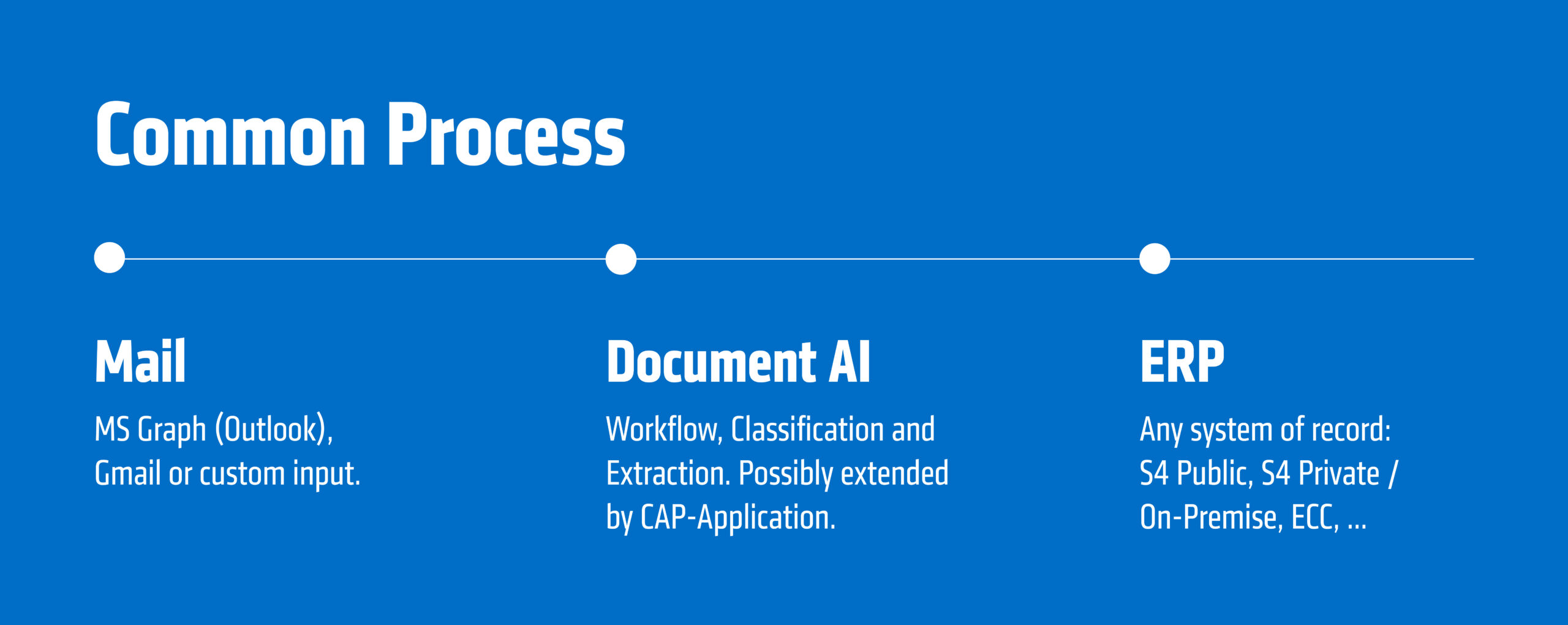
Experts from adesso business consulting will work together with colleagues from your company to implement a defined proof of concept on-site within two and a half days. This results in a seamless end-to-end flow that is then ready for review:
- An email with a PDF attachment arrives in a defined inbox.
- This attachment is processed by SAP Document AI and validated using a sample transformation rule.
- Finally, a posting is made in SAP S/4HANA.
Block 4: Review
During the review, the participating business units work with adesso to evaluate the implemented proof of concept based on clear criteria: the correct recognition of document content, the validation of the transformation rule, the successful transfer to SAP S/4HANA, and the traceability of the end-to-end process. Outstanding issues, necessary adjustments, and technical or business risks are documented and prioritized. Based on this , a coordinated roadmap is created for further development toward a minimum viable product (MVP). Finally, the POC and the associated documentation are handed over. The result is a validated POC with documented test results and a concrete development roadmap for the MVP.
This quickly establishes a concrete foundation for evaluating the benefits, integration path, and next steps for your specific use case.
Interested?
If you’d like to find out how AI-powered document processing can be applied to your specific process, please feel free to contact us. Together, we’ll determine which document type and use case are suitable for an initial proof of concept.