Given the pending decision of many companies to undertake an S/4HANA transformation, SAP Extended Warehouse Management (EWM) and Cloud Warehouse Management are becoming increasingly important topics. The discontinuation of support for Warehouse Management (WM) by 2027, coupled with the concerns of many small and medium-sized enterprises (SMEs) that EWM is too large and too expensive, also necessitates a closer look. What many companies don’t realize is that with EWM under S/4HANA, the limitations of previous EWM systems have finally changed!
In this blog post, we will address the most important points surrounding the topic of EWM (or Cloud WM) so that you get a precise overview of the implementation options for EWM and why EWM is also relevant for medium-sized businesses.

4 reasons for SAP EWM in medium-sized businesses
Medium-sized businesses often ask themselves whether SAP EWM is a suitable solution for them. This is primarily due to its immense range of functions, which can seem overwhelming at first glance. However, first impressions can be deceiving. Here are four reasons why SAP EWM is suitable not only for large corporations but also for medium-sized businesses in general.
Only long term option
From the end of maintenance in 2027, SAP EWM will be the only long-term SAP option for companies. While SAP Stock Room Management is an alternative, particularly for companies already using WM and willing to forgo some familiar functions, it is also better suited for very small manual warehouses and offers even less functionality compared to the well-known SAP WM.
Embedded Variants of EWM in S/4HANA
The Basic version of SAP EWM is already included in S/4HANA licenses and covers the basic processes of the previous SAP WM within the EWM system. While getting used to SAP EWM does require some initial time investment, in the long run it offers significant advantages over SAP WM, for example, through streamlined transactions and integration into a single warehouse management monitor. EWM is available in Basic and Advanced embedded versions.
Smooth Transformation
In principle, it is possible to migrate EWM from WM. However, a greenfield approach is recommended, specifically copying the warehouse structure, but not the processes. This means that the essential WM functions are retained, while additional options for expansion, automation, and transparency are added.
New Perspectives
SAP EWM also opens up new perspectives. Warehouse management focused on enabling precise inventory control. EWM goes a step further, as it primarily focuses on mapping warehouse processes. The changed fundamental concept and expanded functionality create the advantages that make the modernization and automation of storage processes, as well as the mapping of complex warehouse operations, possible in the first place. This opportunity should be recognized.
General advantages of SAP EWM
Transparency and Automation
Transparency and automation are key elements of EWM, significantly increasing the efficiency of warehouse operations. Thanks to its seamless transparency, EWM provides a comprehensive overview of all warehouse processes and goods movements at any time. This includes the precise tracking of goods location data, displayed in the system in real time, enabling warehouse managers to make informed decisions and react immediately to changes.
Automation in EWM optimizes numerous warehouse processes, from putaway to picking. For example, the system can automatically determine the optimal storage location for each product by considering factors such as size, weight, and current stock levels. This intelligent storage location management, often referred to as “chaotic storage,” maximizes storage space and minimizes search times. Furthermore, automation leads to a significant reduction in manual intervention, which lowers the error rate and increases efficiency.
EWM also enables the creation of customized reports and KPIs tailored specifically to the company’s needs. This ensures continuous monitoring and optimization of warehouse performance. Through this combination of transparency and automation, EWM helps companies streamline their warehouse processes, reduce costs, and increase customer satisfaction through faster and more precise deliveries.
Mobile Working in Real Time
Another major advantage, both in conjunction with and independently of Handling Unit Management, is the ability to use handheld scanners with Radio Frequency (RF) technology. EWM offers a standard transaction in which all common warehouse operations are predefined. This enables efficient and error-free execution of warehouse processes such as putaway, retrieval, and stock transfers.
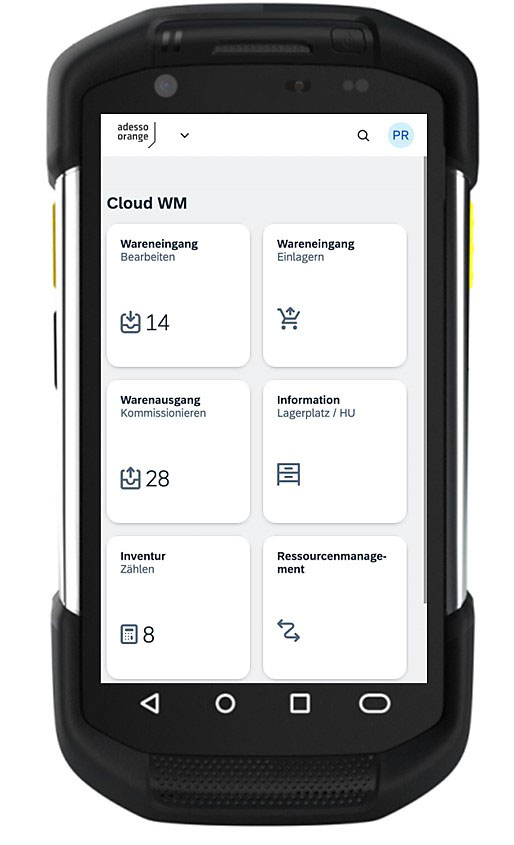
Alternatively, adesso offers standard Fiori apps that can be easily used on a scanner or via web access from any browser-enabled device to support mobile warehouse functions such as resource management and putaway, retrieval, and transfer processes. These Fiori applications are user-friendly and enable seamless mobile interaction with the warehouse management system. For example, a warehouse employee can log in to the device with their credentials and will automatically receive tasks for their area from the control center.
The use of Fiori applications increases employee productivity and simplifies data collection. The intuitive user interface and mobile accessibility allow for more efficient warehouse processes and reduce errors. This leads to an overall improvement in the performance of the warehouse management system and contributes to the optimization of the entire logistics chain.
Flexibility in System Deployment
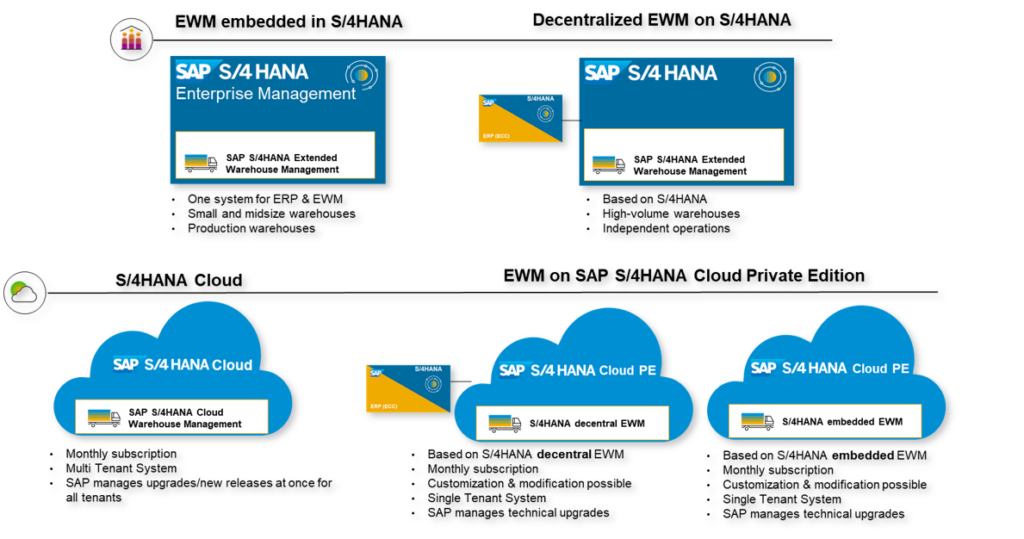
EWM offers high deployment flexibility, as it can be operated in both public and private clouds. Furthermore, EWM can be licensed as an embedded solution in Basic and Advanced editions, depending on your company’s specific requirements and preferences. This flexibility allows you to select and customize the infrastructure best suited to your business.
The public cloud option offers the advantage of being a scalable and cost-effective solution that doesn’t require extensive IT investments. It enables rapid implementation and ensures automatic updates, so your system is always up to date.
In contrast, the private cloud option offers more control and customization options, as it operates in a dedicated environment. This is particularly advantageous for companies with specific security and compliance requirements or those needing customized integrations.
EWM Basic and EWM Advanced
Different warehouses require different levels of process depth. Warehouse structures and uses vary considerably, resulting in diverse processes for storage, retrieval, and production supply. Despite this diversity, all processes are based on a common fundamental structure and require individual adjustments. The necessary effort varies depending on the complexity of the respective process.
With the option to license EWM as an embedded solution in Basic and Advanced versions, companies can tailor the functionality precisely to their needs. The Basic license offers fundamental warehouse management functions, while the Advanced license includes extended functions and additional modules such as MFS (Material Flow System) within EWM, covering complex warehouse processes and specific requirements.
This flexibility makes it possible to optimally adapt EWM to the specific requirements of the company, thereby increasing efficiency and cost-effectiveness.
SAP EWM – The Basic-Version
The Basic version is included in the standard S/4HANA installation at no additional license cost and covers the essential functions of the previous SAP WM and Stock Room Management. New transactions and a redesigned user interface provide a fresh look and improved user experience. While the initial learning curve for SAP EWM may be steep, the improvements in warehouse operations quickly become apparent. Furthermore, numerous opportunities for expansion, automation, and increased transparency are available. Advanced functionalities can be added at any time for a license fee.
SAP EWM – The Advanced-Version
The Advanced license model includes enhanced features such as MFS (Material Flow System), wave formation, cross-docking, labor management, value-added services, inventory cost management, transportation management, package optimization, kitting processes, and dock appointment scheduling. This decision does not need to be made initially. Advanced is embedded and available in a decentralized manner.
But into the (public) cloud? – Advantages and disadvantages of cloud warehouse management
The cloud strategy was followed by a strong positioning of the S/4HANA Public Cloud. This cloud-based solution offers companies the opportunity to manage their warehouses in an agile and cost-efficient manner, without having to worry about the complexity and maintenance of on-premises systems.
By using S/4HANA Public Cloud, companies can quickly migrate their warehouses to an S/4HANA foundation. Implementation with SAP Activate or adesso active Warehouse Transformation helps to implement warehouse processes quickly and efficiently while simultaneously benefiting from the advantages of a modern, flexible cloud platform.
Cloud warehouse management offers a number of unique features compared to on-premise extended warehouse management (EWM), which bring both advantages and disadvantages. It is important to carefully consider the specific requirements of each company to select the right solution.
Advantages of Cloud Warehouse Management
The advantages of cloud warehouse management include scalability, cost efficiency, rapid implementation, and automatic updates.
Scalability
Cloud solutions enable easy scaling of warehouse systems and functionality according to the company’s needs, without requiring additional hardware investments or costly upgrades.
Cost Efficiency
By using cloud resources, companies can reduce the costs of hardware, maintenance and support and instead switch to a subscription model based on usage.
Implementation Effort
Cloud warehouse management solutions typically offer a simpler implementation compared to on-premises and private cloud systems, as they are pre-configured using scope items. Furthermore, the Fit2Standard approach supports process workshops with clearly defined objectives. Especially in the public cloud, the key is to keep the core clean and adhere to the standard. This allows you to migrate to the public cloud quickly and with minimal effort within just a few months.
Automatic Updates
The public cloud platform offers updates and improvements twice a year, which are implemented automatically. Compared to traditional SAP systems, the effort required for updates and testing is lower due to the standardized approach and limited customization options. However, this also applies to private cloud systems when using the Fit2Standard approach.
Disadvantages of Cloud Warehouse Management
The disadvantages of cloud warehouse management include dependence on the internet, data privacy concerns, and adaptability.
Dependence on the Internet
Cloud-based systems require a reliable internet connection to function smoothly. If the connection is interrupted, this can lead to service disruptions.
Privacy Concerns
Using SAP Public Cloud can raise data privacy concerns, as companies may not have full control over the exact location of their data and may encounter difficulties complying with international data protection standards. Additionally, despite encryption, there is a risk of security vulnerabilities and challenges in comprehensively monitoring and auditing data processing practices.
Adaptability
Cloud solutions may not offer the same adaptability as on-premises and private cloud systems because the “fit-to-standard” approach relies on standardized functions and configurations. This can impose limitations for organizations with specific requirements. Therefore, a preliminary assessment is essential, especially regarding the public cloud. Are you cloud-ready?
Conclusion
In summary, Extended Warehouse Management (EWM) is an extremely versatile solution, also suitable for medium-sized businesses with their supply chain and warehouse management requirements. Its numerous advantages enable medium-sized companies to operate successfully in the complex world of warehouse management.
Implementing EWM requires a certain adjustment period and, particularly in the case of the public cloud and cloud warehouse management (Cloud WM), an adaptation of your processes. We help you carry out this transformation. To this end, we have optimized our project-proven adesso active Transformation (aaT) methodology for EWM projects and created an ideal solution for our customers: adesso active Warehouse Transformation (aaWT). We also offer a solution based on SAP Activate for the public cloud.
If you would like to learn more about EWM transformation, please feel free to contact me or adesso orange. Together we can implement your project.