With the migration from ECC 6.0 to SAP S/4HANA, the long-established business partner concept becomes mandatory. Therefore, it is not possible to convert an ECC system using a brownfield approach without a prior migration. Furthermore, even in a greenfield approach, it can be beneficial to switch to the business partner concept in ECC 6.0 beforehand.
In adesso projects for business partner conversion and the related discussions with our SAP customers, two key questions regularly arise that need clarification to assess the project scope:
- How good is the data quality of the debtors, creditors, contacts and employees?
- Is the master data maintained in accordance with the requirements of SAP S/4HANA?
Data Cleansing
These questions cannot be satisfactorily answered without a prior evaluation of the master data. However, the correct answers to these questions influence the effort required by the specialist departments for master data cleansing and the uninterrupted execution of the overall project plan for the business partner migration to ECC.
When cleaning up master data, the question also arises whether there are duplicate data issues. While it’s possible to convert to S/4 using the duplicates, this would simply transfer the data clutter into the new system. Transferring such data clutter into the new S/4 environment is not advisable.
Clean Master Data with the CVI Q-Check Tool
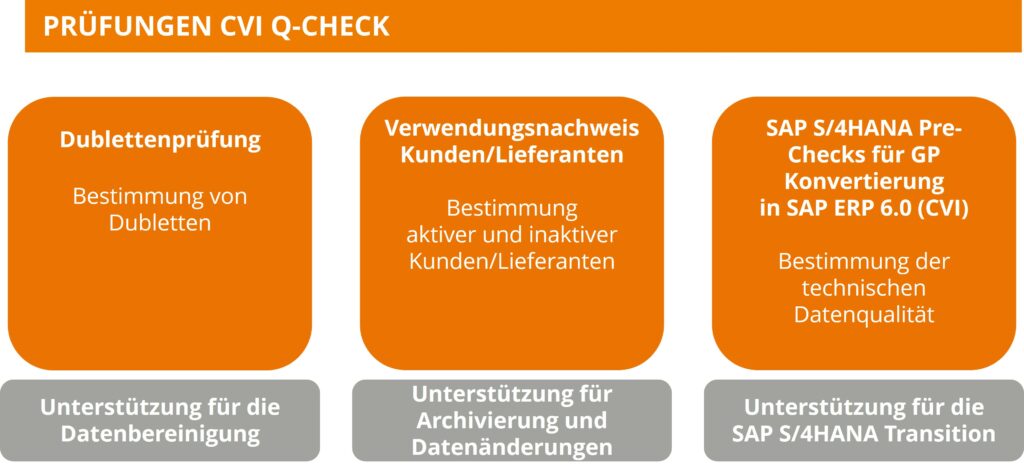
For us at adesso, the solution to this problem is obvious: The master data must be brought up to a corresponding quality level before the switchover. Based on this insight, we developed the CVI Q-Check Tool (CVI, Customer Vendor Integration) master data evaluation tool. It is fully integrated into our active transformation process model for business partner migration and is successfully used in our projects. The CVI Q-Check Tool provides support on three levels:
- Identification of non-S/4 compliant master data fields
- Duplicate check (sharp and fuzzy, and on request with various phonetic search methods)
- Evaluation of the proof of use
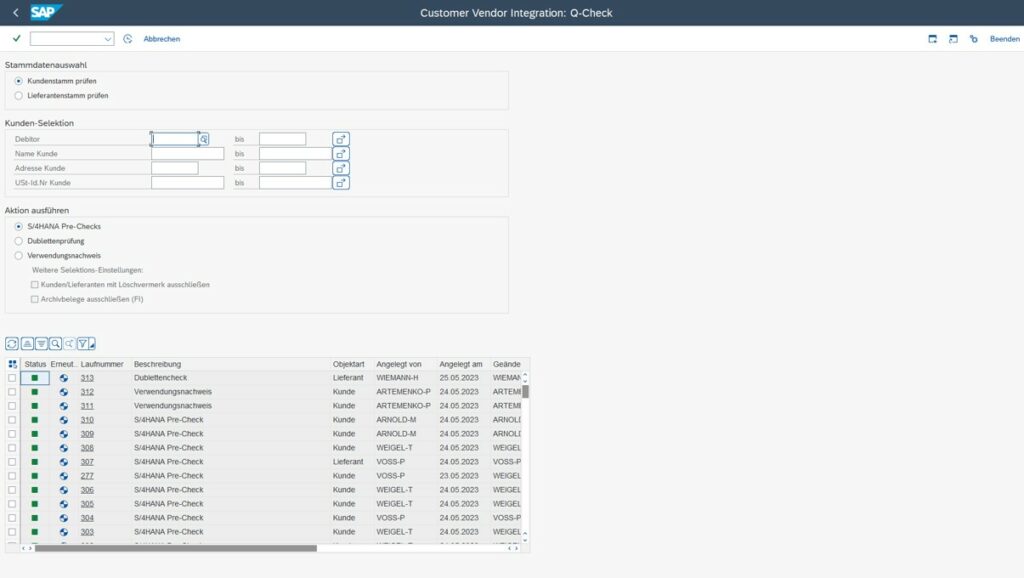
The tool is transferred to the customer’s ECC system via a transport request and provides easy-to-use Excel worklists that can be processed by the relevant departments using a checklist approach and then cleaned (data cleansing) in ECC 6.0. Another advantage is that no notes need to be imported into the ECC system, which would have been necessary with SAP’s standard tools.
In some projects, the CVI Q-Check tool also uncovered other issues such as custom number ranges, etc., which were introduced into the ERP system years ago but were never actually used or are not intended to be used in the future.
The CVI Q-Check tool is built on a powerful framework (Q-Check). In addition to the analysis methods included in CVI Q-Check, further methods, such as duplicate checking in the material master or other master data objects, can be implemented and used.
Furthermore, methods from the Q-Check framework can be integrated into operational processes or workflows, for example, to check rules when creating master data and to protect users from creating inaccurate master data. This ensures that master data remains consistently clean.
Business Partner Conversion
Our approach to business partner migration integrates master data evaluation right from the first phase, “Project Preparation and Analysis.” Based on the insights gained, the project can be planned without further risks, and the workload of the relevant departments for data cleansing can be determined early on. Once the departments have completed the master data cleansing, the business partner migration continues with the subsequent project phases according to the adesso approach.

The process model, which includes all activities of the business partner transition, offers the advantage that, at the outset, it can be jointly defined with the customer at the level of the activities to be carried out, specifying who is responsible for and performs which activities. This allows the customer to actively participate in the transition process and provides maximum transparency regarding the activities to be performed.
If data cleansing of the relevant master data is planned, the use of the CVI Q-Check tool significantly increases project efficiency and transparency for the customer. This ensures that the digitization of business processes can be successfully carried out with clean master data.
The combination of the adesso active transformation methodology and the CVI Q-Check tool provides all the content needed to optimally prepare an ECC system for the S/4 migration with clean master data and the necessary activities.