The transition to SAP S/4HANA – sooner or later, there’s no getting around it. It’s advisable not to put off the transition until the last minute. Here at adesso, we’ve developed a roadmap that shows how the transformation of IT systems and landscapes to SAP S/4HANA can be carried out professionally and in a way that’s clear to everyone involved: the adesso active transformation.
Specifically, the adesso active transformation is a hybrid process model comprising six sequential phases, which gradually guides the transition to S/4HANA. As an SAP Gold Partner, we at adesso orange work very closely with SAP and have based our model on SAP’s activate model. In this way, we provide a common thread running through the transformation – from strategic planning and organisational enablement, through detailed planning, right through to implementation.
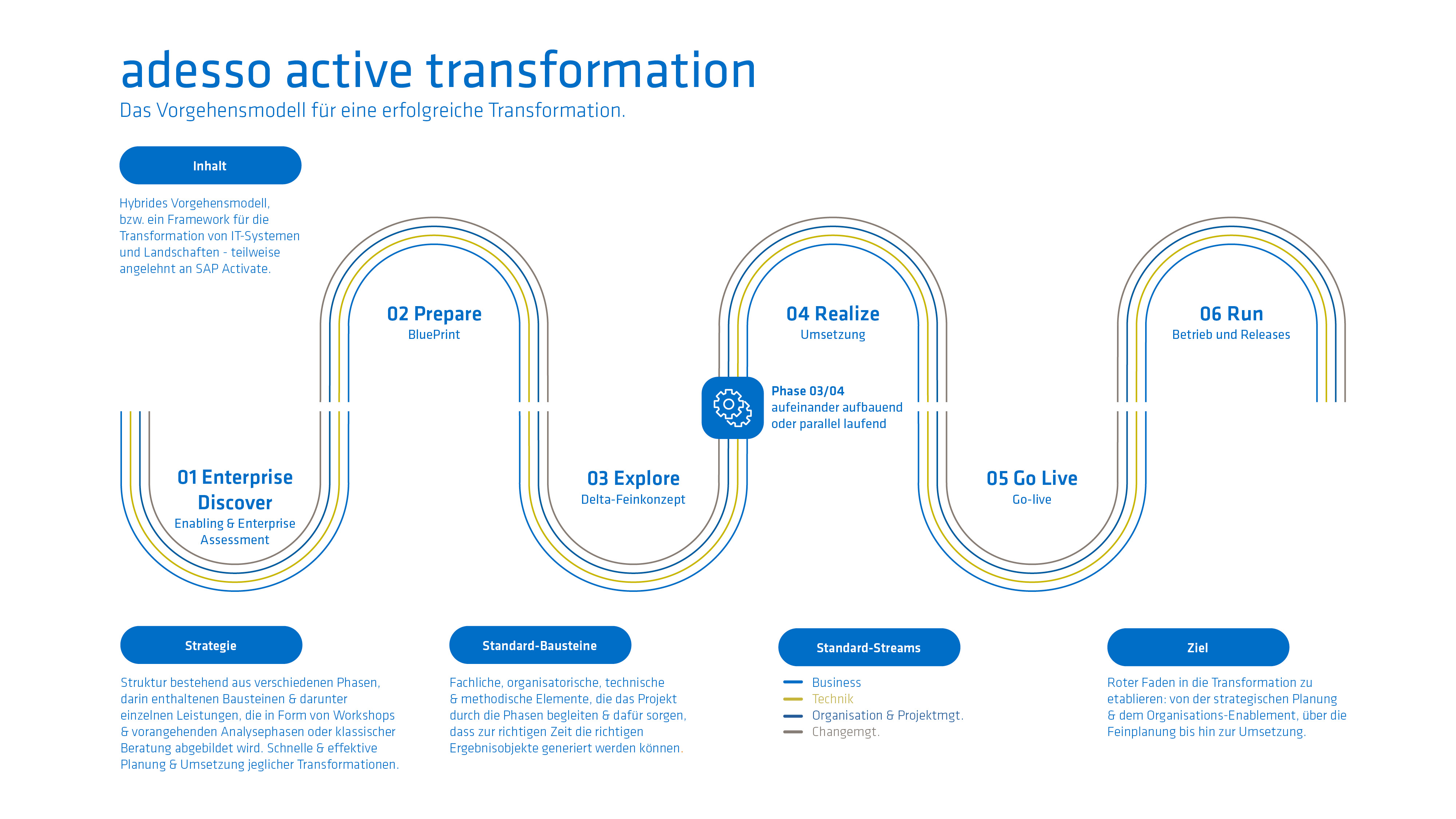
The 6 phases explained
Phase 1: Enterprise discover
Our first step is to prepare the client for the transformation; not in a technical sense, but rather to sharpen their awareness: What lies ahead? What opportunities does a switch to S/4HANA offer? But it’s not just you who should gain the best possible overview. We, too, want to know exactly what conditions we’re facing and which approach is best suited: Greenfield, Brownfield or perhaps a hybrid? Incidentally, I’ve already written a blog post about the different approaches.
As part of the transformation, we are working across four streams:
- Organisation and project management
- Technology
- Business
- Change-management
The streams make projects easier to understand and bring structure to the processes. At the same time, they form the core activities of every project. The streams also help to improve understanding in complex undertakings such as software implementation or transformation. On the subject of change management, I would like to refer you to my colleague Heike Willkomm. She and her team offer excellent and helpful training courses and workshops that demonstrate how change can be successfully implemented within a company in a way that ensures everyone involved feels comfortable.
The Enterprise Discovery phase therefore marks the start of the transformation and establishes the key framework conditions. This phase typically lasts three to six weeks; it is therefore quite short and characterised by workshops. The aim of this phase is to establish clear project parameters and provide a mutual update on the current state of the company’s IT infrastructure.
Phase 2: Prepare
During the Prepare phase, we work with you to define the transformation pathway. This means we draw up a roadmap to guide us over the coming weeks and months – the central theme of the transformation. We conduct this phase primarily using traditional consulting and workshop methods: analysis, design, training, implementation and coordination.
In our transformation projects, we use what are known as building blocks to structure the process and establish a clear thread. These guide the project through all its phases and ensure that the project team delivers the right deliverables at the right time. Building blocks are self-contained and assigned to a specific phase. We distinguish between business and technical building blocks.
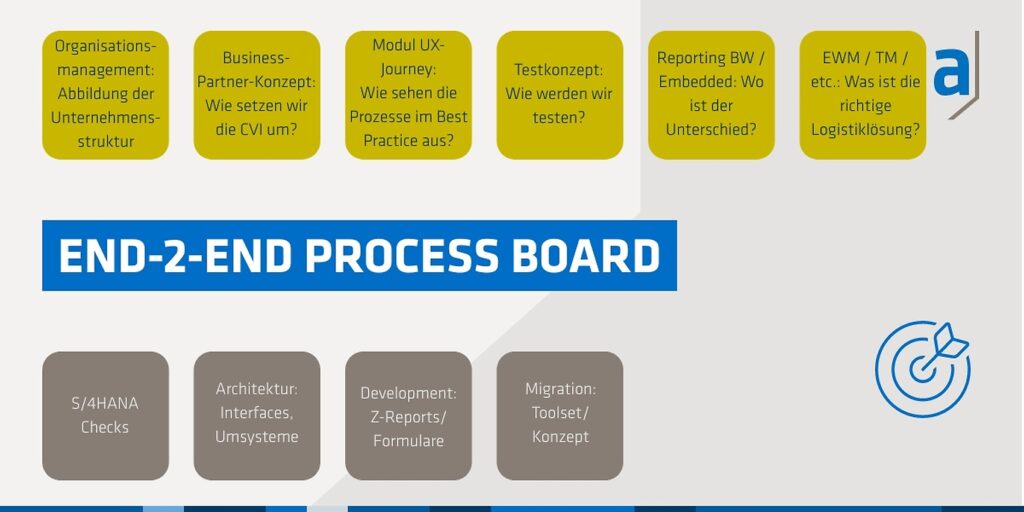
The most important and largest component is the UX Journey: together, we review your business processes and compare them with SAP’s best practices. If they align, we select the best practices and implement them. If not, we consider whether we can carry over legacy code from the R/3 systems or whether we need – or indeed should – explore new approaches.
This is often the point at which it becomes clear to what extent a return to the standard is feasible for you, and what procedural changes this would entail. The outcome of the UX Journey is a simplified version of the technical concept. This provides us with a project plan to serve as the basis for the next two phases.
Phase 3: Explore
Now we’re getting down to business – the conceptual work begins. Together with you, we’ll form process clusters. We’ll go through the processes step by step and align them with one another. How do you want to position yourselves in the future? This forward-looking perspective is essential. An important element is our Interaction Room. This is a workshop format in which we bring specialist departments and IT together around one table. In a joint discussion, they are to contribute their needs and requirements, discuss processes and ultimately agree on a common approach.
From a technical perspective, we handle the deployment of the system. We set up the system, integrate the SAP Business Technology Platform – which is a standard component of modern S/4HANA systems – and have produced comprehensive documentation of the results. This includes, for example, migration strategies, blueprints and user stories, as well as topics relating to testing and IT security.
At the end of the Explore phase, we present a detailed plan: a prioritised backlog for the next phase and a final schedule for the implementation phases. In short: all the necessary preparations for implementation have been made.
Phase 4: Realize
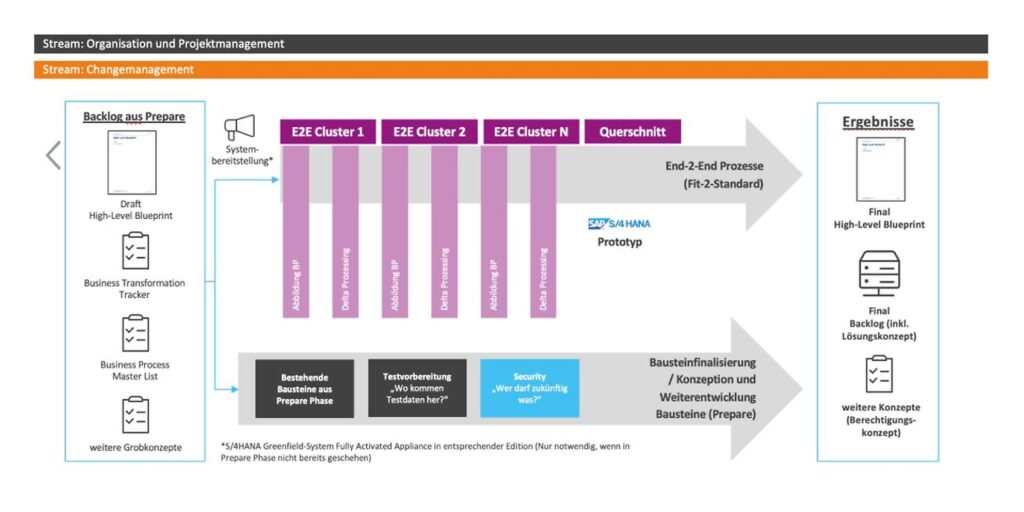
In this phase, all the cogs fall into place. The main objective of the Realise phase is to ensure that the system is ready for go-live, successful integration testing and acceptance. We achieve this through a series of milestones. We implement, test and validate user stories – all in accordance with the backlog from the Explore phase. We carry out migration procedures and test cycles, and finally train the users.
Essentially, the aim is to implement the well-developed concepts through the business and technical streams in the form of sprints. This is where the quality of the project management we established earlier really comes into its own – because at this stage, there is little room for change. In this phase, our colleagues from Change Management are particularly in demand: they oversee the testing and training to ensure a smooth integration and, above all, successful acceptance of the system.
As soon as there are no further questions, we will be ready to put the new system into operation. The final phase of the adesso active transformation is about to begin.
Phase 5 & 6: Go Live and Run
The final rehearsal is imminent. We will run through everything we have set up, tested and implemented so far one last time. At go-live, the system will be put into production. A successful final rehearsal concludes with the acceptance of the system and the go-ahead for go-live. The system is now ready for use – the operational phase begins.
First, we support the system’s restart during the so-called hypercare and stabilisation phase. Then the handover takes place. This usually marks the end of a project to migrate to SAP S/4HANA. Afterwards, we’ll discuss the entire project with you in detail once more and gather your feedback. Constructive and critical feedback is essential for us. It is the only way we can improve and optimise future transformations. Because after the project is before the project!
S/4HANA-roadmap in conclusion
Migrating to SAP S/4HANA or implementing new software requires careful planning and close consultation with customers. You need to gain a clear understanding of your IT landscape so that, together, we can choose the best approach for your transformation. Workshops, discussions and training sessions are essential for the successful completion of the project.
A clear, consistent approach with a strong focus on business and technical processes is also essential for the migration of IT systems and landscapes. With our process model, adesso active transformation, we help you to make this transformation clear, understandable, transparent and, ultimately, successful.
Get in touch with me or with us via adesso business consulting – together we’ll bring your IT project to life!
You can find more articles on interesting topics on a regular basis on our adesso business consulting blog.