The Right Migration Path for SAP S/4HANA and What You Should Consider in Financial Accounting
With the upcoming end of support for SAP Business Suite 7, many companies are facing one of the most important strategic decisions for their SAP landscape: Which migration path to SAP S/4HANA will lay the best foundation for your SAP future?
The answer is rarely clear-cut. Greenfield, Brownfield, and Selective Data Transition (SDT) follow different approaches and vary significantly in terms of effort, project risk, flexibility, and long-term benefits. Which strategy is suitable depends less on current trends and more on the company’s individual circumstances.
This article explains the three migration approaches, highlights their advantages and disadvantages, and presents a practical decision tree that offers companies initial guidance in selecting the appropriate migration path. Particular attention is paid to the implications for financial accounting, which is often more heavily impacted by the choice of migration path than other areas of the business.
An Overview of the Three Migration Approaches
Greenfield: The Fresh Start
With the Greenfield approach, SAP S/4HANA is implemented from scratch. Companies consistently align themselves with SAP standard processes and typically import historical data only selectively or in the form of opening balances.
The greatest advantage lies in the opportunity to fundamentally overhaul process landscapes that have evolved over time. Custom solutions can be reevaluated, organizational structures harmonized, and new SAP functions utilized optimally from the start.
On the other hand, this approach involves a comparatively high level of project effort. Business processes must be redefined, master data must be cleaned up, and business units must be closely involved in the redesign.
Brownfield: System Conversion
In the brownfield approach, the existing SAP ECC system is technically converted to SAP S/4HANA. Business processes, Customizing settings, and organizational structures are generally retained.
This reduces the implementation effort. Users continue to work with familiar processes, which often results in lower training and change management costs.
However, existing in-house developments, process-specific features, and legacy technical issues are largely carried over. Optimizations often take place only after the actual migration. It should also be noted that, depending on the volume of data, the technical conversion may involve significant downtime. In the worst-case scenario, the system comes to a complete standstill for the duration of the conversion.
Selective Data Transition: The Middle Ground
Selective Data Transition (SDT)* combines elements of both approaches. Companies make targeted decisions about which organizational units, processes, or data sets should be migrated, harmonized, or deliberately rebuilt.
This approach is particularly well-suited for system consolidations, corporate mergers, carve-outs, carve-ins, or extensive reorganizations. However, SDT can also be useful for a single SAP landscape, for example, when only selected company codes or business units are to be cleaned up and migrated.
Technically, a Selective Data Transition is usually carried out using specialized migration tools that enable the selective transfer and transformation of data, often allowing for a largely uninterrupted migration since data is synchronized in the background while the legacy system continues to run.
*Note on terminology: “Selective Data Transition” is the official term used by SAP. In practice, the term “Bluefield” – a trademark of the consulting firm SNP – is also sometimes used. Both terms describe the same basic concept.
The Decision Tree
The following figure summarizes the most important decision criteria and serves as an initial guide for selecting the appropriate migration path.
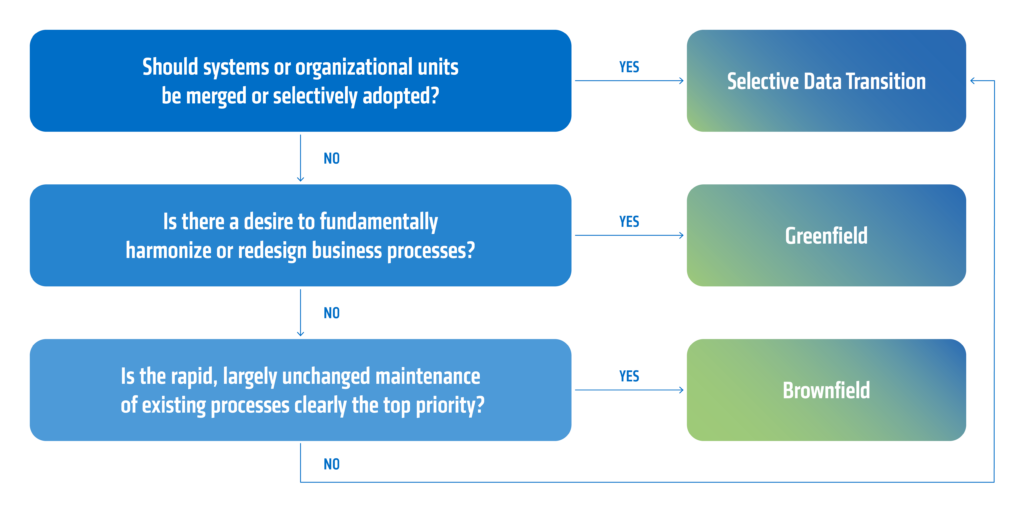
The tree guides the decision-making process through three consecutive key questions: First, it assesses whether multiple systems or organizational units are to be consolidated or selectively migrated. If this is the case, Selective Data Transition is the obvious choice. If this is not the case, the next question is whether there is a fundamental desire for process harmonization. If the answer is yes, this points toward Greenfield. Only if both questions are answered in the negative does the third question determine whether the rapid, largely unchanged preservation of existing processes clearly has the highest priority. If this is the case, this points toward Brownfield.
If the third question is also answered in the negative, this does not mean that no migration is desired at all, but merely that none of the three priorities (consolidation, harmonization, or speed/process preservation) clearly takes precedence. It is precisely in this case that Selective Data Transition offers the necessary flexibility to harmonize individual areas in a targeted manner without having to rebuild everything from scratch or adopt it without verification.
The tree thus illustrates typical project scenarios but does not replace a detailed analysis of the existing system landscape, as the individual criteria influence one another in practice.
The Most Important Decision Criteria
The three key questions of the decision tree can each be refined using specific criteria:
1. Consolidation: Should systems or organizational units be consolidated?
The number of existing SAP systems is a key decision criterion. In the case of a single, well-maintained SAP landscape, all three migration paths are generally viable options. If, on the other hand, multiple systems are to be merged, companies are to be harmonized following a merger, or individual organizational units are to be spun off, a Selective Data Transition often becomes the preferred option.
2. Harmonization: Is there a desire for a fundamental redesign of processes?
The starting point for any migration should not be the technical implementation, but rather the question of the desired end state: Is the goal simply to create a modern technical platform, or does the migration also offer an opportunity to standardize business processes and realign organizational structures? Processes that have evolved over time often drift far from the SAP standard. If many custom processes have emerged, a greenfield migration offers the chance to simplify business workflows and align them with proven SAP standards. If, on the other hand, existing processes are already close to the standard and reliably meet business requirements, this tends to favor a brownfield migration.
3. Process Preservation and Pace: Should existing structures be largely preserved?
Three aspects are particularly relevant to this question:
In-house developments and custom code
What matters is not so much the sheer number of programs as their actual utility. It is important to assess which developments are in productive use, which can be replaced by standard functions, and which adjustments are required due to SAP simplification items. A large volume of custom code by no means precludes a brownfield approach, but it does influence the effort required for analysis and adaptation.
Data history
If it is possible to work with initial data sets or a defined dataset, this provides greater flexibility for greenfield or SDT projects. If, on the other hand, there are legal or business requirements for the complete migration of historical data, brownfield projects often become a more attractive option.
Time and Budget
Brownfield often enables the fastest transition to SAP S/4HANA. In the long term, however, project costs alone should not be the sole consideration. A Brownfield approach that appears cost-effective at first can result in higher operating and maintenance costs if existing process or system weaknesses are carried over permanently.
Regardless of the choice: Readiness for Change
The technical migration is only one part of the project. At least as crucial is the willingness of business units to accept new processes and ways of working. Greenfield projects, in particular, require robust change management and close user involvement, regardless of which migration path a company ultimately chooses. This change perspective applies across all three approaches and thus complements the technical criteria from financial accounting, which are the focus of the following section.
Specific Challenges in Financial Accounting
From a financial perspective, considering the technical migration alone is not sufficient. Depending on the migration strategy, different business challenges arise. While a brownfield approach largely preserves existing organizational structures and customizing settings, greenfield and selective data transition offer the opportunity to fundamentally harmonize structures that have evolved over time.
Among other things, the following aspects deserve special attention, as the three migration approaches differ significantly in this regard:
Charts of accounts: With a brownfield approach, a historically evolved chart of accounts – often maintained inconsistently – remains in place. Greenfield and SDT, on the other hand, offer the opportunity to establish a harmonized, group-wide, uniform chart of accounts.
Posting and Cost Accounting Circles: Consolidating multiple posting circles into a single one is practically not an option in a Brownfield approach, but it is a classic use case in a Selective Data Transition.
Fiscal year variants: Different fiscal year variants across multiple company codes are virtually impossible to standardize in a Brownfield scenario, whereas Greenfield and SDT enable harmonization.
Ledger Structures: Greenfield allows for a clean, fresh setup of parallel ledgers, such as for IFRS and local accounting standards. In a Brownfield project, existing ledger configurations – including any legacy technical issues – are carried over unchanged.
Currencies: As part of a system consolidation using SDT, different group and local currencies, as well as translation methods, must be deliberately harmonized. In a Brownfield scenario, the existing currency configuration remains unchanged.
Business Partners and Customer-Vendor Integration (CVI): Greenfield and SDT allow for a clean, consistent rebuild of the CVI. With Brownfield, a historically evolved, sometimes flawed CVI configuration is carried over unchanged. Jan-Philip Becker demonstrates in his blog post how the associated challenges can be systematically addressed using the Brownfield approach.
Number Ranges: If number ranges are to be standardized across multiple company codes or systems, this can only be meaningfully implemented in Greenfield or SDT. Brownfield carries over existing number ranges unchanged.
A Particularly Underestimated Factor: Master Data Quality
In practice, the decision regarding a migration path is often dominated by technical considerations: the convertibility of the system, the number of SAP systems, or add-on compatibility. However, at least as critical to the project’s success is an aspect that is often neglected in early project phases: the quality of the existing master data.
Incomplete or inconsistent master and organizational data are not automatically cleaned up during a migration. Rather, existing inconsistencies are often carried over unchanged into the new system, where they complicate both business processes and subsequent maintenance. Early analysis and cleanup of master data therefore significantly reduces the effort required in later project phases, regardless of which of the three migration paths a company chooses. You can read more about this in a blog post here.
In practice, a recurring pattern emerges: A brownfield decision – which initially seems obvious for cost reasons – is often reconsidered during the technical analysis when it becomes apparent that, for example, account determination or payment terms have been maintained inconsistently over the years. In such cases, a brownfield conversion preceded by targeted master data cleanup is often recommended. This helps avoid both the costs of a complete rebuild and the carryover of existing data inconsistencies.
Checklist for Internal Preparation
Before the selection of the migration path is brought to the consulting phase, it is worth clarifying the following points internally:
- How many systems or clients are within the scope and are to be consolidated?
- How extensive and how well-documented is the custom code base actually?
- How consistent are chart of accounts, fiscal year variants, and number ranges across all affected company codes?
- What portion of the data history must remain live in the system, and what portion can be archived?
- To what extent are the business units open to significantly changed processes?
- What amount of downtime is realistically acceptable for the go-live?
- What is the realistic time and budget window available?
Ultimately, experience from numerous transformation projects shows that the success of an SAP S/4HANA migration rarely fails due to technical implementation. Rather, data quality, organizational harmonization, and the early involvement of business units are often the factors that determine the project’s long-term success.
Conclusion
There is no one-size-fits-all answer to the question posed at the beginning about the best foundation for the future of SAP. Nevertheless, choosing the right migration path is one of the most important strategic decisions in an SAP S/4HANA project: While Brownfield offers advantages for stable system landscapes with minimal need for change, Greenfield, and Selective Data Transition provide greater flexibility for process harmonization and organizational realignment. It is crucial to take a holistic view of the initial situation and not focus exclusively on technical criteria.
In financial accounting in particular, factors such as charts of accounts, company code structures, ledger structures, and master data quality often have a greater impact on the project scope than the actual system conversion. A thorough preliminary analysis of these interdependencies creates transparency and lays the foundation for a robust migration strategy. The subsequent fine-tuning and implementation require experienced guidance.
adesso business consulting supports companies throughout the entire transformation process – from analyzing the existing system landscape and evaluating suitable migration strategies to the successful implementation of SAP S/4HANA. Our FI experts help you assess chart of accounts, company code structures, and master data quality early on, thereby laying the groundwork for a robust migration strategy. Please contact us if you’d like to work with us to assess your current situation.