The end of the month, countless hours of overtime, and constant pressure: For many finance teams, the traditional month-end closing is a regular test of endurance. Fragmented system landscapes, manual Excel jungles, and the typical end-of-period madness repeatedly slow down accounting. But what if the closing process were no longer a multi-day state of emergency, but instead ran largely seamlessly as part of day-to-day operations? This is exactly where the principle of Continuous Closing comes in. Through the interplay of SAP S/4HANA, process control with SAP Advanced Financial Closing (AFC), and real-time reconciliation via ICMR, the hectic closing rush on the reporting date is transformed into a continuous, highly automated workflow. The result: closing times cut in half, noticeably less strain on teams, and full financial transparency at the push of a button.
The Technological Foundation: The Universal Journal (ACDOCA)
The technological core of this transformation lies in the architecture of SAP S/4HANA. In traditional ERP landscapes, financial accounting and controlling often exist in separate worlds, requiring time-consuming data transfers, batch runs, and reconciliation work at the end of the period. SAP S/4HANA eliminates this separation.
By consolidating all finance-related data in the Universal Journal (ACDOCA), a unified database (“single source of truth”) is created. All transactions are stored in a single data structure, so that general ledger accounting, asset accounting, cost accounting, and income statement accounting are updated simultaneously. This eliminates traditional extraction, transformation, and loading (ETL) processes. The financial truth is available the very moment a business transaction is posted. This creates the essential prerequisite for performing closing activities not only in an aggregated manner at the end of the month, but also concurrently during day-to-day operations.
Process Orchestration with SAP Advanced Financial Closing (AFC)
A key obstacle on the path to continuous closing is the lack of transparency regarding the processing status of decentralized teams and subsidiaries. Without centralized control, sequential wait times arise: One department cannot begin until another has completed its work, yet the flow of information often stalls.
This is where SAP Advanced Financial Closing (AFC) establishes itself as the central control and orchestration hub. As a cloud-based hub solution, AFC integrates seamlessly into existing system landscapes and enables the management of closing activities across various SAP systems, central finance instances, and third-party ERPs.
AFC’s operation is based on the standardization and automation of complex process chains:
- Global Templates: Based on predefined best-practice models, finance managers create task plans that define organizational assignments, chronological sequences, and logical dependencies.
- Automatic Job Cascading: As soon as an upstream task is successfully completed, AFC automatically triggers downstream steps – whether it’s running accrual runs, performing value date adjustments, or allocating overhead costs.
- Real-time monitoring: Through modern SAP Fiori applications, accounting managers and financial controllers can access the progress of all task plans in real time. Delays, erroneous job executions, or bottlenecks are immediately highlighted visually.
- Governance and Compliance: Integrated approval workflows ensure that critical postings or adjustments are reviewed according to the dual-control principle and documented in the audit trail in an audit-proof manner.
This structured approach drastically reduces the coordination effort required by management and ensures that the schedule is met without time-consuming status meetings.
Automated real-time intercompany reconciliation via SAP ICMR
In addition to pure process control, the reconciliation of intercompany transactions (intercompany matching and reconciliation) is one of the most time-consuming tasks in the period-end closing process. Discrepancies in internal goods and services, differing posting dates, or currency fluctuations – combined with a lack of real-time data – regularly lead to late corrections and delayed consolidated financial statements.
The SAP ICMR solution, integrated into SAP S/4HANA, fundamentally redesigns this process. Since ICMR accesses the primary data in the Universal Journal directly, separate data transfers are no longer necessary. Transactions between affiliated companies are analyzed and matched immediately upon posting.
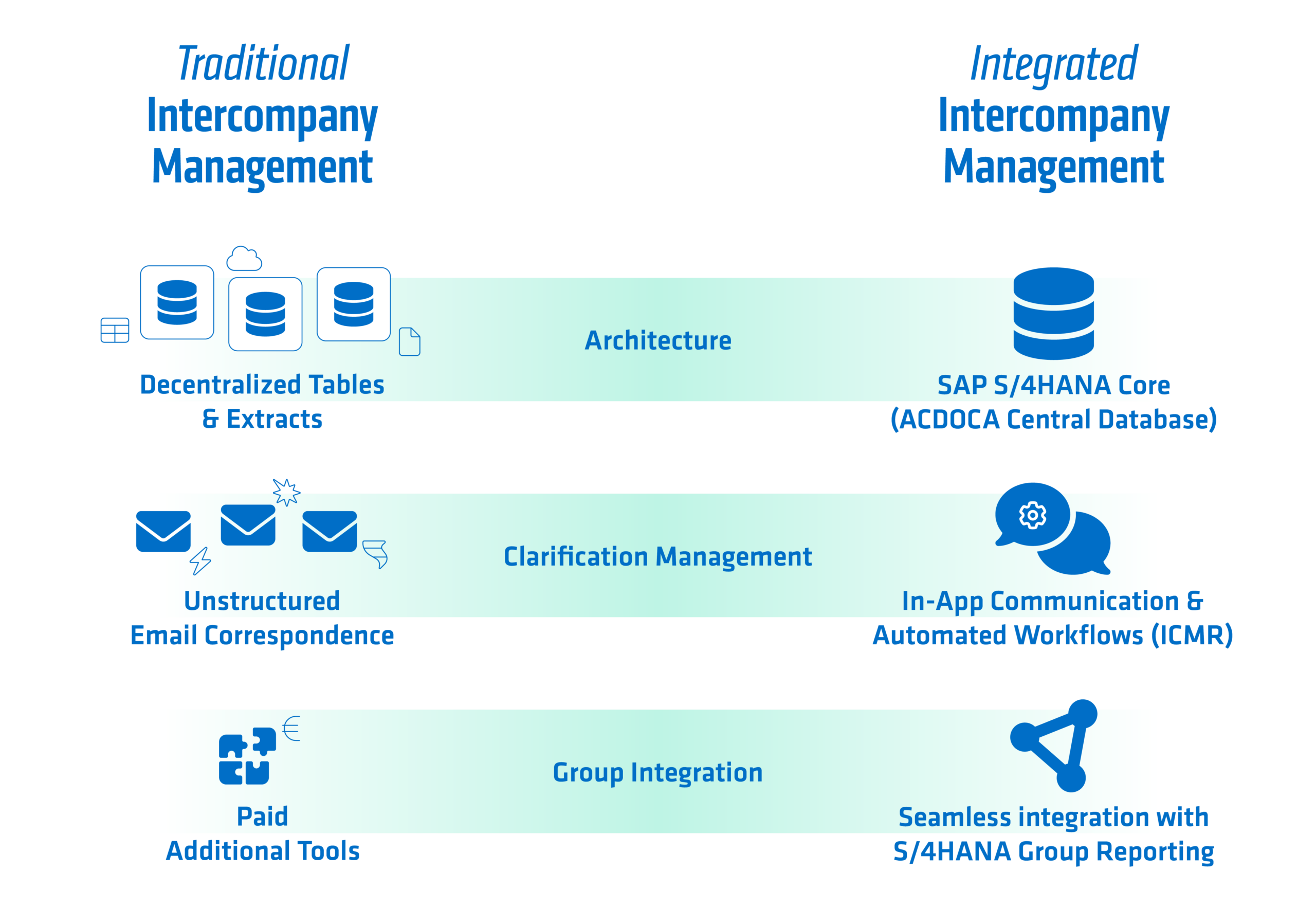
The flexible matching engine uses freely configurable rules to automatically match document pairs at the document level. Detailed tolerance limits allow the system to automatically adjust for minor discrepancies, such as rounding differences. Should any unclear discrepancies arise, ICMR offers structured in-app communication channels: Accountants can comment on differences directly within the user interface, link documents, and send clarification workflows to the partner company. Since reconciliation can be performed on an ongoing basis, the end-of-period intercompany reconciliation is no longer a daunting task.
Shorter Closing Times and Operational Benefits
ICMR leads to measurable performance gains in the finance organization. The overarching goal – a significant acceleration and, in many cases, a reduction in closing times – is achieved by eliminating sequential wait times and automating routine processes.
By continuously distributing review, reconciliation, and posting tasks throughout the entire month, the critical workload spike after the end of the period is eliminated. This gives finance departments valuable breathing room. Errors or discrepancies in the data are identified and corrected immediately during the current month, rather than having to be resolved as unexplained items under enormous time pressure.
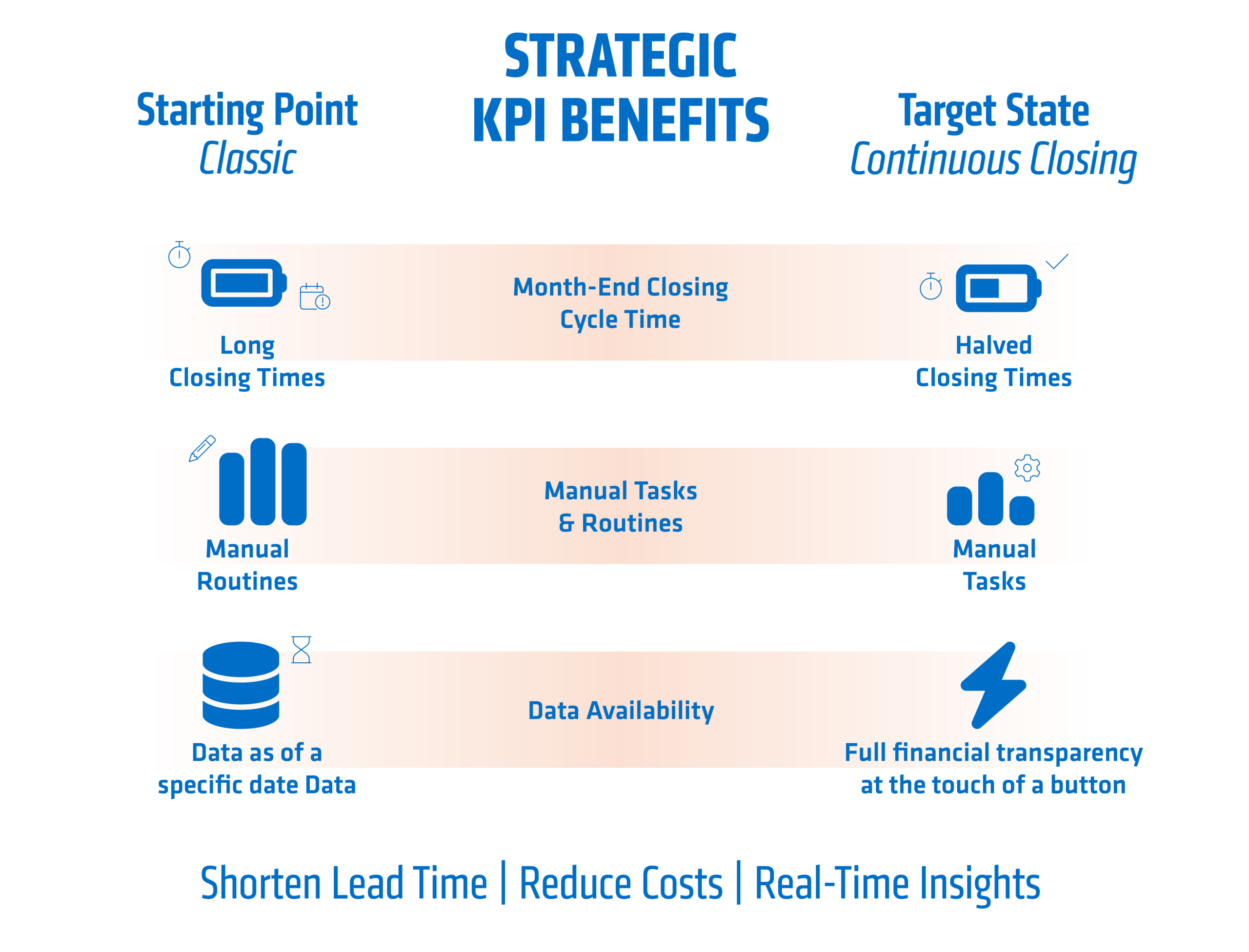
This acceleration not only reduces operational process costs but also fundamentally changes the role of general ledger accountants and financial controllers. Instead of spending time on manual data compilation and error detection, the focus shifts to the qualitative analysis of financial data. Accounting is transforming from a retrospective documentation function into a forward-looking partner to corporate management.
Strategic Implications and Outlook for Financial Management
Successfully implementing continuous closing requires not only the necessary technological infrastructure but also a clear strategic direction for financial management. For accounting managers, this results in specific areas of action for transforming their organization:
- Standardization before automation: Existing closing processes must be critically reviewed and standardized. Only clearly defined workflows can be effectively converted into digital task models.
- Gradual implementation: A phased approach has proven effective. By activating SAP ICMR early on, immediate success can be achieved in reducing the workload associated with intercompany reconciliation.
- Focus on change management: The shift from peak workloads tied to specific reporting dates to continuous routine tasks requires a change in mindset within the teams. Process ownership replaces work focused solely on specific reporting dates.
In the future, this trend will intensify further as intelligent technologies become increasingly integrated. Modern systems will increasingly be able to independently detect anomalies in posting behavior at an early stage, suggest automatic corrections, and further minimize the remaining audit effort. Companies that align their processes today with the principle of continuous closing not only secure speed and cost advantages but also lay the necessary foundation for a future-proof, data-driven finance organization.
Have we piqued your interest? If you’d like to learn more about how to successfully transition your accounting to continuous closing and make the most of SAP S/4HANA’s capabilities, we’d be happy to assist you. Contact us for a no-obligation discussion.