The success of an IT project depends on more than the right technology, well-defined processes, or experienced project management. It is equally important to have professionals with the right skills and experience available at the right time and with the right level of capacity. This is where resource management plays a key role, particularly in a global delivery environment where managing resources can be highly complex.
One of the key responsibilities of a Resource Manager is to connect business and project requirements with available skills and capacity. However, resource management is about much more than simply “finding someone” for a project. It involves understanding the requirements, identifying the necessary skills and capacity, exploring internal options, and, when needed, coordinating external resources or new hires.
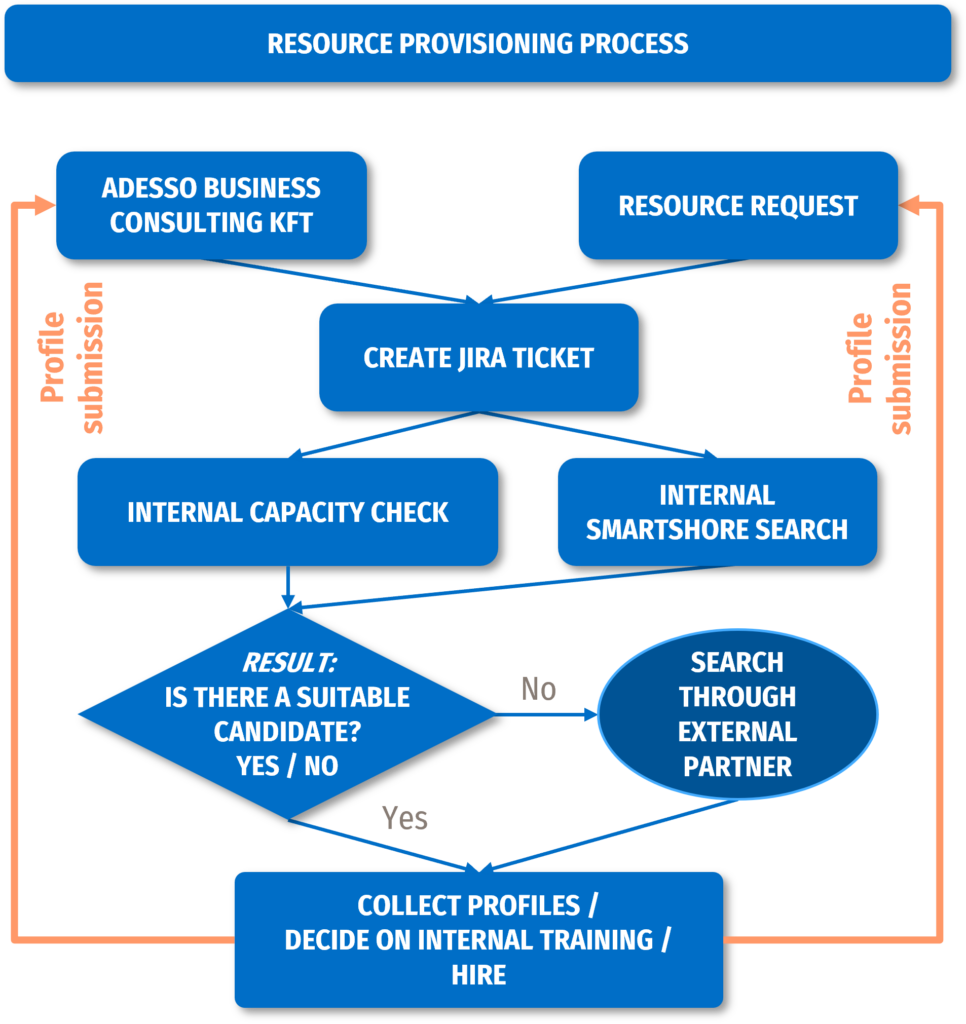
How does a resource search start?
The process begins with a request from a Project or Service Manager. To successfully identify the right resource, it is not enough to know that “an ABAP developer is needed.” It is important to understand the project duration, required capacity, technical skills and seniority level, language requirements, and the specific responsibilities the person will have.
Once the request is received, the Resource Manager gathers the necessary information and manages the search in a structured and transparent way. Supporting tools such as Jira tickets make the process visible to everyone involved, showing the current status, profiles identified, and decisions made.
Internal resources should always be considered first
The first step is to review available internal resources. This can involve regular resource meetings, discussions with professional leads, and reaching out to delivery teams in different countries.
This is particularly important in an international organization. There may be no available capacity in one country while the required skills are available in another delivery organization. One of the key benefits of resource management is making these capacities visible and enabling their effective allocation.
The optimal solution is not always a full-time resource. Part-time capacity, temporary assignments, or a combination of several team members may be more appropriate. Therefore, in addition to skills, capacity, timing, and the business requirements of the project all need to be considered.
What happens when there is no suitable internal resource?
The IT market has a number of skills that are consistently difficult to source. A specialized SAP technology, rare industry experience, or a specific language requirement can significantly reduce the pool of potential candidates. In such cases, several options should be considered in parallel.
One option is to involve external partners, who can provide specialists within a shorter timeframe when the required skills are not available internally. In other cases, recruitment may be the right approach, particularly when the demand is expected to be long-term.
A third option is to develop existing talent. A junior colleague with the right foundation can acquire the required expertise through targeted training and mentoring. This can address the immediate project need while also strengthening the company’s long-term resource capabilities.
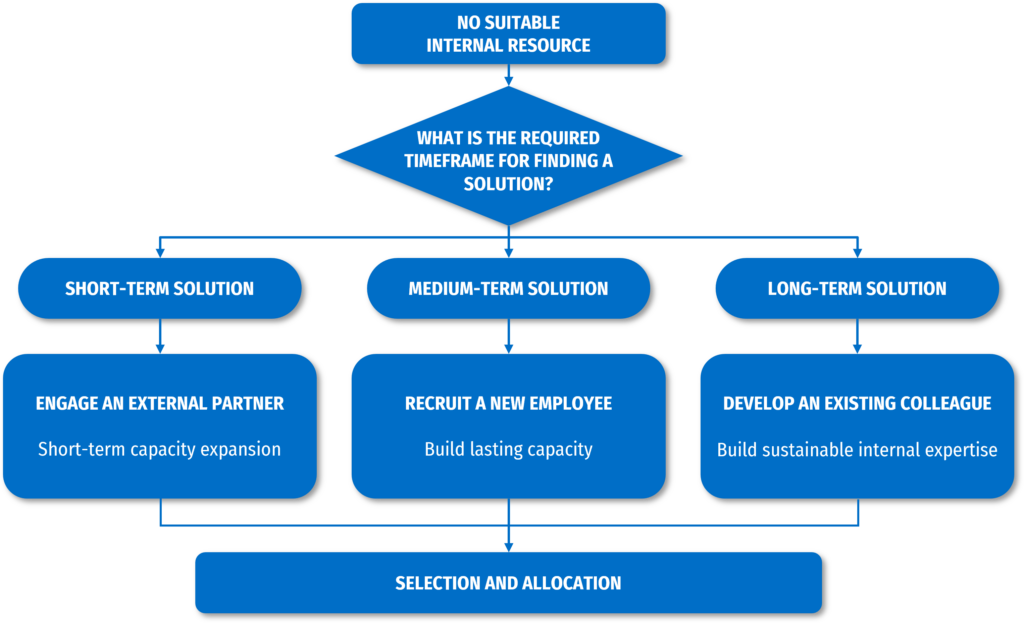
A good example is a utilities project that required several specialists with ABAP development and utilities industry expertise at the same time. Due to the limited talent pool, relying on a single sourcing channel was not sufficient. The solution combined external partners, internal resource reallocation, and the hiring and targeted training of junior colleagues. This demonstrates that resource management often means coordinating several measures rather than finding a single “perfect match.”
The Resource Manager’s role goes beyond finding resources
In a well-functioning organization, resource management covers much more than fulfilling project requests. It includes managing relationships with contractual partners in Hungary and abroad, coordinating incoming and outgoing resource requests, and ensuring effective information flow.
Close cooperation with HR and recruitment teams is also essential. Based on current business needs, the Resource Manager can recommend opening new positions or modifying or closing existing searches. In an international environment, this coordination can also cross national borders, aligning recruitment capacity in nearshore countries such as Romania, Bulgaria, or Türkiye with current business needs.
Resource Managers can also contribute to the resource-related aspects of customer tenders and proposals. At this stage, the role becomes more forward-looking: determining which skills and how many resources will be needed, and which delivery model will best support successful project execution.
Turning data into decision support
Reporting is another important part of resource management. Regular analysis of capacity, utilization, open requests, available skills, and expected resource demand helps ensure that decisions are based on data rather than assumptions.
A well-functioning resource management system therefore does more than show “who is available now.” It can also highlight where capacity shortages are expected, which skills are scarce, where recruitment or training may be needed, and where existing capacity could be utilized more effectively.
Effective resource management depends on strong relationships
One of the keys to successful resource management is building and maintaining an active internal network. A Resource Manager needs to know the professional leads, Project and Service Managers, recruitment teams, delivery organization, and external partners. The stronger this network is, the faster the organization can respond to new requirements.
Ultimately, resource management is not simply about ensuring that every project has someone assigned to it. The goal is to place the right skills, with the right capacity, at the right time and in the right place, while also considering the long-term interests of both employees and the company.
In a global delivery organization, the Resource Manager is therefore a coordinator, connector, analyst, problem solver, and business partner all at once. Success is often not the result of one major decision, but of bringing together many small pieces of information, relationships, and opportunities in the right way.
Whether a project calls for ABAP development, industry-specific SAP expertise or additional capacity, adesso assembles teams tailored to customers’ needs and able to scale flexibly. This gives customers greater confidence in planning and delivery from the very start of the project, supported by transparent resource planning.