Electronic Invoicing Is Only the Beginning
Europe’s tax landscape is undergoing a fundamental transformation driven by the adoption of electronic invoicing. E-invoicing is increasingly accompanied by digital reporting obligations and, in particular, transaction-level controls, as our review of the Peppol Conference Europe 2026 highlights.
At the same time, businesses must continue to prepare periodic VAT returns, statistical declarations and tax audit files. The challenge, therefore, extends beyond transmitting data electronically: information must remain consistent from the underlying business transaction through to the submission to the relevant tax authority.
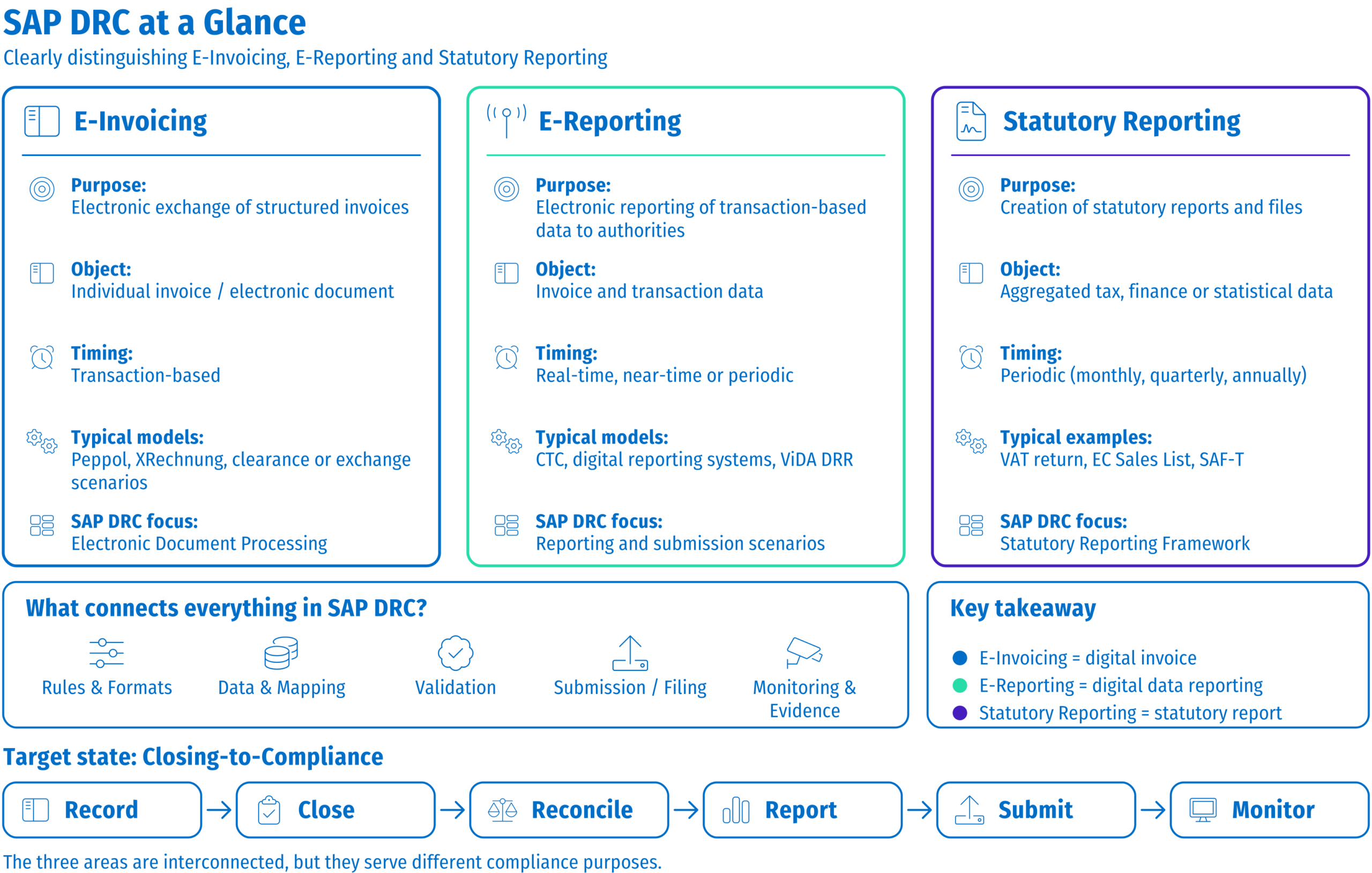
Against this backdrop, SAP Document and Reporting Compliance (SAP DRC) provides a unified process framework. The strategic target state is the end-to-end process known as Closing-to-Compliance.
DRC Reporting Core: Structured Management of Statutory Reporting
SAP DRC uses four key objects to organise statutory reporting obligations: Reporting Entities, Report Categories, Reporting Activities and Report Definitions.
A Reporting Entity can, for example, encompass multiple company codes. Report Categories represent different types of statutory reports, such as country-specific periodic VAT returns and EC Sales Lists. Reporting Activities define process steps, including report generation and additional processing activities. Report Definitions specify the output format and the underlying data mapping.
The SAP Fiori apps Define Statutory Reports and Run Statutory Reports enable users to configure, generate and monitor statutory reports.
VAT, Tax & Statistics: One Process Framework, Country-Specific Rules
Depending on the jurisdiction, typical use cases include periodic VAT returns, EC Sales Lists, withholding tax reports and statistical declarations.
However, reporting periods, mandatory data fields and tax authority formats vary significantly between countries. A common governance and execution framework is therefore valuable, provided that local regulatory requirements remain fully addressed. The SAP capabilities available in practice depend on the country, software release and product scope.
SAF-T & Audit: From Statutory Reports to Audit-Ready Data
The OECD developed the Standard Audit File for Tax (SAF-T) as an approach to providing tax-relevant accounting information in a structured format.
National implementations include Poland’s JPK files, Romania’s D406 declaration, Portugal’s SAF-T (PT) and Norway’s SAF-T Financial. The specific requirements differ in terms of data content, format and submission procedures.
SAP DRC supports selected country-specific tax audit files. However, their reliability and auditability depend on complete accounting records, traceable data lineage, documented controls and compliance with the prescribed file format.
Real-Time Reporting & CTC: Moving Towards Transaction-Level Compliance
Continuous Transaction Controls (CTC) encompass processes for reporting or verifying business transactions in near real time.
Hungary, for example, operates a transaction-based invoice reporting model. Italy, by contrast, validates electronic invoices through the Sistema di Interscambio (SdI) before they are delivered to the recipient through the prescribed process. Invoice reporting, as in Hungary, and tax authority clearance, as in Italy, therefore represent distinct control models.
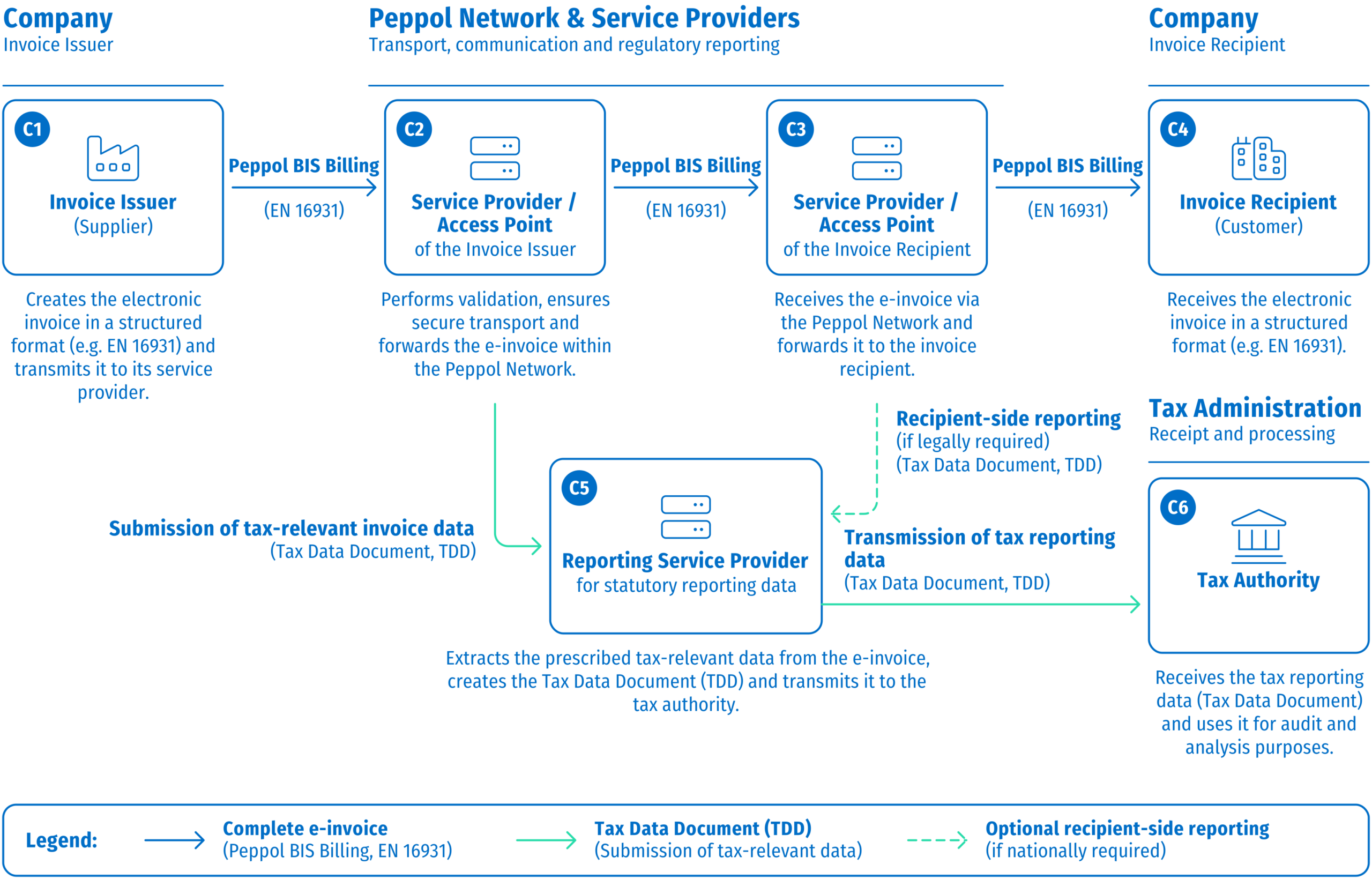
Under the Peppol four-corner model, invoice issuers and recipients exchange electronic invoices through two service providers. Five-corner models additionally incorporate the reporting of tax-relevant data to the tax administration.
The Peppol–ViDA pilot is also exploring a six-corner architecture: an additional service provider (C5) transmits tax-relevant data to the tax authority (C6). This model uses a Tax Data Document (TDD) containing defined invoice information. The underlying TDD specification supports different reporting roles and reporting functions.
Taken together, these models demonstrate how E-Invoicing and E-Reporting can converge without implying that a single, mandatory EU-wide architecture has already been established.
ViDA & Regulatory Radar: Compliance as a Continuous Responsibility
In the context of the European regulatory framework, our article “Entering the digital tax world with ViDA” outlines the three pillars of VAT in the Digital Age: digital reporting requirements, the platform economy and simplified VAT registration.
From 1 July 2030, harmonised digital reporting requirements will apply to certain intra-Community B2B supplies and acquisitions of goods, as well as cross-border services subject to the applicable reverse-charge mechanism. Existing national transaction-based real-time reporting systems must, in turn, be aligned with the European framework by 1 January 2035.
Data standards are evolving in parallel. The pre-release version of XRechnung 4.0 addresses, among other aspects, structured cash discount information, delivery details and multiple purchase orders. However, this version is not yet intended for productive use.
This creates an ongoing need for structured regulatory change management within businesses.
Architecture & Integration: A Standardised Core, Local Execution
From an architectural perspective, multinational businesses should adopt a consistent approach to data models, validation, monitoring and error handling wherever possible. Country-specific tax rules, integrations with tax authorities and filing deadlines, however, must continue to be managed locally.
SAP DRC integrates supported SAP S/4HANA processes into this framework. In Germany, for example, the electronic submission of periodic VAT returns is available as standard functionality.
The decisive factors are the officially supported country scenarios, system editions and communication channels.
Data & Reconciliation: Compliance Starts Before Submission
A technically valid document does not necessarily constitute a substantively accurate statutory filing. Tax codes, VAT identification numbers, supply or service periods and amounts must reconcile with the underlying accounting entries and business transactions. Key controls include tax account reconciliations, matching source documents against reported data, duplicate checks and resolving rejections issued by tax authorities.
Reconciliation against tax data provided by the authorities is also gaining importance. In India, for example, SAP supports relevant reconciliation processes for certain Goods and Services Tax (GST) filings.
In addition, traceable archiving and documented procedures strengthen the internal control framework and establish an auditable trail from the original transaction to the statutory filing.
Closing & Operations: From Financial Close to Closing-to-Compliance
In the context of the financial close, our article “Continuous Closing” explains how SAP S/4HANA, Advanced Financial Closing and Intercompany Matching and Reconciliation support the closing process.
The same principle applies to statutory reporting: data should be validated continuously wherever possible, rather than identifying errors only when filing deadlines approach.
An effective operating model therefore brings together Finance, Tax and IT through clearly defined responsibilities, aligned deadlines, exception-handling workflows and continuous monitoring.
This leads to the following target operating model: Record → Close → Reconcile → Report → Submit → Monitor
For transaction-based reporting obligations, such as those in Hungary, validation and monitoring already begin during day-to-day business operations (Record).
Conclusion: Closing-to-Compliance as the Strategic Target State
Ultimately, the future of statutory reporting does not lie in adding more standalone reports. It lies in integrated, data-driven compliance processes.
SAP DRC provides the technology framework to enable this approach. In practice, Closing-to-Compliance connects accurate accounting entries, reliable financial closing data, statutory filings and ongoing monitoring in a transparent, end-to-end process.
At adesso business consulting, we support you every step of the way
From assessing your existing SAP system landscape and defining the functional solution design to the technical implementation of SAP Document and Reporting Compliance (SAP DRC) and go-live, we guide you through every stage with our extensive SAP expertise and years of hands-on experience. Together, we streamline your statutory reporting processes, enhance data quality, and lay the foundation for meeting future regulatory requirements.