SAP transformation projects – such as the migration to SAP S/4HANA – are a major undertaking for many companies. They combine business reorientation, data migration, process harmonization, technical modernization, and change management. This is precisely why it’s worth considering AI and automation not just after go-live, but systematically incorporating them into the transformation project from the start.
In many projects today, this is still done too piecemeal: individual teams test a copilot, automate project tasks, or discuss selected SAP Business AI functions. What is often missing is a consistent approach across all project phases. At adesso business consulting, we therefore rely on a structured AI & automation approach that brings together SAP Business AI, SAP Build, and relevant non-SAP solutions – always depending on the target vision, deployment, existing licenses, data situation, and economic benefits.
The key point is this: Not every company starts from the same situation. Public cloud, private cloud, sovereign cloud, and on-premise environments open up different possibilities. The good news, however, is that even customers with hybrid or on-premise scenarios can make effective use of AI and automation—but the solution space must be realistically assessed and clearly prioritized.
The SAP Business AI Readiness Check by adesso
We deploy the SAP Business AI Readiness Check by adesso as early as the (Enterprise) Discover phase. The goal is to establish transparency at an early stage regarding which AI and automation potentials are realistic, economically viable, and compatible within the specific customer scenario.
To do this, we consider, among other things:
- which SAP solutions, releases, and licenses are currently available or planned,
- which SAP Business AI functions and SAP Build scenarios could be relevant in principle,
- which non-SAP solutions for AI and automation are already in use or licensed,
- which industry-specific requirements, regulatory guidelines, and security requirements must be taken into account,
- how data quality, process documentation, and organizational readiness should be assessed.
In many cases, the Readiness Check can be prepared by adesso, keeping the customer’s workload to a minimum. During a joint meeting, the assumptions are validated, supplemented, and prioritized. For illustration purposes, here is an excerpt from our demo system:
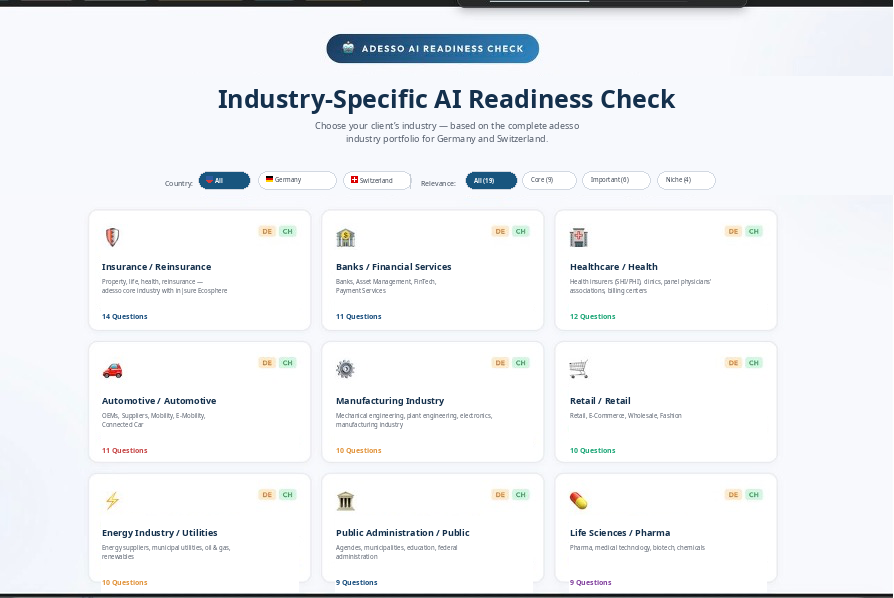
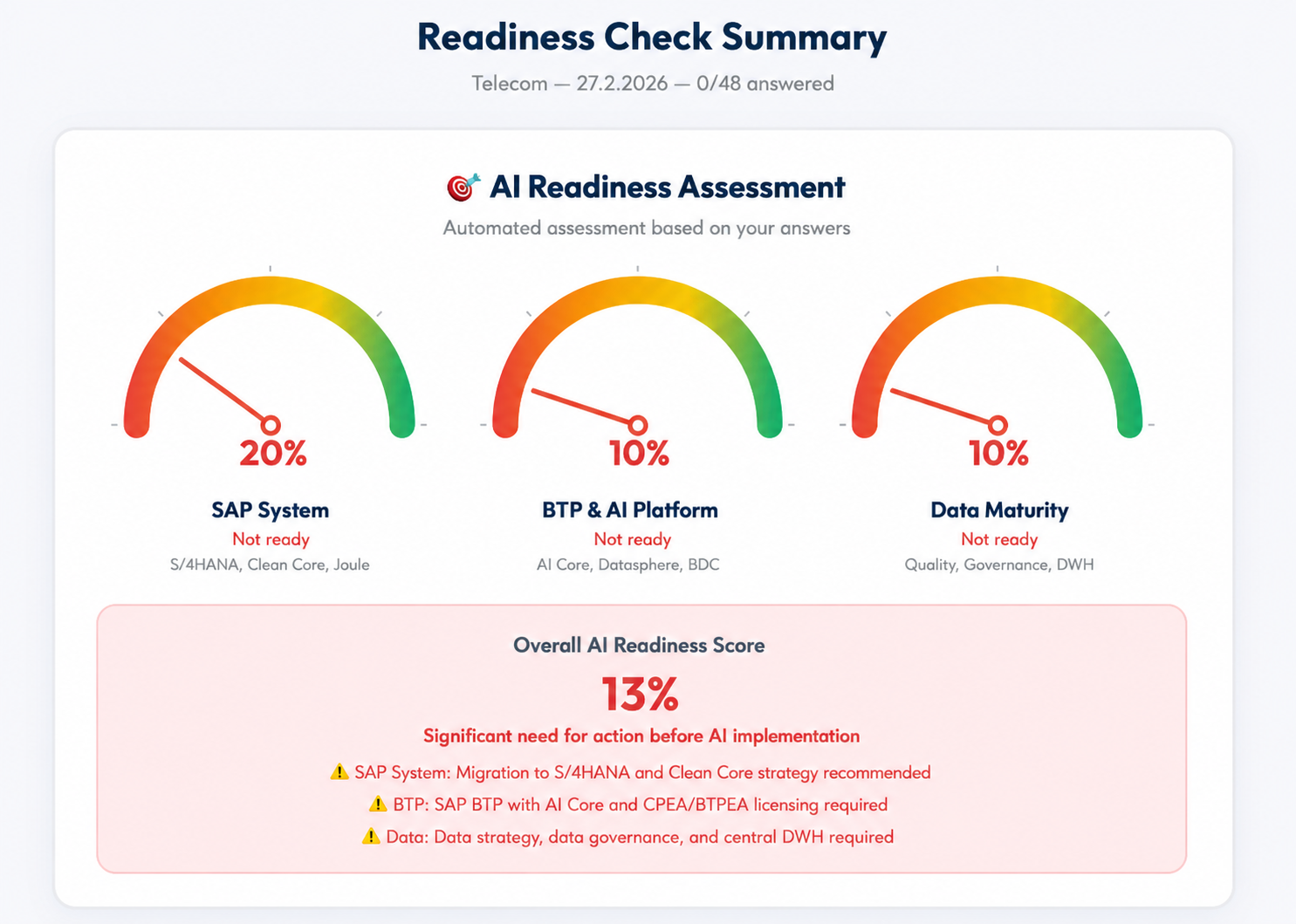
As a result, customers receive a structured assessment of their current situation, specific areas for action, and an initial prioritization of potential measures. These results are compiled into a report and can serve as the basis for further transformation planning. Below is a highly condensed representation from the demo system:
SAP Business AI
What Can Be Used in a Specific Customer Scenario?
The SAP Business AI Feature Catalog in the SAP Discovery Center now includes several hundred AI functions and agents. For customers, however, it is not the absolute number that matters, but rather the question: Which functions are actually usable for my system landscape, my licenses, my deployment, and my processes?
This is exactly where our analysis comes in. We narrow down the extensive SAP Business AI catalog to those functions that are functionally relevant and technically feasible in the specific customer scenario. For example, if a company does not use SAP SuccessFactors, the AI functions intended for it are not relevant in the first step. If a customer does not have certain S/4HANA Cloud functions in their target vision, these are also not planned as benefits that can be realized in the short term.
Why does deployment play a central role?
When evaluating SAP Business AI, the deployment model is a key factor. In SAP S/4HANA Cloud, Public Edition, and in many private cloud scenarios, numerous pre-defined embedded AI use cases from SAP can be evaluated much more directly. In sovereign cloud or on-premise scenarios, however, access to the full range of SAP Business AI is often more limited or more heavily dependent on architecture, release status, integration, and licensing.
However, this does not mean that these customers are left out. On-premise and hybrid SAP landscapes can also be integrated into AI and automation scenarios via suitable interfaces, SAP BTP, SAP AI Foundation, SAP Build, data platforms, or customer-specific integration patterns. The key is to manage expectations effectively : Embedded AI, Premium AI, and Custom AI are different levers – each with distinct prerequisites, cost structures, and governance requirements.
Why are non-SAP tools also relevant for SAP transformations?
SAP Activate structures the SAP transformation very effectively. In reality, however, a company consists of more than just SAP. Many customers already use Microsoft 365, Power Platform, Azure, Google Cloud, OpenAI, Anthropic, Salesforce, or other platforms. These existing tools can also provide measurable benefits in the SAP transformation project – not as a replacement for SAP methodology, but as a complement.
A simple example is Microsoft Power Automate. Project onboarding can be largely automated: welcome emails, checklists, permissions for Teams channels or SharePoint sites, forwarding of relevant project deadlines, and reminders for time tracking. Depending on the project size, this saves a noticeable amount of time per onboarding while simultaneously reducing manual errors. For such recurring tasks, standardized workflow templates from adesso can be used and customized to meet specific client needs.
Microsoft Copilot can also deliver added value in a project context, for example through meeting transcription and summarization, support with scheduling and task structuring, or by tracking to-dos. If project documents are stored in Teams or SharePoint, agent-based knowledge assistants can also be set up to access defined project documents and assist with finding documents or answering content-related questions. This requires clear permissions, clean data sources, a robust governance model, and a mindful approach to handling confidential project information.
The adesso Approach: Technology-Agnostic, Yet Controlled
Our approach is deliberately technology-agnostic: We do not view SAP Business AI, SAP Build, and non-SAP AI as separate entities, but rather as a shared solution space. What matters is not whether a use case is “SAP” or “non-SAP,” but whether it is functionally relevant, can be operated securely, makes economic sense, and is architecturally compatible.
Two integration concepts are particularly relevant here: the Model Context Protocol (MCP) and the Agent-to-Agent Protocol (A2A). Both pursue different but complementary goals.
MCP was introduced by Anthropic and has since been incorporated into the Agentic AI Foundation under the umbrella of the Linux Foundation. It primarily addresses the standardized connection of AI applications to tools, data sources, and systems. Put simply: An MCP server provides defined functions, resources, or contextual information. An AI application can utilize these – depending on permissions, context, and tool selection. For SAP scenarios, such functions can, for example, be based on exposed APIs, OData services, CDS views, or other integration layers. This means that not every model is individually connected to every system; instead, integration becomes more modular and interchangeable.
A2A was originally introduced by Google and is now also an open standard under the umbrella of the Linux Foundation. While MCP primarily addresses the connection between AI applications and tools or data sources, A2A focuses more on interoperability between agents. Agents can use it to make themselves discoverable, delegate tasks, and exchange results. However, the actual orchestration, security testing, and business-specific control remain the responsibility of the respective platform and target architecture.
One possible use case, for example, would be a user asking a question related to SAP data from within Microsoft Teams. The Microsoft side recognizes that an SAP-related agent or function is required for this task. The request is forwarded in a controlled manner, the relevant information is retrieved from the SAP context, and the result is displayed to the user in their familiar work environment. Conversely, a non-SAP agent can be integrated from within an SAP context if, for example, information from Outlook, SharePoint, or a CRM system is required. Such scenarios are technically appealing but must always be considered in conjunction with permissions, logging, data protection, security architecture, and responsibilities.
Cost-effectiveness over gimmicks: Embedded over Custom
AI should not be an end in itself. That is why we prioritize AI and automation based on a simple business logic: first, leverage existing and off-the-shelf capabilities; then, evaluate paid or custom extensions.
- Embedded Base AI: First, we evaluate AI functions that may be available within existing SAP Cloud applications or under existing usage rights.
- Embedded Premium AI: We then evaluate premium features that require a fee, such as those based on SAP AI Units, provided that the benefits, volume, and cost-effectiveness justify them.
- Custom AI: Only when the standard solution is insufficient do we consider customer-specific AI scenarios – taking into account Clean Core, integration architecture, security, operations, and scalability.
Custom AI use cases are documented in a structured manner using an adesso business consulting template and then prioritized based on business relevance, feasibility, effort, risk, and added value. This approach is particularly suitable during the Explore phase, for example in the context of Fit-to-Standard or Fit-Gap analyses with the business departments. This results not in a loose collection of ideas, but in a robust backlog for AI and automation.
Conclusion
An SAP S/4HANA transformation is an ideal time to view AI and automation not merely as a future optimization but as an integral part of the target vision. By assessing during the transformation which embedded AI functions, SAP build automations, and non-SAP AI solutions can be effectively deployed, you lay the groundwork early on for measurable benefits in the project and in subsequent operations.
With our AI & Automation approach, we identify the following in the context of SAP transformation:
- SAP tools and AI functions to support the transformation itself,
- SAP Business AI for the production target system and subsequent operations,
- Automation potential with SAP Build and related platforms,
- relevant non-SAP solutions that the customer already uses or has licensed,
- integration patterns that enable SAP and non-SAP environments to interact securely and cost-effectively.
In this way, AI is not treated as an isolated innovation topic, but as a concrete lever for faster project work, better decisions, more efficient processes, and a future-proof SAP landscape.
Are you ready for the AI Readiness Check of your SAP project? Let’s work together to explore how AI and automation can effectively support your SAP transformation.