The SAP Business Technology Platform (BTP) has become a cornerstone of enterprise IT. It helps companies integrate their data and extend their solutions. Furthermore, the BTP serves as an entry point to the cloud, providing all services as Software-as-a-Service (SaaS) and itself designed as a Platform-as-a-Service (PaaS). In this blog post, we take a closer look at its features and benefits, and how the SAP BTP supports companies in meeting the challenges of the digital world and transforming their business processes.
SAP BTP – A strategic transformation
Since the discontinuation of SAP Cloud Platform in 2021 – previously known as Neo Environment, and having undergone several name changes – the introduction of BTP has not only filled the gap but also opened up new ways for companies to adapt to the challenges of the modern world.
The BTP represents a strategic shift for SAP towards a more open and accessible approach. This shift is evident not only in the integration of existing services and the introduction of new functionalities, but also in how the platform is hosted. Previously, SAP solutions were primarily run in SAP’s own data centers. Today, however, a strategic change is underway, manifested in the increased use of AWS and Azure as hosting providers for the BTP. This development underscores SAP’s commitment to making the platform even more accessible and flexible. Customers have the choice of where and how they want to run the solution. Furthermore, industry-specific solutions are also delivered and made available to customers via the BTP.
Our developers will find a comprehensive toolkit in the BTP to make their work more efficient and develop new software functionalities. The platform’s openness is supported by the use of the open-source Cloud Foundry platform, which supports a wide range of common programming languages. This flexibility allows developers to use their preferred tools and languages while still benefiting from the advantages of the BTP. There’s no need to commit to any specific technology.
Furthermore, BTP has evolved from a once “closed” ecosystem into an open API platform designed for the entire SAP ecosystem. This strategic move unlocks immense potential for both developers and end users to create innovative solutions.
Role in the landscape
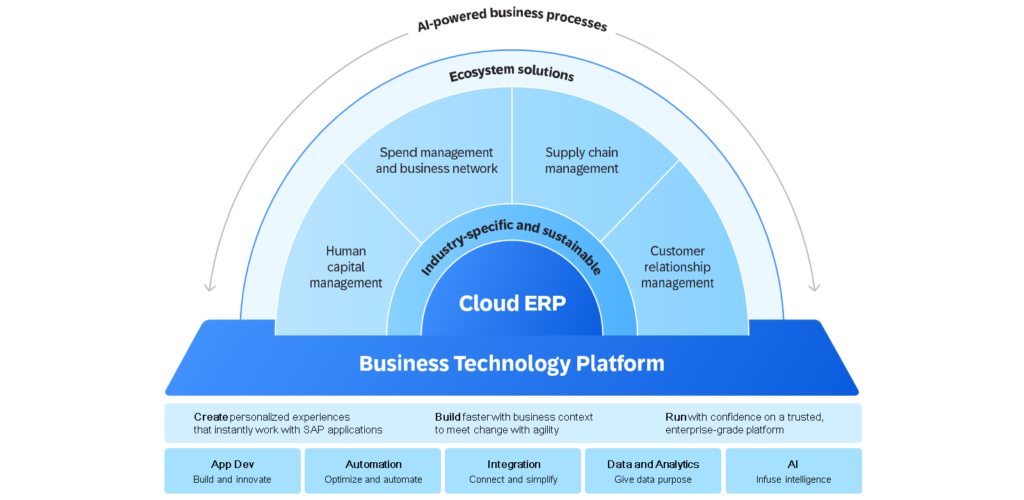
In the dynamic world of enterprise IT, SAP Business Process Technology (BTP) plays a key role and serves as a central building block for digital transformation. It forms the backbone of SAP’s Intelligent Enterprise Framework, which aims to support the efficient use of SAP systems while simultaneously developing innovative solutions to meet constantly changing requirements. BTP is divided into five essential segments. These are seamlessly interconnected and offer a wide range of functionalities.
BTP facilitates the transition between cloud and on-premises environments, enabling flexibility and innovation. It provides powerful tools for data-driven decision-making and real-time analytics to make informed choices and gain a competitive edge.
Another crucial aspect is BTP’s integration capability, which allows us to connect SAP systems with non-SAP systems and cloud services. This seamless integration of application development, automation, integration, data and analytics, and artificial intelligence enables us to optimize business processes and adapt to constantly changing market conditions.
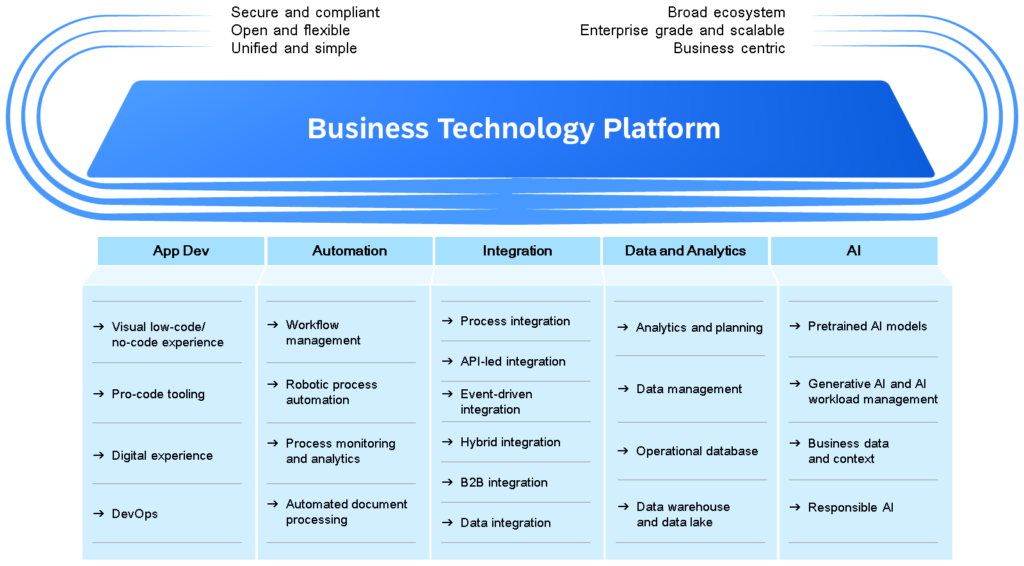
The five pillars of the SAP Business Technology Platform
The SAP Business Technology Platform is based on five essential pillars that support us at adesso orange in driving digital transformations in the SAP environment and developing innovative solutions.
App development
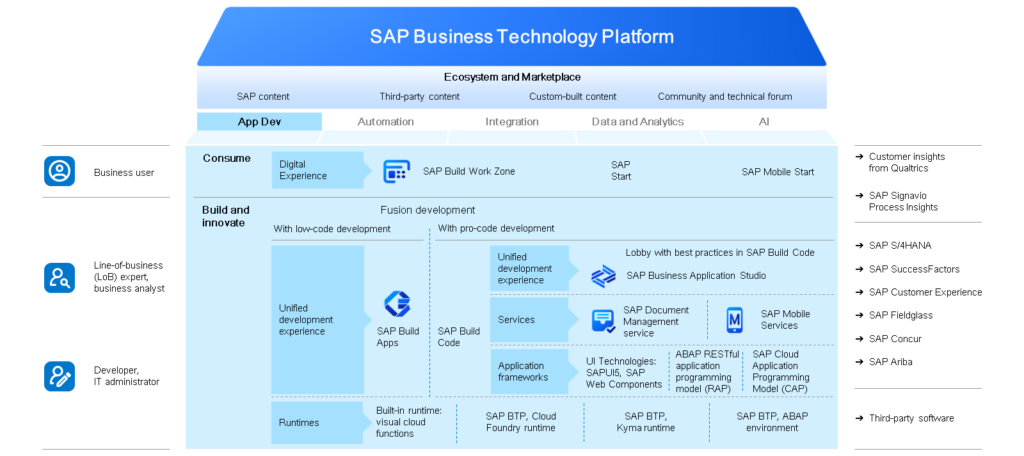
App development within the BTP offers a comprehensive toolkit for developers to efficiently design and extend applications. A key element is SAP Business Application Studio, an integrated and centralized development environment that enables developers to quickly and easily create and customize applications. Furthermore, the BTP offers support for low-code/no-code development, allowing business users to create applications without extensive coding knowledge.
Services
An example of a service in the field of app development would be SAP Work Zone, which is a comprehensive solution for efficiently designing and managing digital workplaces.
Automation
BTP’s automation capabilities help companies automate recurring tasks and optimize business processes. This includes automating manual tasks, creating workflows, and implementing business rules for process optimization.
Services
In the field of automation services, SAP Intelligent Robotic Process Automation is an outstanding example, as it automates repetitive business processes and thus increases efficiency.
Integration
SAP BTP’s integration capabilities enable companies to seamlessly connect various IT systems and processes. This includes the integration of SAP and non-SAP solutions, as well as connections to external systems and cloud services. The platform offers a range of tools and services for API management, business process integration, and interface development. One example is ELSTER integration, which enables the electronic transmission of tax data directly from SAP Business One.
Services
For integration services, the platform offers SAP Cloud Integration, which enables simple and scalable integration of cloud and on-premise applications.
Data and Analytics
BTP’s data and analytics capabilities enable companies to manage and analyze their data and gain insights from it. This includes database management, dashboard and report creation, and the implementation of advanced analytical methods such as machine learning and artificial intelligence.
Services
When it comes to data and analytics, SAP HANA Cloud offers a powerful database platform for processing large amounts of data in real time.
Artificial Intelligence
The artificial intelligence capabilities within BTP allow us to integrate further intelligent technologies into applications and processes. This includes the implementation of AI algorithms for automated decision-making, the creation of chatbots and virtual assistants, and the integration of image and speech recognition functions.
Services
For example, in the area of AI services, SAP AI Business Services offers pre-built AI models for various use cases.
Runtime environments and development methods
BTP supports various runtime environments and development methodologies to meet the needs of developers and facilitate application development. Two important concepts in this context are RAP (RESTful Application Programming Model) and CAP (Cloud Application Programming Model).
RAP & CAP
Two important approaches for developing applications in the cloud are RAP and CAP. RAP, or RESTful Application Programming Model, enables our developers to quickly create applications using pre-built components and prototypes. This reduces development time and costs. Furthermore, RAP can be used not only to implement cloud applications on the BTP (Building Technology Platform) but also within an S/4HANA system. It is used both in the cloud in the ABAP Runtime on the BTP and in the on-premise S/4HANA stack.
CAP, or Cloud Application Programming Model, offers a structured methodology for developing cloud applications. Based on best practices and standards, it enables developers to quickly and efficiently build, extend, and deploy applications. By supporting various programming languages and technologies, CAP gives developers the flexibility to choose the tools best suited to their specific needs. Unlike RAP, however, CAP cannot be used on-premises and is intended exclusively for cloud development.
Governance and Accountability: The Role of SAP BTP Strategy & Roadmap
Governance and accountability in the use of SAP BTP are crucial for the success of a company’s digital transformation. A well-designed BTP strategy and roadmap enables companies to use the platform efficiently and achieve their business objectives.
Why do companies need an SAP BTP strategy?
In today’s digital world, companies face challenges such as digitalization efforts, technological changes, and market influences. A proactive (strategic) approach, rather than a reactive one, is therefore essential. An SAP BTP strategy helps to fully leverage the platform’s potential and drive digital transformation sustainably and effectively. The main reasons for a BTP strategy are:
- Strategic and value-added-focused selection of functions and applications: This ensures that business requirements are optimally met.
- Developing innovative and investment-safe solutions: A clear BTP strategy supports companies in creating new solutions.
- Regulatory, secure and resilient BTP services: Through strategic planning and development, BTP services become more secure and resilient.
- Proactive and agile development of BTP solutions: Clear, business-focused strategic guidelines and principles enable agile development.
The building blocks of a BTP strategy and roadmap
Developing a BTP strategy includes several key components:
- Corporate strategic use of BTP services: The BTP strategy should be aligned with the overall corporate goals.
- Cloud migration: For companies whose IT architecture no longer aligns with SAP product strategies, migrating to the cloud is an essential step.
- Holistic strategy: This should include topics such as change management, practices & value streams, as well as contracts & licenses.
- Validating and evaluating services: Companies that already use BTP services should validate and evaluate them strategically or in terms of content.
BTP Strategy Models
Depending on the maturity level of the cloud transformation, different BTP strategy models can be applied:
- BTP Strategy Basic: For companies at the beginning of their BTP transformation. This involves developing a comprehensive strategy to kick-start the transformation.
- BTP Strategy Advanced: For companies that already use some cloud services and want to continue their transformation strategically and sustainably. This includes additional workshops on change management, practices & value streams, and finance & contracts.
- BTP Technical Advisory: For companies that have an existing BTP strategy and require individual support for the technical validation and classification of the services.
The Importance of Governance
An effective governance structure includes policies, processes, and procedures for ensuring compliance with company goals and policies. It ensures that the platform is properly operated and maintained. A dedicated team must have clearly defined areas of responsibility to guarantee the continuous optimization and scaling of the BTP.
Conclusion
A well-thought-out SAP BTP strategy and governance structure are crucial to fully leveraging the platform’s benefits. This strategy enables companies to proactively adapt to constantly changing market conditions and achieve their digital goals. Support from experienced partners like adesso is essential for developing industry-specific and customized solutions.
Cloud awareness for BTP’s success
A deep understanding of the cloud is crucial to unlocking the full potential of the SAP Business Technology Platform, as it is a public cloud PaaS service offering. This means that the BTP is hosted on cloud infrastructures, and therefore a certain level of expertise in cloud technologies and practices is necessary to use it effectively.
Using the public cloud offers numerous advantages, including scalability, flexibility, cost efficiency, and faster deployment of resources and services. Companies that adopt BTP (Business Process Technology) benefit from these advantages by reducing their infrastructure costs, improving operational flexibility, and accelerating innovation.
Furthermore, BTP’s cloud-based nature enables seamless integration and collaboration with other cloud services and platforms. This opens up the possibility of optimizing business processes and developing innovative solutions that extend beyond the boundaries of BTP.
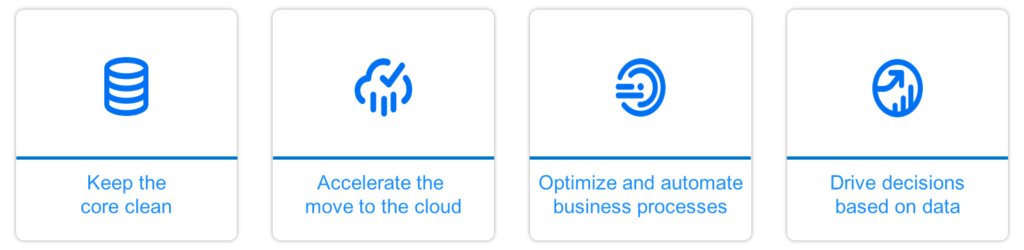
Another important aspect is the clean-core approach, which ensures that the solutions provided by BTP are more maintainable. This approach allows companies to focus on their business-critical processes while the underlying infrastructure is managed by SAP. By outsourcing maintenance and operations tasks to SAP, companies can use their resources more efficiently and optimize their business processes.
Conclusion – An enabler, but not a panacea.
It is important to emphasize that while SAP BTP, with all its functions and benefits, is a powerful tool for businesses, it should not be considered a panacea. Rather, BTP supports companies in achieving their digital goals and transforming business processes. It offers tools and services for development, integration, automation, and analysis.
Successful use of BTP requires a clear strategy, well-informed decisions, and continuous adaptation to changing requirements. Furthermore, success also depends on other factors such as leadership, governance, training, and collaboration. BTP is undoubtedly a significant enabler, but not a standalone solution. Integration into a holistic transformation approach can be crucial for long-term success.
Overall, the SAP Business Technology Platform offers the opportunity to modernize IT infrastructures, drive innovation, and streamline business processes. It provides a unified platform for the seamless integration of cloud and on-premise solutions. It improves data management, supports continuous application development, and facilitates integration into heterogeneous IT landscapes. Furthermore, it forms a foundation for intelligent technologies such as IoT and artificial intelligence. This equips us with the tools to thrive in a fast-paced SAP environment.
In another blog post, Christian Engel, who is responsible for BTP-related topics at adesso orange AG, also deals with the SAP Business Technology Platform.