Why is SAP BTP the key to a future-proof IT landscape?
The Business Technology Platform (BTP) isn’t as new as many people think. As is typical in times of digitalization, the platform has evolved and undergone several name changes along the way: SAP Cloud Platform, HANA Cloud Platform, and now Business Technology Platform. We’ve found that the BTP remains a mystery to many. Therefore, we want to clarify things and highlight the opportunities and possibilities that the BTP offers businesses.
4. What expansion possibilities does BTP offer?
5. What might a technical enablement look like?
1. What is BTP?
In the classic sense, Business Process Technology (BTP) is a platform-as-a-service solution that, if one were to build a layered model, would be based on the well-known hyperscalers AWS, Azure, Google, and now also Alibaba. Simply purchasing or using BTP does not create any added value for the company. It merely provides the company with a large toolbox that it then needs to utilize.
2. What is in the toolbox?
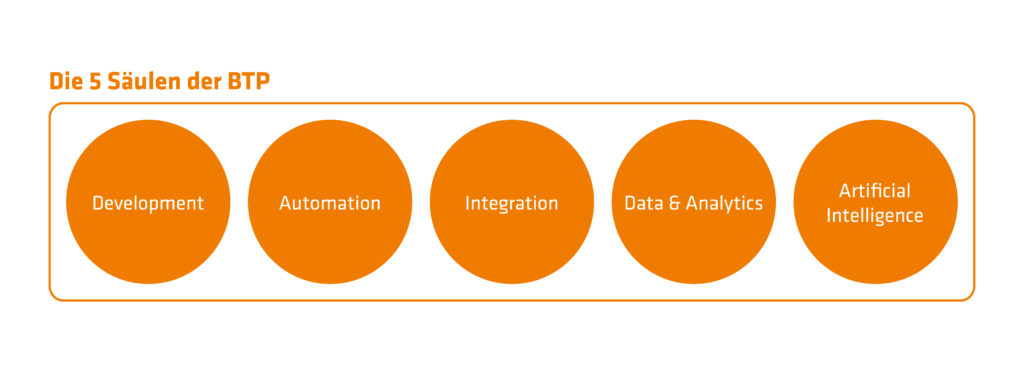
The 5 pillars of BTP, which contain different SAP services that can be used and, above all, combined, are:
Development
From no-code and low-code to pro-code, various frameworks and technologies are possible, including JavaScript, Java, and ABAP. ABAP remains relevant for building applications and extensions in the S/4HANA context.
Automation
Process automation involves recording workflows and outsourcing them to bots to automate tasks. OCR approaches are used to automate document input and processing.
Integration
Increasingly large and complex heterogeneous system landscapes and business processes no longer run in a monolithic environment but are mapped across system boundaries. This necessitates increasingly complex integration scenarios. To implement these, middleware is required, which is covered by BTP’s Integration Suite component. API management and other complementary functions complete the integration.
Data & Analytics
It includes the classic functions from the BI world. Topics such as SAP Analytics Cloud, Data Warehouse Cloud, and Data Intelligence belong to this pillar. One of the newest topics in this area is data spaces, which is addressed by SAP DataSphere.
Artificial Intelligence
Tools and services from the fields of machine learning and artificial intelligence are part of this pillar. For example, in the future there will be services for integrations with ChatGPT or for mapping chatbots.
3. What are the advantages of BTP and how can they be used within the context of an S/4HANA transformation?
Integrated solutions:
SAP BTP combines a wide range of cloud services and platform capabilities into a unified environment. Businesses can access these integrated solutions to meet diverse business needs, including data management, analytics, integration, extension, security, and more.
Scalability and flexibility:
BTP enables companies to flexibly scale and adapt their systems. They can add new features and services or increase or decrease existing resources as needed. This allows companies to respond quickly to changing business requirements and optimize the scalability of their IT infrastructure.
Efficient data management:
SAP BTP enables companies to collect, integrate, and manage data from various sources. The platform offers powerful tools and services for data modeling, integration, and cleansing to create a consistent and reliable data foundation. This facilitates better decision-making and optimized business processes.
Ecosystem and marketplace:
SAP BTP is part of a large ecosystem of SAP partners and developers. Companies can benefit from pre-built applications, extensions, and integrations available on the SAP Marketplace. This allows them to quickly extend their IT solutions and benefit from the best practices of other companies.
Important: Most innovations and new services will only be available on this platform. To continue benefiting from and utilizing these SAP and partner innovations, familiarity with the BTP is mandatory. This final advantage also bridges the gap to your ongoing and upcoming S/4HANA transformation projects.
Adaptability and expandability:
Companies can use SAP BTP to adapt and extend their existing SAP systems. The platform offers tools and technologies for developing customized applications, integrating third-party solutions, and extending existing SAP software. This allows companies to tailor their IT landscape to their specific requirements and develop innovative solutions.
Existing ERP landscapes contain a number of custom developments and Z-solutions, developed for a variety of reasons. These are usually integrated directly into the ERP system as reports or through previously known extension options like BADI. This results in significant testing effort for customizations and considerable adjustments required for release updates. BTP offers alternative extensibility options.
4. What expansion possibilities does BTP offer?
The focus here should be on so-called side-by-side extensions with the goal of a clean core. Therefore, within the context of an S/4HANA transformation, it is crucial to consider the strategic direction and use of BTP (Business Process Technology) as early as possible, ideally during the discovery phase. This presents an opportunity to transform custom developments, which are necessary in S/4HANA for various reasons, onto a new and future-proof foundation and, in doing so, generate added value by utilizing new frameworks such as SAPUI5.
Added value is a good keyword. Because that is by far the most important point. All the points mentioned above are the pillars and tools available to us at BTP. These must be used to create added value within a company.
Simply using individual tools doesn’t create added value; it’s the combination of these pillars that makes the difference, enabling end-to-end scenarios. For example, collecting and refining data with data and analytics tools, followed by deriving automated actions through process automation and direct integration into my S/4HANA system. A purely technical approach won’t get you anywhere.
Case studies from the various departments must be identified and addressed using the tools available at the Business Process Technology (BTP) to develop solutions. It’s essential to broaden our horizons, as the toolbox is significantly larger and more flexible than before. Therefore, there are still plenty of pain points in the departments that we can resolve with a BTP. To make this happen, the company needs to be empowered to adopt the BTP approach.
“Technical enablement is necessary in IT so that the toolbox is understood and mastered.”
5. What might a technical enablement look like?
Business enablement by creating an understanding of the opportunities offered by a BTP and then discussing business needs (sustainability, data rooms, automation, etc.) independently of the technology.
What might this approach look like in practice?
A technology-agnostic approach to identifying the customer’s problems. We work with a format called the Interaction Room.
Design – What does the user really need?
Human-centered design isn’t just a buzzword for us. Our UX design projects begin with the question: What does the user truly need? We employ design thinking, design scoping, and UX research to answer this question. Here, we also draw on our experience from numerous successful client projects. Our goal is to quickly develop testable prototypes of the truly essential solutions—before investing in a single line of code.
Engineering – We don’t build castles in the air.
Before the prototypes are implemented based on the design, a feasibility check is conducted. How can the solution be implemented? We look for the optimal path for the customer. To this end, our experienced SAP Solution Architects take a close look at the customer’s IT landscape, recommend existing components, and provide the right impetus to further improve the solution. With the right plan in place, we then move into the implementation phase.
Production – This is where solutions are created
Once the SAP Solution Architects give the go-ahead, the project enters development. From backend and frontend to workflows and AI – we bring together precisely the right experts in an optimized project setup, depending on the type of solution. This allows us to tackle challenges quickly and agilely with our interdisciplinary team. The finished solution is then thoroughly tested and also reviewed by end users.
Parts – Waste nothing, reuse
From design and engineering to production, we don’t have to reinvent the wheel. As part of the powerful SAP ecosystem, we can access many proven components, tools, and best practices. We also reuse deliverables from our previous projects to arrive at the right solution faster.
Shipment – The solution is on its way
We hand over the finished solution to the customer and deploy it in the live system. But our job doesn’t end there. We help our customers take the first steps with the new solution. Especially in the initial days, being readily available, having an optimally structured change management process, and intensive user training ensure high acceptance of the solution among end users. And of course, we also ensure that the solution can be operated successfully.
Monitoring – Everything in view
The Innovation Factory is not a black box, but a transparent factory. This gives you not only a constant overview of your projects and programs, but also the ability to make adjustments directly during the ongoing process.
You can access the expertise of our specialists at any time, regardless of the topic. Together, we’ll always be heading in the right direction.