In a rapidly changing business world, corporate digitalization, such as the implementation of SAP S/4HANA software, is an ambitious goal. The change process that accompanies an SAP S/4HANA implementation can be very challenging. One challenge lies in one of the most important—if not the most important—links in an organization: its people. In this blog post, we delve deeper into the essence of Organizational Change Management (OCM) in SAP S/4HANA implementations and share practical strategies for successful change. Our focus is primarily on the “how” of change—how we prepare, guide, and support people through organizational transformation.
The Importance of Organizational Change Management
Especially when companies opt for a so-called greenfield approach, massive changes occur within the organization. SAP uses the term greenfield approach when a company does not currently use an SAP ERP system. This differs from the so-called brownfield approach, which usually involves migrating from an older SAP version to the SAP S/4HANA solution.
All too often, the numerous challenges involved in an SAP S/4HANA project are completely underestimated – as evidenced by many statements and reports from companies when asked about the biggest stumbling blocks in their projects. The consequences of this underestimation can be significant:
- It is not uncommon for project budgets to be exceeded.
- Employees are dissatisfied and demotivated.
- The day-to-day operations are not running smoothly after the go-live.
At best, an intensive hypercare phase can get the business back on track, but the negative employee morale and damage to the company culture remain. Organizational Change Management in SAP S/4HANA implementations is about understanding and managing the human aspects of change.
This involves not only the technical aspects of software implementation, but also supporting people in adapting to new systems, processes, and ways of working. This is crucial in a cloud system where a “fit-to-standard” mindset prevails, moving away from customized systems and towards predefined ones.
How do you Communicate the Introduction or Switch to SAP S/4HANA?
Open and frequent communication lays the foundation for positive changes within the SAP S/4HANA implementation. It’s crucial to inform employees about the reasons for the change, its associated benefits, and its impact on their daily work. Why the change? What value does the change offer each individual? How long will it take? These are just a few examples of questions that need to be answered. This not only creates clarity but can also reduce uncertainty and resistance to change.
How can managers be best involved in the implementation process?
Leaders should not only emphasize the importance and purpose of the change, but also lead by example. If leaders are enthusiastic about SAP S/4HANA, their employees are more likely to follow suit. A change management workshop aimed at (senior) managers offers a perfect opportunity for this and exemplifies how we can make leadership a part of this organizational transformation.
How can engagement with SAP S/4HANA be increased?
Involve your employees in the project from the very beginning. They will gain valuable insights and can help shape the new SAP S/4HANA system. This increases their sense of belonging and reduces resistance.
How can you ensure that employees have the correct level of knowledge?
Functional training is enough, right? No. Comprehensive training to ensure employees are familiar with SAP S/4HANA is essential. However, in addition to the functionality, the employees involved also need to understand the associated (new) processes. It is very helpful to define what employees “need to know” (regarding integrations or related information) and what they “need to be able to do” (functionally within the system).
In this way, we can have an impact on the employees involved and recognize the benefits. Above all, it is important to give them time to familiarize themselves with the new system and practice using it, in order to avoid workarounds and excessive time expenditure.
How can Change be jointly advanced in the Implementation Project?
So-called “change agents” are effective (project) team members responsible for various aspects of change, such as communication, training, and problem-solving. This shared responsibility increases efficiency. Furthermore, these individuals monitor the change process across all aspects of the project and provide regular feedback to the central change management team. The reluctance to voice frustration and problems is significantly reduced when colleagues can confide in the change agents, who are also colleagues.
Implementation Strategies for SAP S/4HANA
Clear Goals
Clearly define what you want to achieve with your SAP S/4HANA implementation and the underlying intentions, and communicate these points regularly throughout the organization. This helps create a shared understanding of the change and fosters transparency. Don’t forget to emphasize the human aspect, such as the added value for employees. After all, this is a holistic business project, not just a traditional IT project.
Step-by-Step Implementation
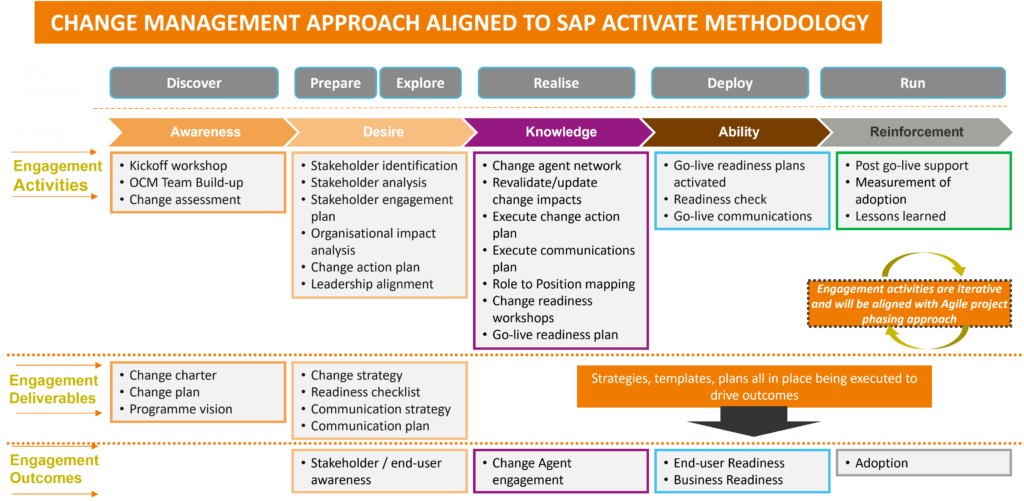
Step-by-step implementation: If possible, introduce SAP S/4HANA gradually to avoid overwhelming your team. SAP has adapted its Activate methodology to the change management approach. adesso orange has consolidated this approach into its own methodology, adesso active Transformation.
Feedback and Adaption
Be open to employee feedback and incorporate it (whenever possible) into decisions regarding SAP S/4HANA and your change management tools. This demonstrates that their contribution is valued and can increase acceptance of the change.
Measurable Results
Definieren Sie messbare KPIs, um den Erfolg der Veränderung zu bewerten. Dies gibt Aufschluss darüber, welche Bereiche gut funktionieren und wo Anpassungen erforderlich sind. Beispiele sind Statistiken über die Systemnutzung und die Überwachung der Anzahl von Zwischenfällen oder Widerständen seitens der Organisation.
Post-Implementation Support
Provide ongoing support for the use of SAP S/4HANA. For example, answer questions and resolve problems even after implementation. This helps to strengthen trust in the new system.
Conclusion
Change is a journey and deserves attention and commitment during digital transformation. Organizational change management is an essential component of successful digital transformation projects. It ensures that companies not only introduce new technologies but also adapt their processes and bring their employees along on the journey.
One thing is certain: the earlier companies address Organizational Change Management (OCM), and the sooner and more effectively project team members and the organization are prepared for the project, the smoother the onboarding process and collaboration will be. Professional OCM is therefore crucial to ensuring a seamless S/4HANA implementation and positively driving digital transformation. Companies that understand the importance of Organizational Change Management and have embraced this new reality gain a competitive edge, improved employee satisfaction, and enhanced communication. They benefit from greater agility in responding to market fluctuations, faster time-to-market for new products and services, lower costs, and increased productivity.
When planning an SAP S/4HANA implementation, it is crucial to utilize SAP-specific change management tools and resources. We are pleased to support you with our expertise in SAP project management and organizational change management in your transformation projects. We are, of course, happy to answer any questions you may have about SAP change management and the associated tools and templates.