The standard S/4 brownfield approach involves technically converting the current SAP ECC 6.0 system to the new S/4HANA software, either as a whole or in two steps. This means that data, custom developments, and customizing are retained. At the same time, the mandatory changes are implemented in the system.
Targeted implementation of S/4HANA in SMEs
The S/4 transition must be completed by the end of 2027 (2030 under Extended Support). However, it’s not just this time pressure that’s causing concern for existing SAP customers. What we at adesso orange repeatedly observe in customer discussions and in our day-to-day project work is that knowledge gaps exist, particularly due to operational demands. Simply put, there isn’t enough time in daily business to delve deeply into S/4HANA and all its implementation approaches. This leads to uncertainty about how to approach the topic.
Two pivotal questions
As a result, companies often conduct extensive and costly strategy and analysis workshops, only to conclude that the brownfield approach seems to be the right one. However, it’s quite simple to make a decisive decision about the approach by asking two key questions.
Question 1: Are the SAP users in the company satisfied with the business processes currently supported by SAP solutions and do they want to continue with the current process logic with S/4HANA?
Question 2: Is the IT department able to implement the maintenance of the current SAP solution satisfactorily and cost-effectively, and does it have little technical or data-related overhead?
If he answers both questions with “yes,” the existing SAP customer is highly likely a brownfield customer! Of course, there are companies with complex IT system landscapes that need to approach the topic strategically and with the support of analysis. However, if a system landscape consists of an SAP ERP, perhaps one or two other SAP product solutions, and some connected third-party solutions or warehouse technology, this isn’t overly complicated from the perspective of an S/4 transition approach. Accordingly, lengthy and expensive strategy and analysis workshops aren’t necessary before a reliable indication of time and cost is available.
Go-live in just a few days?
Typically, a one-step conversion is planned for three to four days before going live. But what happens when unforeseen situations arise and the conversion, and therefore the entire project, goes off track?
Testing beforehand seems to be the solution. However, a conversion already requires S/4 knowledge, basic S/4 licenses (flat fee), and possibly, depending on the situation, an available NetWeaver 7.5x installation as well as S/4HANA-compatible hardware. So, quite a bit of equipment and investment is needed just to be able to start testing.
The solution: our Active Transformation
At adesso orange AG, we have developed an S/4 methodology using our proprietary Active Transformation approach to circumvent this dilemma. The idea behind this approach is that existing SAP customers convert their ERP system to S/4 in a test run. The Software Update Manager (SUM) logs all problems that arise during the conversion. These are then resolved and documented as tasks for the actual migration project. The following figure shows the SUM results after such a test run from a real-world project.
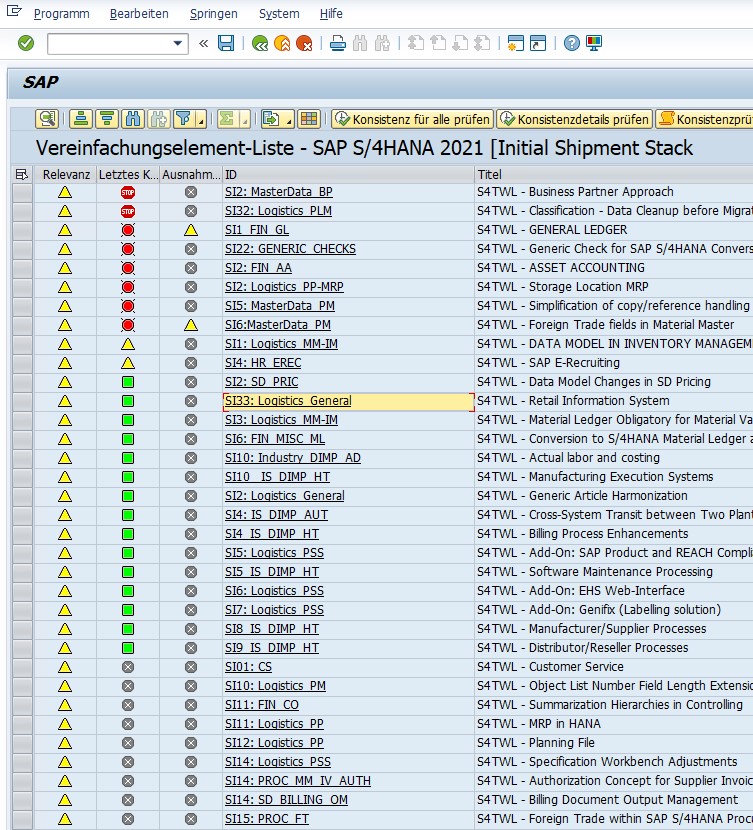
After the test conversion, SAP users have access to an S/4 system with their processes, data, and customer developments, in which approximately 60 to 70% of the processes can run and be tested. Testing the functionality of customer developments is also possible. Based on the findings, a project plan with budget planning for the actual S/4 migration is then created. As SAP system specialists, we also provide the necessary S/4HANA infrastructure and licenses if required.
New features and processes in S/4
When migrating to S/4HANA, a number of new functions and processes become available. These are primarily the new processes and functions in internal and external accounting that represent the most significant changes for SAP users. In logistics, the changes are generally minor. Nearly all logistics processes run in S/4HANA, and some continue in a compatibility mode. It is not mandatory, for example, to migrate the WM module to eWM or the Logistics Execution Transport (LETRA) module to SAP TM.
This gives companies the option of implementing the new processes at a later date, after the S/4 migration, at their own pace until the end of 2027, if necessary. This allows the project scope and budget for the actual S/4 transformation to be reduced to the essentials and also significantly shortens the project duration.
Of course, it’s possible to implement one or two new processes during a brownfield migration if needed. However, it’s advisable not to let this get out of hand. Generally, it’s more efficient to first familiarize yourself with the S/4HANA technical aspects and then innovate at your own pace. Before you start the actual migration project, there are a few important preparatory steps to take in SAP ERP.
Preparatory measures in SAP ERP
A decision needs to be made as to whether the “New General Ledger,” already available in ECC 6.0, offers any benefit. If there is a benefit, the conversion should be implemented in ECC to allow SAP users in the business departments to familiarize themselves with this process change. If there is no benefit, it should be combined with the S/4 migration, as the conversion can then be carried out without process changes and therefore without extensive planning.
As an SAP customer, you need to switch to the new business partner structure in SAP ERP. This isn’t rocket science and is very well supported by standard SAP tools. All that remains is the cleansing of the master data. adesso orange also offers a detailed procedure for this and a tool to support you with CVI Q-Check.
It is important to make internal and external accounting departments aware of the changes in S/4HANA. A FICO awareness workshop is recommended. This often transforms a technically driven project into a business-driven one, and users are prepared for the process changes. Additional topics in the logistics area may also arise, depending on which SAP business processes the company uses.
Depending on the initial situation, it makes sense to thoroughly clean up the ECC system before migrating to S/4HANA. This can include customer developments that are no longer needed, as well as historical data that unnecessarily bloats the ERP system and shouldn’t be carried over to S/4. It’s an opportunity for a thorough cleanup, but not mandatory.
Our recommendation for medium-sized businesses is to take a hands-on approach to the S/4 migration with appropriate support, rather than conducting extensive preliminary analyses and strategy workshops. Pragmatism and the sensible use of the tools and testing routines provided by SAP are sufficient.
Of course, the S/4 approach for SMEs can be individually expanded according to customer requirements using the adesso-orange modular system. This allows customers to decide early on which innovations they want to use with S/4 or introduce at a later date, as illustrated in the following figure.
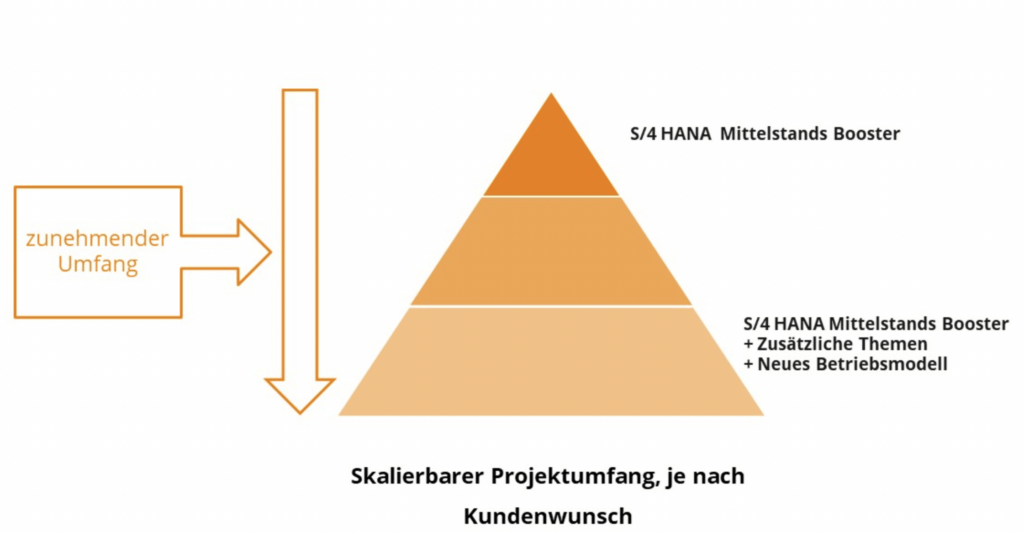
Procedural model of the S/4 SME approach
The process model for our S/4 SME approach booster shows that after the test conversion, which takes place in the Enterprise Discovery phase, the S/4 brownfield transformation can be started directly.
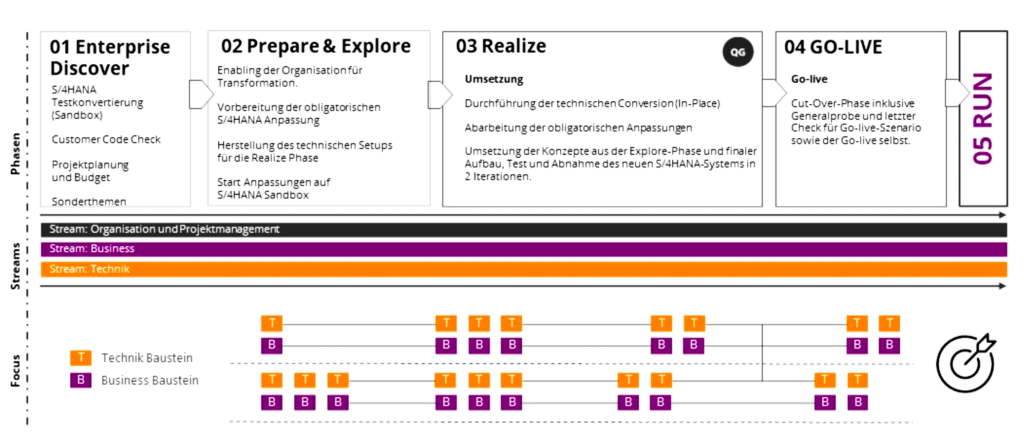
Phase Enterprise-discover
It is also possible to conduct the Enterprise Discovery phase prior to the transformation project. This phase, in addition to addressing other customer-specific questions, provides clear information about the approach to the S/4 transformation (roadmap), process changes in the IT department and business units (S/4 impact), the handling of in-house developments and interfaces as well as other SAP or third-party applications, the project plan for the transformation with work packages, budget, timeline, organization, roles and resource allocation, the benefits of the S/4 transformation, possible IT operating models, and maximum certainty for planning your S/4HANA transformation project.
During the Enterprise Discover project phase, the necessary tasks are completed. This phase is supported by adesso Transformation Accelerators developed in previous projects. This allows for a timely start to the Prepare project phase in many cases. This phase benefits from the fact that a test conversion has already taken place, eliminating the need for an entire test run in the implementation phase.
Advantages of the S/4 SME Booster
- No lengthy operational investigations or costs for analysis workshops.
- No effort is required to make the S/4 readiness check functional (often extensive instructions need to be entered for it to run).
- No necessary investments in hardware or licenses in advance of the S/4 migration project.
- Minimal strain on the customer’s IT or specialist departments during the S/4 test conversion.
- Clear and reliable budget and time planning for the S/4 migration project.
- The ERP system, including all processes, data, and customer developments, is available in S/4.
- Detailed documentation of all steps, activities and their results during the S/4 test conversion.
- The test-converted system can also be used to implement more complex project components (e.g., complex in-house developments or modification/adaptation of forms) in advance of the S/4 brownfield transformation project, leading to further streamlining of the project.
- Creating a foundation to calmly develop further S/4 innovations after the transition.
- Minimal organizational change ensures that the new system can efficiently support your business processes immediately after go-live.
- High flexibility in the project, as the test-converted system can also be retained as a sandbox if desired.
- And thus minimized risk.
In a separate blog post, my colleague Stephan Thies, who heads the Line of Business Manufacturing at adesso orange, also dealt with the system conversion paths Greenfield and Brownfield.
Now you can migrate to S/4HANA with the advantages of adesso Active Transformation. adesso orange AG, or I personally, look forward to hearing from you.