SAP customers in the public sector face the challenge of migrating to SAP S/4HANA, which also entails changes to “Public Sector Management (PSM)”. This is SAP’s core solution for public administration processes. It can be flexibly integrated with other SAP solutions and third-party systems.
The PSM can be further subdivided as follows:
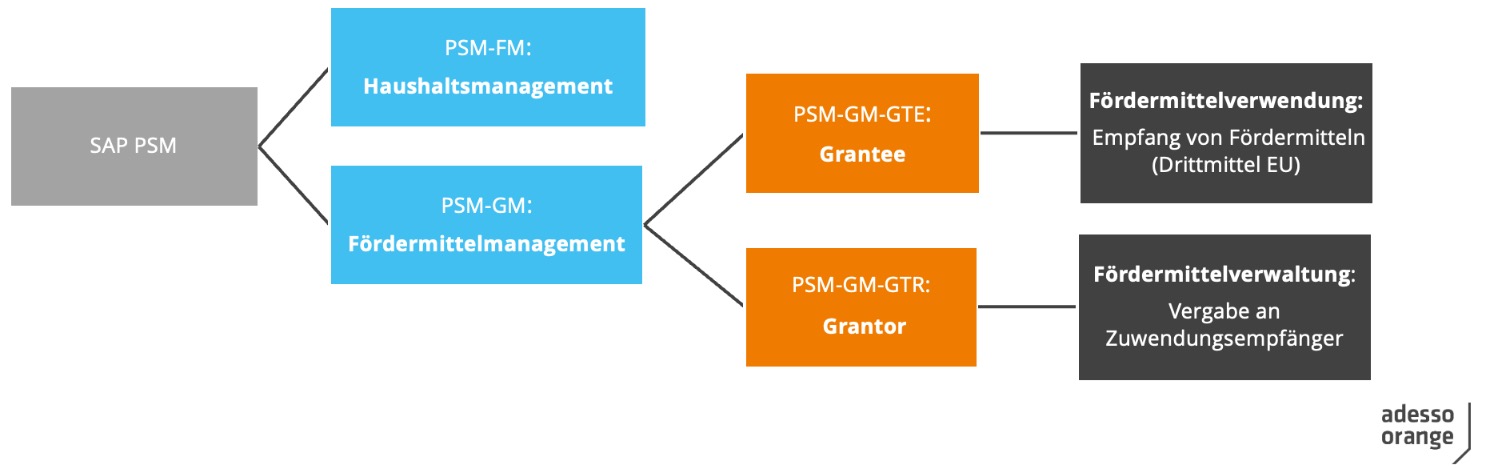
The following information relates exclusively to the migration to SAP S/4HANA in grant management (Grantor). It provides an overview of the most important changes. Further information is available via the links provided in the relevant sections. An SAP account (S-User) is required to access some of the links below. SAP is responsible for the accuracy of the information on its websites. This blog post does not speak on behalf of SAP and makes no claim to completeness or accuracy. Further notes or updates may be available and must be considered individually in the context of the relevant system scenario.
January 2023: Funding allocation is now available in SAP S/4HANA
In October 2022, SAP released SAP S/4HANA 2022 (major release). SAP Grantor Management is part of this release. In January 2023, it was announced that there are now three possible deployment scenarios for Grantor within SAP S/4HANA. In future, Grantor can be used entirely within SAP S/4HANA without CRM.
The familiar features from the previous SAP Grantor Management system, which is based on CRM, remain relevant. One exception is Web Request, which is not available in the new S/4HANA Grantor Management solution.
The key features of the new S/4HANA Grantor On-Premise solution
Key features:
- Funding schemes
- Funding application
- Approval for integration with AP/AR and PSCD
- Integration with Financial Management
- Budget Management System
- Budget commitments for earmarked funds
Three deployment scenarios:
- Side-by-side: The CRM system is connected to an S/4HANA system via CRM middleware (all releases). The S/4HANA system is used solely as an ECC system.
- NEW – S/4 only: The end-to-end grantor management processes – from funding programmes, grant applications and submissions through to invoicing and payment – are all handled within a single S/4HANA system.
- NEW – Hybrid scenario: a combination of side-by-side and S/4 only.
A separate CRM system is used for some funding programmes and the associated applications and approvals, whilst the S/4HANA system is used for other funding programmes. Budget reservations and FI processes all run in the same S/4HANA system, regardless of which system the funding programmes, applications or approvals are in.
New features:
Enable the contract account, also known as a business agreement in CRM, in the user interface for the approval header and approval items.
Navigation within the billing document: It is possible to navigate to PSCD and FI billing documents from the transaction history.
Archiving:
Invoice documents and settlement documents can only be archived if the corresponding authorisation has been archived. If an FI-AP/AR document or PSCD document has been archived, an error message is displayed on the user interface for the corresponding authorisation. It is no longer possible to edit the authorisation or the funds call. The only option is to set the status to ‘completed’ or ‘archivable’.
The functions mentioned above are necessary because the invoice amounts for the grant are calculated on the basis of the associated AP&AR/PSCD documents. The invoice amounts would be incorrect if AP&AR/PSCD documents were archived before the grant was approved or the funds were drawn down. The same applies to settlement documents. Information Lifecycle Management (ILM) archiving rules for funding programmes are only applied to the top-level programme in a programme hierarchy; in other words, the retention period is calculated for the top-level programme.
Key improvements:
- CRM WebUI based on Fiori 3: Visual harmonisation (Belize theme), target mode for embedding CRM applications in the Launchpad
- Reduction in total cost of ownership: simplification of the IT landscape; savings on hardware costs, operating costs and time
- No more replication errors: No more waiting for replication errors when creating follow-on documents or during master data replication
- Simultaneous creation of follow-on documents: for example, funding programmes, funds reservation documents, invoice documents
- Abolition of master data replication (business partners, business agreements)
- Errors in follow-on documents are visible to the end user as UI error messages: it is no longer necessary to search through IDocs or queues to identify the source of the error.
- The processing of donor documents is no longer blocked: follow-on documents are not distributed but generated immediately.
- The end user can initiate the re-execution of follow-up processes: if an error occurs when creating a follow-up document (e.g. earmarked funds, settlement), the process can be initiated from the UI as soon as the ‘problem’ has been resolved.
- Invoices and settlement information are retrieved directly from FI: notifications via reports are no longer required to inform grantors of the creation of invoices or offsets.
What new features have been introduced since the initial release of SAP Grantor on S/4HANA?
Following the announcement in January 2023, in which the three possible deployment scenarios for Grantor under SAP S/4HANA were unveiled, a further announcement was made in October 2023.
Details of the latest updates released by SAP in October 2023 can be found in the follow-up article ‘Grant allocation with SAP Grantor in SAP S/4HANA – Part 2’.