The migration to S/4HANA is in full swing. The transformation – a project that can take several years, depending on the size of the company – raises a number of questions. Many SAP customers require professional project support for the planned implementation.
The challenges are not just technical in nature
SAP will discontinue support for its legacy system by 2027 at the latest (or by 2030 for an additional fee). Companies should therefore start thinking now about which system they wish to use in the future. Long-term strategic planning is essential for the transition.
In principle, any digital transformation – such as the current roll-out of SAP S/4HANA – must be preceded by careful consideration of the company’s future strategy. Before a transformation can take place, therefore, it is necessary to consider the desired operating model and process landscape. It is irrelevant whether the change is initiated by IT administrators or senior management.
Companies therefore face more than just technical challenges when migrating to S/4HANA. Transparency in the transformation process, the impact of the transformation and business requirements are also key pillars.
‘The key to a successful digital transformation is not technical feasibility – that is already well established. The critical success factors for the S/4HANA transformation are transparency in the transformation process, business requirements and the impact of the transformation.’
Key to success: transparency in the transformation process
Transparency throughout the transformation process is therefore key to a successful migration to SAP S/4HANA. This applies not only to staff training following the implementation of the new system. It is also important to conduct a critical review of the company’s current situation in the run-up to the migration. Only in this way can we ensure that the benefits of S/4HANA are reflected in increased productivity.
During the transformation process, staff should be involved so that the processes can be adapted to day-to-day requirements during the testing phases. After all, your staff will have to work with the new system, the new interface and the enhanced functions.
Establish communication between all key departments – always with the aim of fostering understanding, acceptance and support for the transformation. Even if a sub-process does not directly affect a particular department, it is important to keep them informed. This increases acceptance of the new workflow and structures within the company. The transformation can proceed more smoothly, and productivity can be boosted even during the transition.
Impact of the transformation
Why not focus more on the impact of the transformation than on the technical approach?
The new SAP S/4HANA system offers many advantages. The specific benefits may vary from one company to another. You should therefore ask yourself the following questions before embarking on this transformation journey with your company:
- Where does your company currently stand?
- Which processes are established?
- What systems are in place?
- What changes would a migration to SAP S/4HANA mean for your business, and how should these be handled?
Only by understanding your business requirements and the functional requirements of SAP S/4HANA can you determine a sound transformation path and turn it into an ideal business case in terms of cost and benefit. This may seem basic, but it’s crucial for you and your technical teams to understand the challenges you face today and how implementing SAP S/4HANA as your new digital core can solve these problems or add new functionality.
Business requirements
SAP S/4HANA includes several new functions and features that can bring business benefits to your company. Before deciding on a transformation path, you need to carefully examine these functions from both a technical and a business perspective.
Especially for companies already using SAP, thinking outside the box is often not easy. After all, it’s not just about a database upgrade. The transition to S/4HANA offers the opportunity to rethink old processes and establish new ones. Leverage the software’s standard features to move away from maintenance-intensive and expensive in-house developments or custom solutions and become a modern, digital enterprise.
What are the specific business requirements?
The main objective when migrating to SAP S/4HANA is to simplify and standardize processes and workflows – not only on a technical level, but also in day-to-day business operations. For companies, this means adapting current processes across all departments.
Migration thus goes hand in hand with the modernization and digitalization of company structures. This can offer great opportunities for increasing productivity, but requires professional change management. Companies should therefore ask themselves in advance what requirements they have for a new system:
- How can employees work more efficiently? What resources are available or needed?
- Who are the company’s customers? Should the focus be shifted to a specific customer group?
- What innovations are planned for the future? How can the company provide them?
- What key performance indicators and business data are needed to evaluate productivity?
- What functions are currently and will be needed in the future? How can the migration ensure that the system remains adaptable?
These questions can only be successfully answered in collaboration with employees and department heads. This means that key users must be involved in all phases of the transformation to identify process weaknesses and find alternatives.
Greenfield, SDT or Brownfield approach?
The technical transformation to SAP S/4HANA can happen in different ways. This depends primarily on your business plan. Will system configuration, data, and custom extensions be migrated? Or will a completely new system be populated with existing data?
Greenfield approach: the new installation
The greenfield approach aims to reimplement the SAP system without disrupting ongoing business processes. The current SAP system continues to run as usual during the migration. Simultaneously, the new S/4HANA system is installed, creating a completely new system from the ground up.
They begin with a “greenfield” implementation. All processes are rethought, evaluated, and implemented from scratch. This gives companies the opportunity to modernize established workflows and clean up existing data. The initial installation typically takes longer because the processes need to be redesigned and adapted to the business model.
Brownfield-approach: The update
The brownfield approach involves a system update in which the current SAP ERP system is gradually migrated to SAP S/4HANA. This requires creating an SAP S/4HANA roadmap that outlines the path to S/4 according to a defined procedure.
All processes within the SAP system are migrated using a brownfield approach. They are evaluated and, if necessary, optimized. This allows for the retention of proven processes while simultaneously benefiting from the new capabilities and technologies of S/4HANA.
This approach is particularly suitable if the SAP system has no legacy issues, or if it is too complex and requires minimal modifications beforehand. The process itself takes between seven and eleven months, as a copy is first created and tested in a development system before being migrated to the production system.
The selective data transition
Selective Data Transition (SDT) is the middle ground between Greenfield and Brownfield projects. At its core is the so-called shell conversion, which allows you to convert only the part of the existing system that you, as a company, want to keep, while also shedding legacy systems. As a company, you decide what you want to upgrade (greenfield-like) and what you want to retain (brownfield-like). SDT makes this possible – thus, this approach offers a third possible path to S/4HANA.
So, how do I begin? Successfully transform with adesso active transformation!
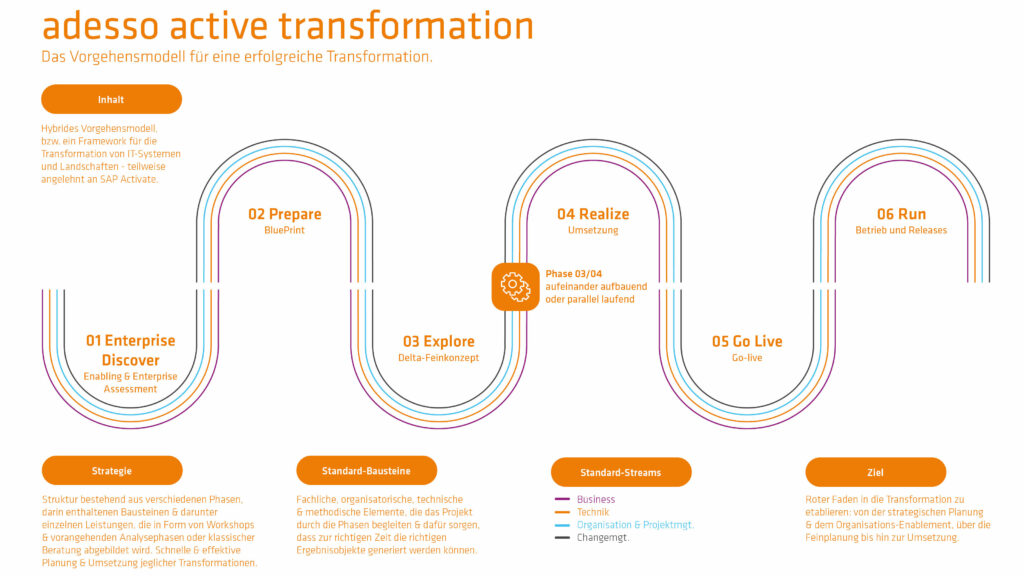
Depending on the situation, companies can safely transform using all of the aforementioned methods – but which is the right path for your migration to SAP S/4HANA? To specifically answer precisely this question, adesso has developed its in-house framework, adesso active transformation. It is approach-agnostic and pursues only one goal: to identify, plan, and implement the right transformation path for your specific needs.
Sprechen Sie uns an!