Advancing globalization and the associated structural change in the corporate world have led to mergers, acquisitions, and, in particular, the sale of business units—known as carve-outs—becoming a daily reality in strategic management. In a highly integrated IT landscape, often based on SAP systems, a carve-out represents one of the most complex technical and organizational challenges a company can face. SAP carve-outs are much more than simple data extractions: they involve the precise, surgical separation of business units that have been intertwined for years in terms of processes and data technology. The success of such a spin-off depends largely on how cleanly the IT structures can be separated without disrupting the ongoing operations of the remaining organization (seller). At the same time, the new entity (NewCo/buyer) must be fully operational from day one.
The basic direction of a carve-out project is defined by the underlying business transaction model. In practice, a distinction is primarily made between asset deals and share deals, with both scenarios placing fundamentally different demands on the IT architecture and the scope of migration.

The asset deal and its IT focus
In an asset deal, specific assets (economic goods) of a company are transferred individually to the buyer. From a legal perspective, this often means that the buyer is only responsible for future liabilities from the date of closing. In the SAP world, this means that the focus is primarily on the transfer of master data and open items that are essential for the continuation of operational business. Historical transaction data ( ) is often not migrated in this scenario, as legal responsibility for the past remains with the seller. This can reduce technical complexity, but requires a very clear definition of what is considered “operationally necessary.”
The share deal and the requirement for historical continuity
In contrast, a share deal involves the acquisition of shares in a legally existing entity (e.g., a limited liability company). Here, the buyer assumes the entire legal identity with all past, present, and future obligations. This has serious consequences for the SAP migration project: As a rule, the complete historical data history of the relevant company code must be migrated in order to comply with future audits, tax audits, and legal reporting requirements. In this context, data quality and the completeness of the history are of the highest priority, as any gap in the documentation represents a legal risk for the buyer.
| Criterion | Asset Deal | Share Deal |
| Legal focus | Transfer of individual assets | Transfer of shares |
| Scope of liability | Focus on future liabilities | Transfer of entire history |
| Scope of migration (SAP) | Master data & open items | Master data & complete history |
| Audit relevance | Low for historical data | High for the entire timeline |
The challenge of division: Selection at company code level
A common scenario in established corporate structures is that a business unit to be sold does not have its own company code in the SAP system, but is merely part of a larger company code. In this case, a separation must be made within the company code, which increases the complexity of the project exponentially. Lower-level organizational units are used as selection criteria, primarily profit centers or segments.
In SAP S/4HANA, profit centers are used to map the internal profitability of areas of responsibility. Since almost every operational document (e.g., in materials management, sales, or cost accounting) is directly or indirectly assigned to a profit center, they are ideal as an anchor point for data selection. Segments, on the other hand, are often derived from profit centers and enable reporting in accordance with international accounting standards such as IFRS or US GAAP.
This makes it possible not only to separate the balance sheet and income statement, but also to precisely identify all subordinate master data such as assets, cost centers, internal orders, etc.
Technical implications of “partial carve-outs”
When part of a company code is carved out, the integrated processes that previously ran within a legal entity must be transformed into intercompany relationships. This requires adjustments in customizing and master data maintenance, as the remaining entity of the seller and the new entity of the buyer must now act as external business partners. A particular problem here is the so-called document split. This must ensure that documents affecting multiple segments are split correctly to guarantee a balance-neutral balance sheet per segment.
Methodology of technical implementation: From clone and delete to selective migration
Various strategies are available for the technical implementation of a carve-out, the choice of which is heavily influenced by the parameters of time, budget, and data security.
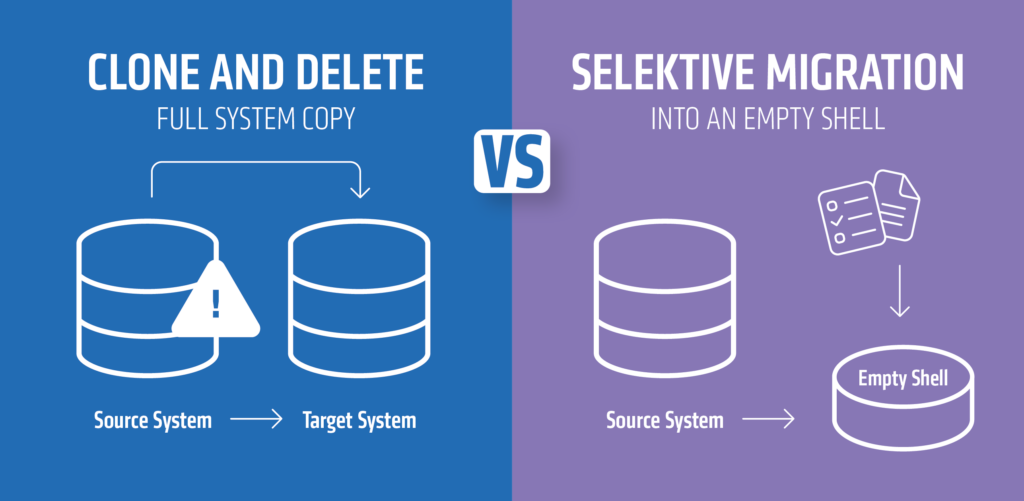
Here are two prominent examples. The “clone and delete” approach is based on creating a complete copy of the source system. All data and configurations that are not part of the transaction are then deleted from the copy.
- Advantages: Rapid availability of a functional system; repository objects and Z developments are transferred one-to-one.
- Disadvantages: Large storage requirements due to the duplication of the entire database; high risk of unintentional disclosure of sensitive seller data if deletion algorithms are not completely effective.
Selective migration to an “empty shell” is often considered the technically superior approach. Here, a target system is set up as an empty shell (only customizing and repository), into which only the identified, relevant data is then migrated.
- Advantages: Maximum data security, as only authorized data leaves the source system; the target system is free of historical baggage; enables transformations (e.g., chart of accounts changes) during the process.
- Disadvantages: Requires specialized ETL tools (such as Natuvion DCS or SAP Landscape Transformation Services) and in-depth expert knowledge for mapping table relationships.
| Strategy | Clone and Delete | Selective Migration |
| Basis | Full system copy | Empty shell copy |
| Data scope | Everything minus non-scope | Only scope data |
| Confidentiality | Risk with residual data | Very high |
| Process optimization | Hardly possible | Possible |
The challenge of document allocation and attachments
A key point in the list of requirements for a carve-out is the correct assignment of documents and their attachments. When a part of a company is sold, the question arises: Which document “belongs” to whom?
In the case of a share deal, the answer is clear: all historical documents of the legal entity are transferred to the buyer. In the case of an asset deal or a partial carve-out, the separation is more difficult. In this case, often only those documents that can be directly assigned to the sold part are migrated. If only part of a company code is spun off, all shared documents (e.g., invoices that relate to several business areas) must either be duplicated or blacked out, which is extremely costly in technical terms.
The migration of document attachments that are linked to SAP documents via Generic Object Services (GOS) or external archiving systems poses a technical risk. These attachments (e.g., PDF invoices, contracts) are essential for daily work and subsequent audits. Without these attachments, NewCo would have the posting record but no insight into the underlying original document. This would jeopardize audit compliance.
Interfaces and satellite systems: The architecture of separation
An SAP system does not exist in a vacuum. The separation and reconfiguration of interfaces is often more time-consuming and complex than the actual data migration. In SAP carve-outs, connections to third-party systems, cloud applications, and partners must be precisely analyzed and rebuilt.
Before technical changes are made, a comprehensive integration impact analysis is essential. This involves identifying all active connections to satellite systems (such as Salesforce for CRM, Ariba for purchasing, or IBP for planning) and middleware solutions (EDI/EAI). The goal is to migrate only those integrations that are relevant to the NewCo and to shut down obsolete connections in a controlled manner.
A key challenge is that the selection logic of the carve-out (e.g., based on profit centers) must be applied consistently across all connected systems. If data in satellite systems is filtered according to criteria other than those in the SAP core, inconsistencies arise. These can jeopardize operational capability from day one.
Quality assurance and test management in carve-outs
Given the enormous risks of a carve-out – from operational downtime to legal consequences – structured test management is essential. A carve-out project requires a specific test strategy that goes beyond classic implementation tests.
Effective test management is typically divided into several phases to ensure both technical integrity and business accuracy:
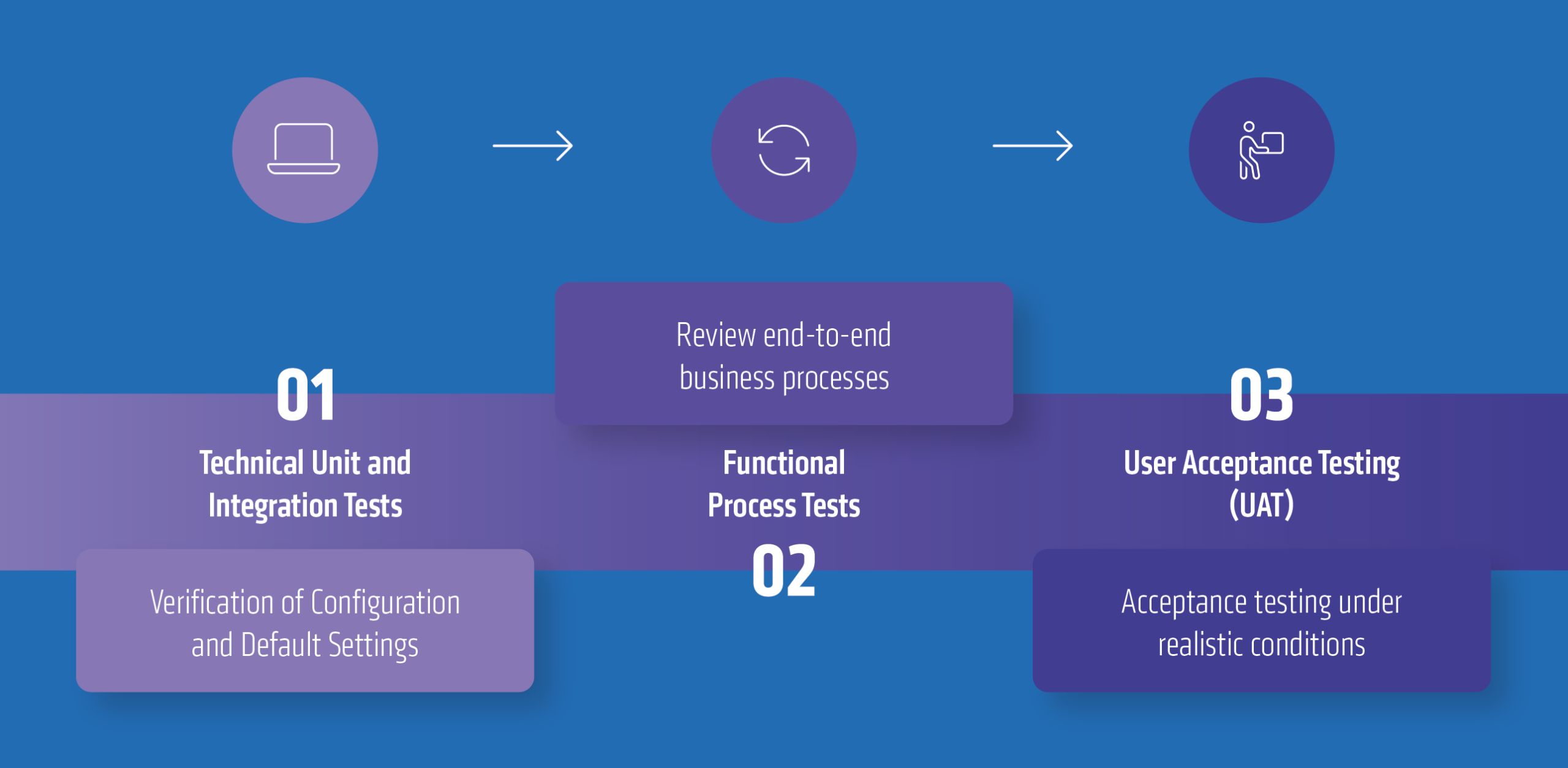
- Technical unit and integration tests: Verification of customizing and technical accessibility of all components. This often identifies and corrects fundamental errors in the system environment.
- Functional process tests: Validation of end-to-end business processes (e.g., order-to-cash, procure-to-pay) using migrated data. The goal is to provide proof-of- that the system offers the same functionality on day 1 as the source system.
- User acceptance testing (UAT): The final checkpoint, where future users of NewCo accept the system in a realistic environment.
A unique feature of carve-out tests is negative testing. This involves specifically checking whether data that does not belong to NewCo is actually not present in the target system. This is particularly critical in terms of compliance and the protection of the seller’s trade secrets.
Dry runs and cutover rehearsals
A dry run (migration dress rehearsal) is recommended before the actual go-live. This rehearsal simulates the exact schedule of the cutover weekend in order to validate the time windows for data unloading, transformation, upload, and manual follow-up work. This is the only way to minimize the risk of unforeseen delays during critical downtime.
Validation tools
Automated testing procedures are used to verify the completeness of the migration.
- Table count: Comparison of data records in source and target tables before and after migration.
- Fingerprint check: Distribution of data records across organizational units (company codes, plants) to ensure that no data from “foreign” units was migrated.
- Foreign key check: Ensuring that the corresponding customizing entries exist in the target system for all migrated transaction data.
Compliance risks and how to minimize them
Errors in data delimitation can lead to serious legal problems. If too little is migrated, the company cannot provide meaningful information to authorities. If too much is migrated (e.g., confidential data of the seller), there is a risk of lawsuits for breach of trade secrets or violations of the GDPR. Clean, tool-supported documentation of all migration steps (logging) is therefore the best insurance against such risks.
Summary and recommendations for action
Carve-outs are a highly complex undertaking that requires a close integration of IT expertise, process understanding, and legal know-how. The key success factors can be summarized as follows:
- Early definition of the dividing line: Whether via company codes or profit centers, the selection logic must be watertight and approved by all stakeholders (including auditors).
- Choosing the right migration strategy: Selective migration offers the highest level of security and flexibility, but requires specialized tools and experienced consultants.
- Holistic view of the system landscape: Interfaces, document attachments, and peripheral systems must not be neglected, as they determine operational capability from day one.
- Structured testing and validation: Data integrity can only be ensured through automated comparisons and intensive functional testing.
- Compliance as a guardrail: Compliance with GoBD protects the company against regulatory risks in the long term.
At adesso business consulting, we have experience in supporting complex SAP carve-out projects. Our range of services includes strategic consulting, technical mapping, and support during the implementation and go-live phases. We take both functional and technical aspects into account, including in the FI, CO, MM, and SD modules, as well as in data migration. We support projects involving system separation or the restructuring of IT landscapes with a structured and methodical approach. This reduces risks and establishes a stable target architecture. We are happy to arrange a non-binding consultation to discuss individual requirements and possible approaches.