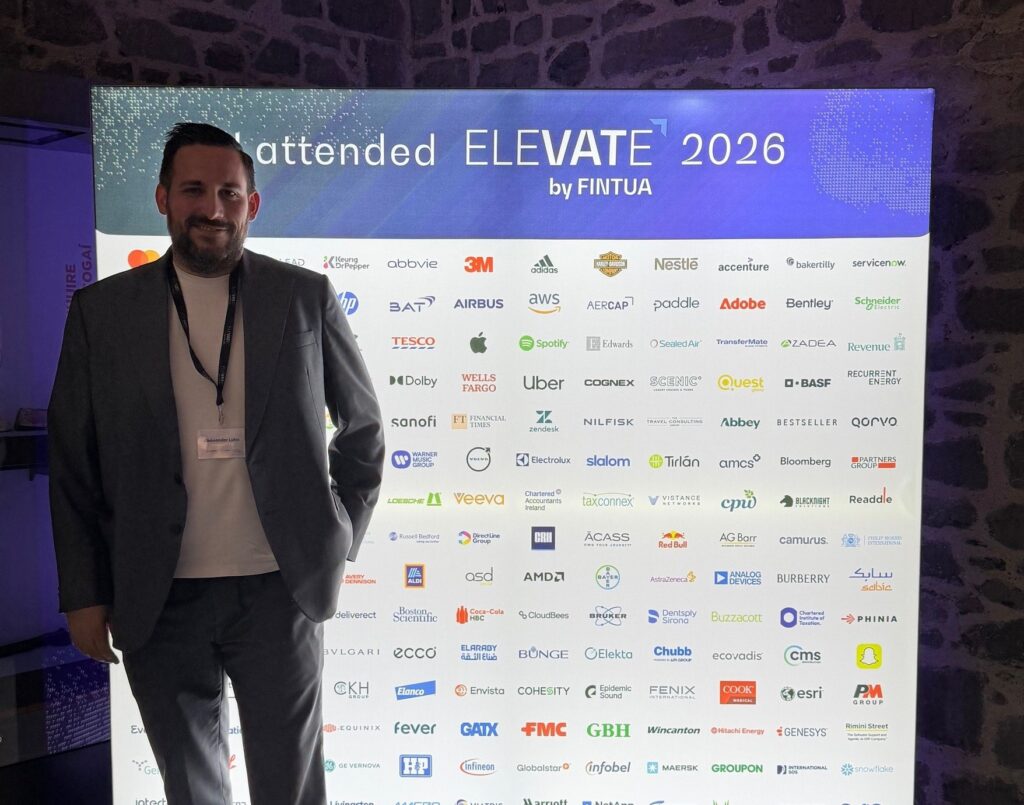
The 7th edition of ELEVATE by Fintua took place this year at St. Mary’s Medieval Mile Museum in Kilkenny. Many experts from the fields of tax technology, indirect tax, AI, and e-invoicing gathered to discuss current developments and present their findings. I am delighted to share my impressions of this fantastic event with you and to provide you with valuable insights into the latest developments in e-invoicing.
The former church building is an extraordinary venue for such a summit. It dates back to the 13th century and was used for centuries as the city’s central church and cemetery. It is estimated that 67,500 people were buried beneath the church. It is therefore a place where the past is very much present and, at the same time, a fitting setting for an event about the future of indirect taxes. For while centuries of history lie beneath our feet, the world of taxation is undergoing fundamental change above ground – primarily due to e-invoicing, VAT in the Digital Age (ViDA), and the increasing use of tax technologies.
ViDA and Digital Reporting Requirements – lots of movement with open flanks
A central topic of the event was the developments surrounding the EU initiative VAT in the Digital Age (ViDA) and, in particular, the Digital Reporting Requirements (DRR). A comprehensive explanation of what ViDA is all about can be found here in the blog post by Dennis Zielinski and Julia Barbara Krings.
Although the direction of ViDA is clearly defined with the 3-pillar model, some details or specifications have not yet been finalized. Adjustments have been made over the last few years, such as the so-called “10-day deadline” for issuing electronic invoices of the supply of goods or services. The original draft provided for a deadline of only two days. However, questions remain as to whether the ten days refer to calendar days or working days. These inconsistencies need to be resolved in a timely manner. The European Commission for Finance (ECOFIN) has a duty to clarify this.
The current mandatory period for implementing the Digital Reporting Requirements essentially provides for two categories of member states:
- Member states of the European Union that have already introduced or committed to an existing e-invoicing system before January 1, 2024, will be given an implementation period for the Digital Reporting Requirements until January 1, 2035.
- All other states must fully comply with the new EU-wide standard by July 1, 2030.
The aim of the ViDA measures is therefore not only to increase digitization, efficiency, and environmental protection, but above all to significantly reduce the VAT gap through better data and faster transparency.
E-invoicing in Ireland: Harmonization, standardization, interoperability
The Digital Reporting Requirements have probably contributed significantly to Ireland now also participating in the e-invoicing world. On October 8, 2025, the Irish Revenue Commissioners published the national e-invoicing requirement, meaning that businesses must comply with the Digital Reporting Requirements by July 1, 2030. This also means that from then on, they will have to send and receive e-invoices for cross-border transactions within the European Union.
The current roadmap envisages the following three phases:
- Phase 1: As of November 1, 2028, large VAT-registered companies will be required to issue domestic B2B invoices in a structured electronic format. All companies based in Ireland must be able to receive such e-invoices by this date.
- Phase 2: As of November 1, 2029, all VAT-registered companies based in Ireland that are involved in intra-EU trade will be required to send structured electronic invoices.
- Phase 3: By July 1, 2030, full compatibility and ViDA compliance with digital reporting requirements will be ensured.
The presentation by the Office of the Revenue Commissioners impressively demonstrated that Ireland is preparing sensibly for the e-invoicing scenario and taking the competitiveness of its market in Europe seriously. They drew up a structured plan that, in addition to the key areas of analysis and design, legislation, stakeholder involvement, and change management, also provides for active participation by companies in order to be as well prepared as possible for the future. You can read about why change management is so important in relation to e-invoicing in the blog post by Berekat Oduncu and Daniel Giesbrecht here.
Peppol as the central e-invoicing network for Ireland?
There are increasing signs that Ireland will follow Belgium’s example in e-invoicing and establish Peppol as an integral part of invoice transmission. A corresponding Peppol pilot is planned, and an announcement on which technology will lead the way in Ireland in the future is expected to be published in the near future.
If you don’t yet know what Peppol is and how e-invoicing was established in Belgium using the 4-corner model, you are welcome to take a look at the article by Felix Löffler and myself from the Peppol Conference 2025 in Brussels here. Although Peppol originated from a European Union initiative for public procurement (B2G), it is now widely used not only in the B2B sector, but also beyond continental borders – including in the United Arab Emirates and Southeast Asia.
AI und VAT Compliance: Mehr Chance als Angst
Another focus at ELEVATE was the use of artificial intelligence in e-invoicing. Used correctly, AI can bring great benefits to businesses. Agents can help minimize penalties and maintain high data quality.
Durch den digitalisierten Wandel von Papier auf E-Rechnung verfügen Steuerbehörden heutzutage nun über Werkzeuge, die vor wenigen Jahren noch undenkbar waren. Systeme wie das MIAS (Mehrwertsteuer-Informationsaustauschsystem) werden sich mit den Digital Reporting Requirements stärker zwischen Käufer und Verkäufer positionieren. Die Übermittlung von elektronischen Rechnungen wird nur noch mit konsistenten Daten funktionieren. Dies bedeutet für Steuerbehörden mehr Transparenz, präzise Validierung von Daten sowie eine schnellere Identifikation von Unstimmigkeiten. Genau dort kann KI ansetzen und Unternehmen zu einem reibungsloseren Verlauf mit E-Invoicing helfen.
However, AI only works with the necessary expertise in the background. Only through the appropriate setup of agents and the targeted use of prompts can AI take relevant contexts into account, interpret tax-relevant patterns sensibly, and identify weaknesses. What is still a small gap in the master data in the ERP system today will be immediately visible in the invoice or report tomorrow. The European standard EN 16931, which will be updated again this year, leaves very little room for inconsistent and incorrect data.
This means that AI can certainly help to implement a minimum standard of quality and ensure compliance with the law at all times – but it will not replace an accountant, application manager, or tax advisor.
Conclusion: Start early – sooner rather than later
Perhaps the most important message of the day is surprisingly simple – “start early.” All experts agree that implementing functional e-invoicing in ERP software such as SAP requires reasonable preparation time. Other large-scale IT projects or deadlines that are sometimes long in coming tempt companies to shift their priorities. However, the world of e-invoicing is constantly evolving. Take the opportunity to start analyzing your existing processes and checking the quality of your master data. After all, an e-invoice is ultimately a digital product consisting of your master data and transaction data. If your master data and processes are poor, your e-invoice will also be poor – true to the motto “garbage in, garbage out.” Be aware that e-invoicing does not forgive mistakes.
Perfect clarity is rare, times and laws can change – but those who start early build structures, reduce later risks, and become competitive faster. Those who also take the human factor into account have a good chance of generating many advantages from e-invoicing. So it’s better to start dealing with the topic of e-invoicing today than tomorrow.
Perhaps the venue was a fitting metaphor for this. Beneath the church in Kilkenny lie traces of centuries of human history. The world of indirect taxation, on the other hand, is in the midst of historic change and is constantly moving forward.
Do you want to take the right steps forward at the right time, but don’t know how? Contact me – with our years of experience in the field, we can help you implement e-invoicing worldwide.