E-Invoicing mandate starting in 2025: What companies need to know now about SAP DRC and SAP BTP
As of January 1, 2025, e-invoicing has been mandatory in the B2B sector in Germany. Since then, companies have been required to be able to receive electronic invoices. Starting January 1, 2027, the next phase will take effect: Companies with annual revenue of at least €800,000 will then be required to create and send e-invoices themselves.
So the key question is: How can this requirement be implemented efficiently and in compliance with the law? The answer: with SAP Document and Reporting Compliance (SAP DRC) in combination with the SAP Business Technology Platform (SAP BTP).
In this blog post, we’ll show how SAP DRC meets the e-invoicing requirement and what role SAP BTP plays in this process.
SAP Document and Reporting Compliance – The Foundation for the E-Invoicing Requirement
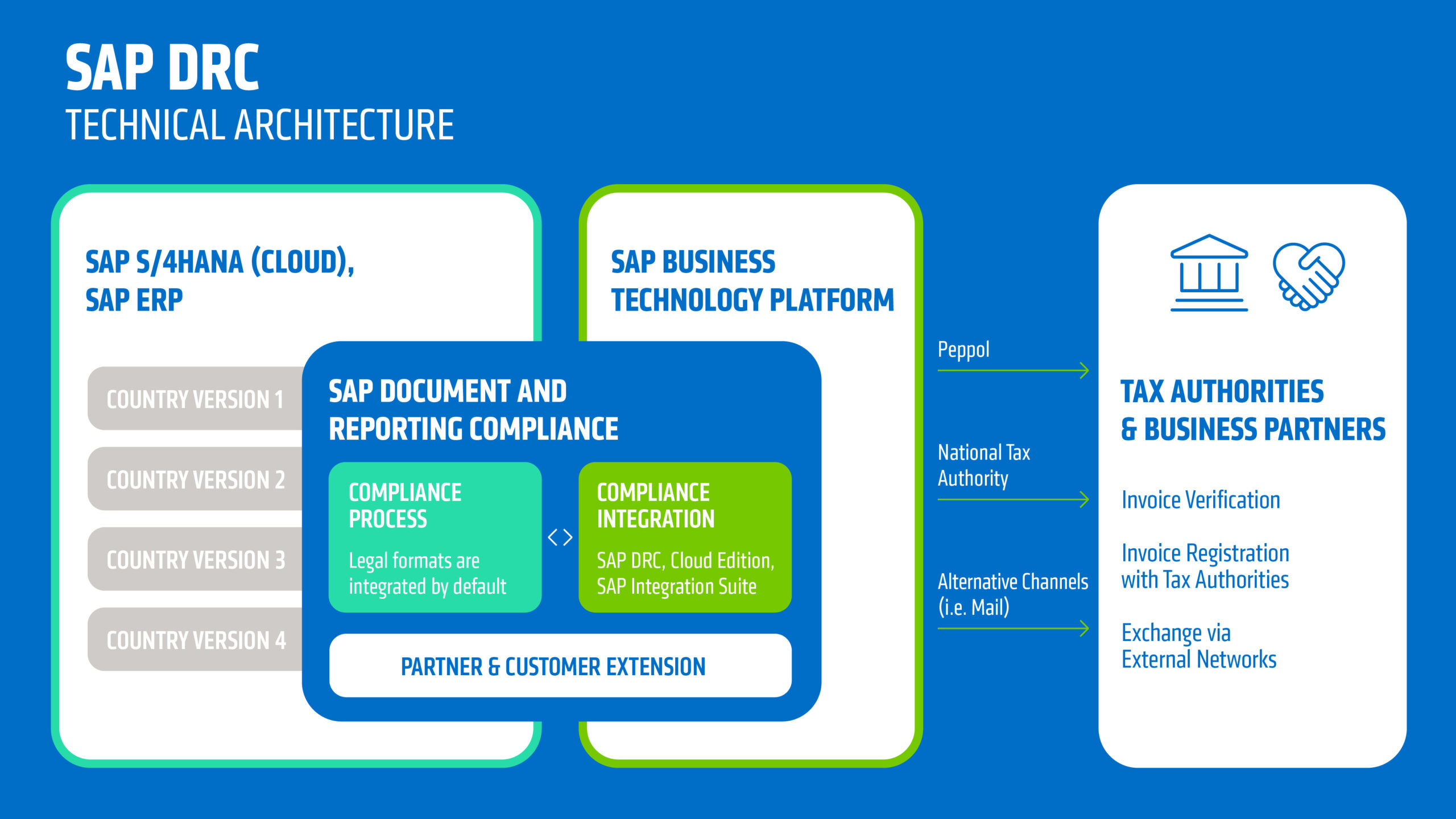
SAP DRC is a fully integrated SAP solution designed to meet the legal requirements for electronic invoices. “Fully integrated” means in this case that SAP DRC is not an additional, separate system, but rather an integral part of SAP that works seamlessly with existing processes. SAP DRC processes master and transaction data in the relevant formats – in Germany, these are XRechnung and ZUGFeRD. Transmission channels, such as via Peppol or email, are also already integrated.
This means that with SAP DRC, companies not only comply with legal requirements but also ensure smooth and automated processes in their accounting departments.
How does e-invoicing work with SAP DRC?
To ensure that invoices can be exchanged securely between systems, SAP DRC uses the SAP Business Technology Platform (BTP) as its technological foundation. The BTP enables communication between internal SAP systems and external partners such as customers, suppliers, or government agencies.
The result: an automated, transparent, and audit-compliant exchange of e-invoices.
What is the SAP Business Technology Platform?
The SAP BTP is a cloud platform that unifies applications, data, analytics, and integrations. It has undergone an exciting evolution:
- 2012: Launched as SAP NetWeaver Cloud
- 2013: Renamed SAP HANA Cloud Platform
- 2017: Renamed SAP Cloud Platform
- 2022: Now known as the SAP Business Technology Platform (SAP BTP)
Through the BTP, systems can be extended in terms of functionality, applications can be developed, and data can be linked without altering the SAP standard. In short: The BTP serves as the foundation for modern, connected business processes while ensuring a “Clean Core.”
Benefits of SAP BTP for e-invoicing
- Rapid cloud transformation: SAP BTP accelerates the implementation of cloud concepts through standard guidelines and methodologies.
- Flexible Extensions: To expand on Key User Extensibility, SAP offers Side-by-Side Extensibility in the SAP BTP environment, enabling organizations to flexibly implement or extend their own developments according to individual requirements.
- Clean Core: In traditional software implementation, extensions are continually developed based on business conditions. After several years, these extensions deviate significantly from the original plan and can negatively impact the system’s productivity. Many companies have experienced this situation. With SAP BTP, however, the system remains close to the standard.
- Seamless Integration: SAP BTP offers the Integration Suite to enable more flexible and effective communication with various systems. Among other features, SAP BTP also provides SAP Document and Reporting Compliance, Cloud Edition, to establish communication between SAP DRC and e-invoice recipients or senders.
SAP Integration Suite: The Control Center for Data Integration
To connect SAP DRC with external systems, two key options are available in SAP BTP: the Integration Suite and SAP DRC, Cloud Edition.
The Integration Suite is a powerful integration platform within BTP and is one of the most frequently used services. It offers comprehensive interfaces and APIs and enables a wide variety of applications, data, and processes to be linked together. This allows integration scenarios to be flexibly implemented in cloud, on-premise, and hybrid environments.
As part of SAP DRC, the SAP Integration Suite performs the following core tasks:
- Enables direct communication with government agencies or business partners.
- Uses the predefined iFlows integration flows to communicate with tax authorities in various countries, thereby ensuring a standardized, maintainable, and scalable connection.
- It is frequently used in on-premise environments where the company generates the legally required files directly in its own SAP backend and transmits them to government agencies or business partners via the Integration Suite.
- The entire transport process, including technical connectivity and error handling, is the responsibility of the SAP customer, thereby offering a high degree of control.
- It handles the transfer of files in country-specific formats (e.g., XML, JSON) that were previously generated in the backend and checked for completeness, format compliance, and consistency with the accounting data.
An important point is that the choice of integration path is not made by the SAP customer, but by the respective country and its regulatory infrastructure. This means there is no free choice as to whether a country is connected via SAP DRC, Cloud Edition, or the SAP Integration Suite. SAP defines the intended or supported path depending on the country.
For this reason, many international companies use a combination of both integration paths. For example:
- SAP Integration Suite for countries such as Italy, Chile, or Colombia
- SAP DRC, Cloud Edition for countries such as Belgium, Malaysia, or Romania
With the Integration Suite, companies can flexibly design and further develop their communication with external partners. Particularly in the B2B sector, it offers the ability to connect business partners directly with one another and securely exchange electronic documents – such as e-invoices.
SAP DRC, Cloud Edition – the standard solution for mandatory e-invoicing
An alternative to the Integration Suite is SAP DRC, Cloud Edition – a service within the BTP. It enables the standardized exchange of e-invoices via the Peppol network while also monitoring data flows. Additionally, it supports integration with country-specific platforms, such as Poland’s KSeF, allowing different regulatory requirements to be met centrally through a cloud service.
Features:
- Exchange of electronic documents
- Submission of reports
- Monitoring of data exchange in the Peppol network and other integrated e-invoicing solutions
As soon as documents or messages are sent or received via Peppol, SAP DRC tracks the respective exchange and forwards the status to the connected system.
Example of an incoming Invoice:
If a company receives an e-invoice from a supplier via Peppol, the network sends a status notification to SAP DRC. This information is then forwarded to the business system (e.g., SAP S/4HANA). There, the recipient is notified and can decide whether to accept or reject the invoice.
Example of an outgoing invoice:
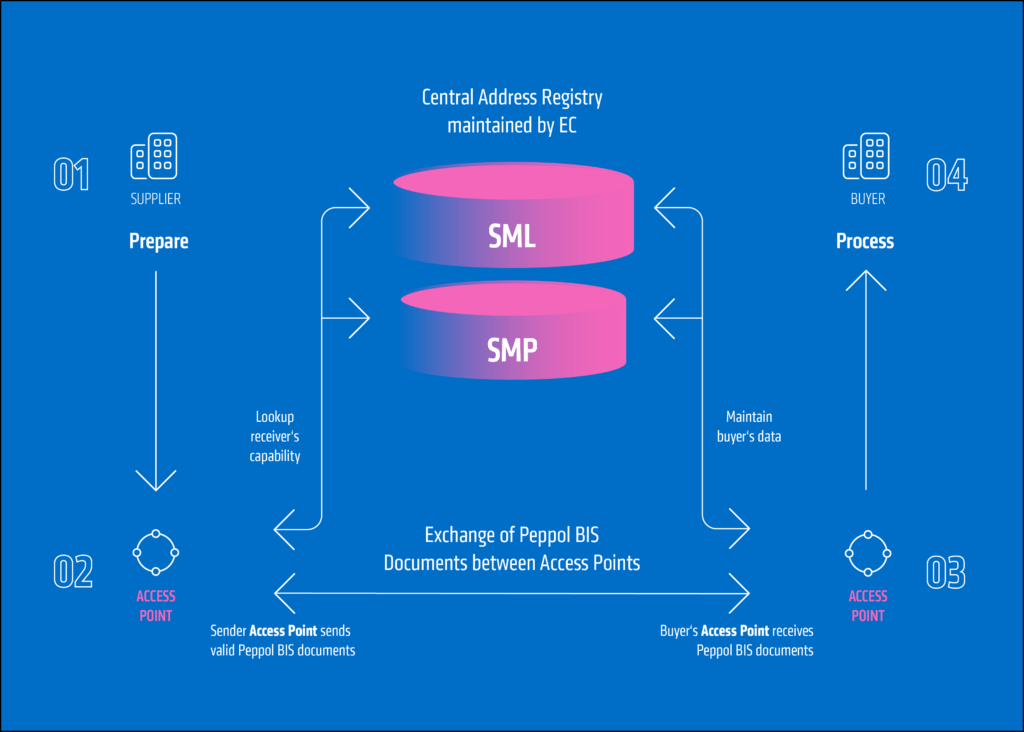
When an e-invoice is created in the business system, it is first sent to SAP DRC. From there, the invoice is then forwarded to the Peppol network. The Peppol network operates according to the so-called four-corner model: The sender and recipient are each connected to their own Peppol access point, which receives the e-invoices in a standardized format and securely forwards them to the business partner’s access point. The recipient receives a notification and can also decide whether to accept or reject the invoice.
In this process, SAP DRC, Cloud Edition acts as a Peppol access point, thereby ensuring the secure and standardized exchange of e-invoices. A more detailed explanation of the Peppol architecture and its significance for e-invoicing in Europe can be found here in another blog post.
Unlike the Integration Suite, SAP DRC, Cloud Edition automatically establishes standard connections to external systems via public cloud services.
Integration with SAP ERP and SAP S/4HANA
SAP DRC, Cloud Edition integrates seamlessly with various SAP systems:
- SAP ERP (via Cloud Connector, available starting with ECC 6.0 EHP1)
- SAP S/4HANA On-Premise (via Cloud Connector)
- SAP S/4HANA Private Cloud (via Cloud Connector)
- SAP S/4HANA Public Cloud (direct connection)
When integrating with on-premise systems (SAP ERP, SAP S/4HANA On-Premise) or SAP S/4HANA Private Cloud, electronic documents are exchanged between the SAP systems via the Cloud Connector, which establishes the connection between SAP ERP and SAP BTP. This ensures that electronic invoice transmission via BTP itself works seamlessly, even on on-premise systems.
No Cloud Connector is required for integration with the SAP S/4HANA Public Cloud, as there is a direct connection to SAP BTP.
Prepare Now for Mandatory E-Invoicing in Germany
The e-invoicing mandate in Germany is coming – and it affects all companies in the B2B sector. Companies must adapt their business processes accordingly to remain competitive. At the same time, they must comply with the legal requirements for e-invoice. With SAP DRC and the SAP Business Technology Platform, SAP offers a future-proof, integrated solution for the e-invoicing mandate and beyond.
At adesso business consulting, we understand the complexity of this challenge, support you in implementing SAP DRC, and show you how to make the most of the benefits of SAP BTP. We’re here to support you every step of the way: with a practical, experienced, and forward-looking approach.
Trust in our expertise, and let’s work together to ensure the success of your SAP DRC implementation. Contact us and secure a future with an efficient and legally compliant e-invoicing process!