A beverage group bottles in one country and sells through a company in another. As soon as the container rolls across the border, it is often unclear which company carries the goods on its balance sheet at that stage. In an industry with short shelf lives, seasonal peaks and tight margins, this uncertainty is not a cosmetic flaw but a real financial risk.
This is exactly where the SAP scope items 5D2 and 5HP come in, cross-company-code sales and cross-company-code stock transfer. They turn complex group processes into a standardized, automated process. Advanced Intercompany in SAP S/4HANA solves precisely this through the two scope items 5D2 and 5HP.
- Maximum efficiency through automation, standardized workflows eliminate manual handovers between the entities. Orders, deliveries and invoicing run in sync, which shortens lead times and lowers the error rate.
- Significant cost reduction, no duplicate data entry, less capital tied up in transit and lower process complexity. Operating administrative costs drop noticeably.
Why traditional structures reach their limits
Anyone growing internationally manages flows of goods across legally independent entities. The traditional approach means duplicate data entry, manual reconciliation and unclear stock in transit. That costs time, money and headaches, especially in food and beverage, where every day in transit eats into shelf life.
Old versus new, the honest comparison
The classic intercompany solution has well-known gaps. The selling company orders without a real purchase order. The delivering company ships without a sales order. Instead of a genuine supplier invoice, only an accounting document generated from an IDoc is created. There is no valuated stock at the selling company, and therefore no clean picture of product costing and landed cost. And period-end closing only runs at the delivering company. KPIs for both sides? Nowhere in sight.
Advanced Intercompany turns this around. Real documents, valuated stock, consistent KPIs for both companies. That is the real difference, not a prettier front end.
Advanced Intercompany Sales (5D2), one customer, two companies
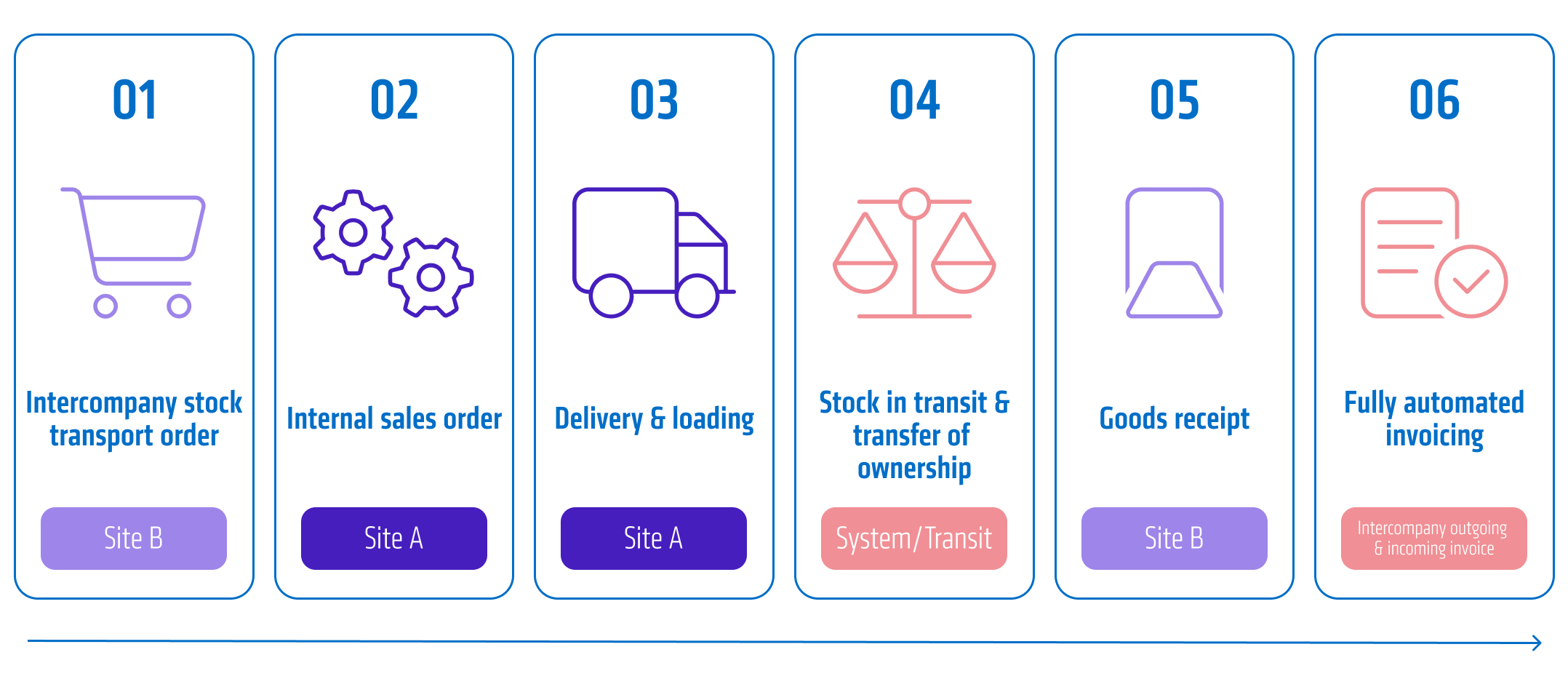
Two affiliated companies work on a single sales order. SAP wires up the purchase order, sales order and settlement automatically. At its core, two companies share the roles.
- The selling company, the interface to the market, bears the commercial risk and issues the final customer invoice.
- The delivering company handles the physical part in the background and settles its service via an internal intercompany invoice.
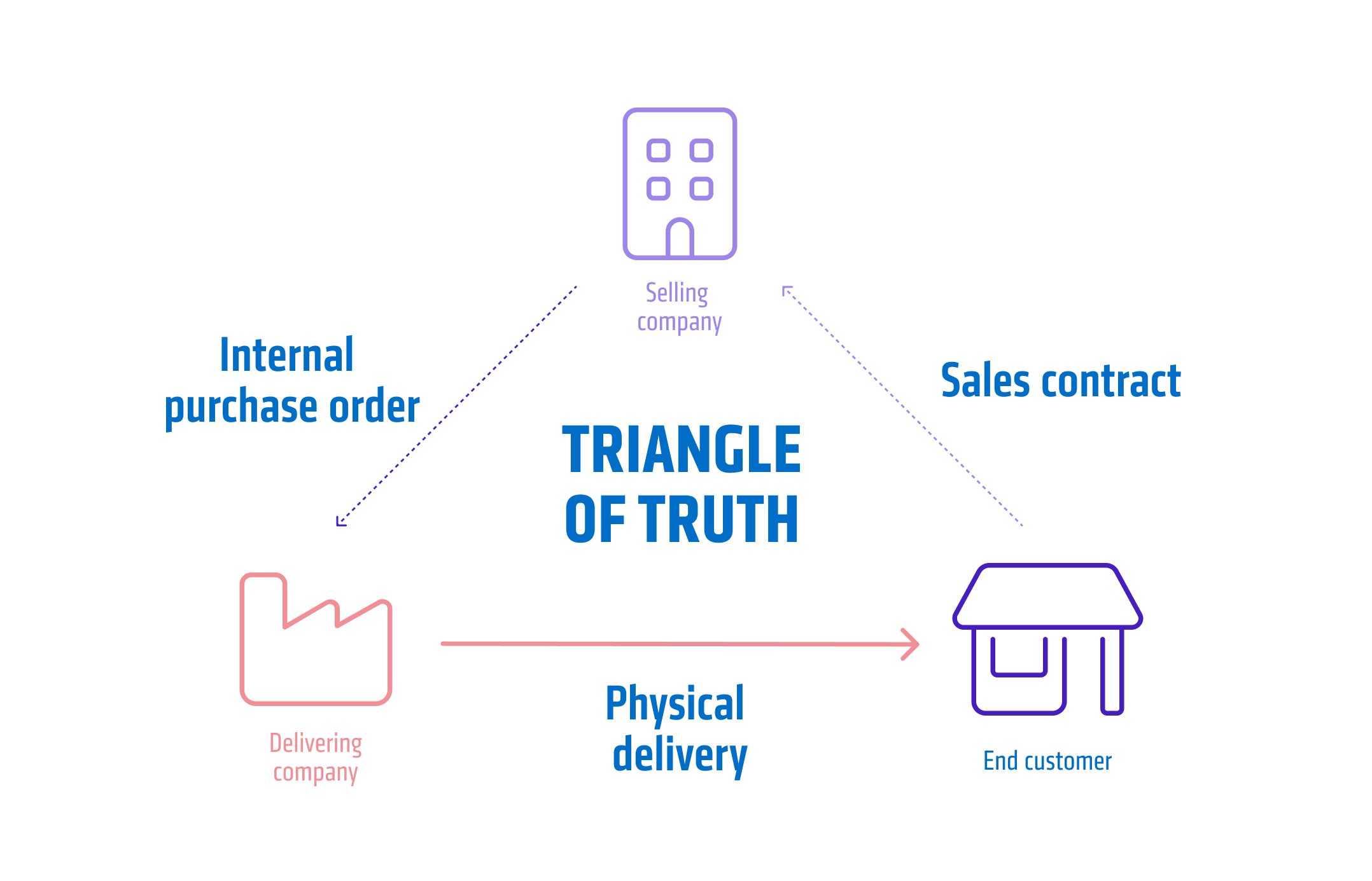
The two-invoice model separates the commercial customer relationship from the physical flow of goods. The F2 customer invoice goes to the end customer, the IV2 intercompany invoice runs internally. Both are created independently but refer to the same delivery.
Advanced Intercompany Stock Transfer (5HP), logistics without shadow work
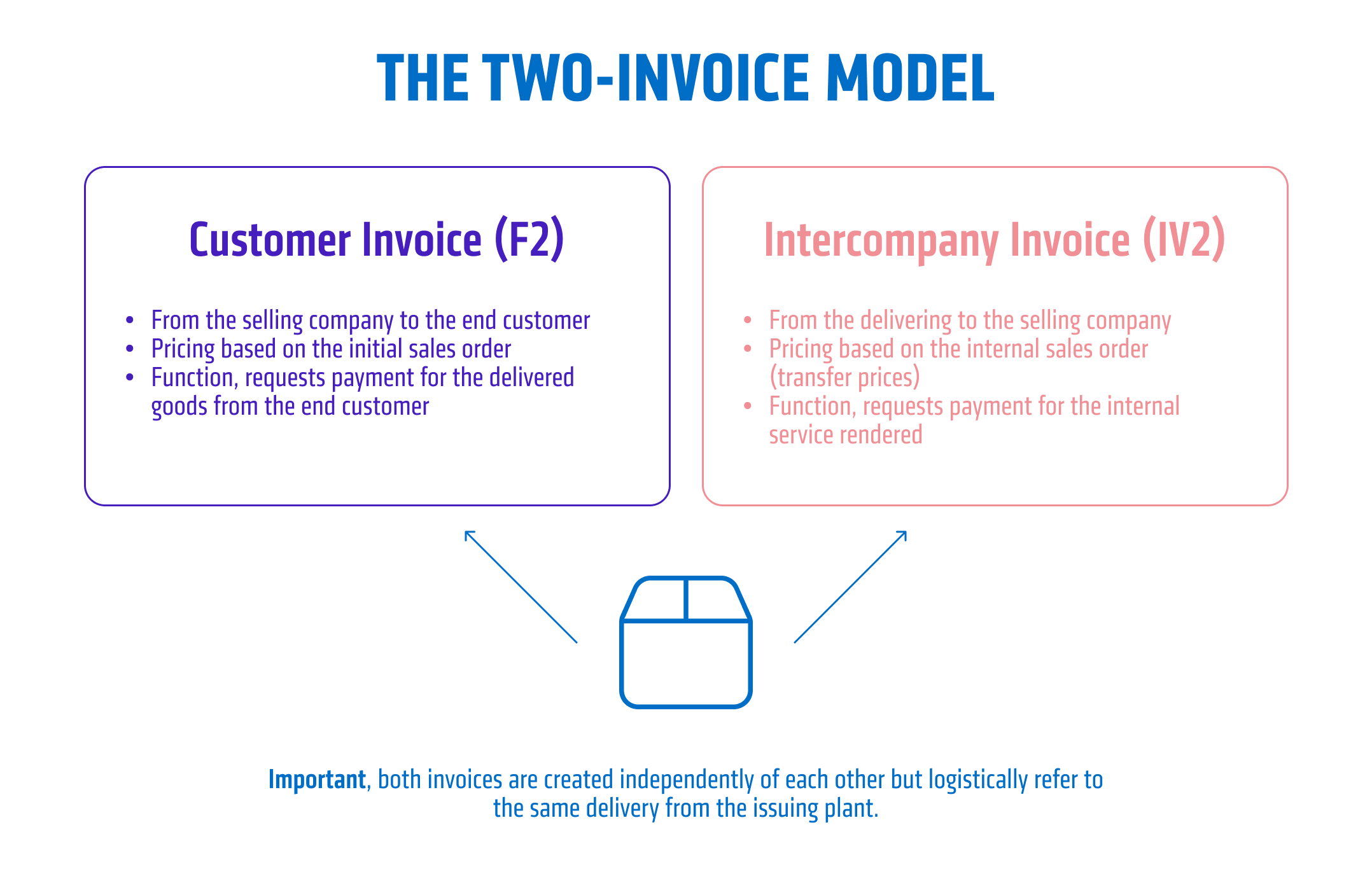
Internal stock transfers, too, often cost time, money and balance-sheet certainty. With 5HP, SAP treats affiliated companies as a single logistics network. In the process, the two company codes appear as Site A and Site B. Physical transport and the digital document chain run in parallel, in six steps.
- The trigger, intercompany stock transport order, Site B. The receiving Site B reports the demand and creates the intercompany stock transport order.
- The digital synchronization, internal sales order, Site A. As soon as the order is triggered, an internal sales order is created fully automatically at the delivering Site A. This saves time and prevents data-entry errors.
- Logistics kicks off, delivery and loading, Site A. Site A picks the freight, creates the delivery documents and loads the goods onto a truck or container.
- The accounting core, stock in transit and transfer of ownership. The goods now sit in valuated stock in transit. It is precisely at this stage that the legal transfer of ownership takes place.
- Die physische Ankunft, Wareneingang, Standort B. Am Zielort wird die Lieferung vereinnahmt. Das lokale Lager verbucht den Wareneingang und stellt das Material direkt für Verarbeitung oder Verkauf bereit.
- The final close, fully automated invoicing. The system simultaneously generates the outgoing invoice for Site A and the matching incoming invoice for Site B, without any manual intervention.
The heart of it, the valuated stock in transit
Most of the frustration arises in the no man’s land between the sites. 5D2 and 5HP solve this through valuated stock in transit. No matter how long the truck or container is on the road, the goods are always precisely assigned, both who owns them and at what value they sit on the balance sheet. The moment of transfer is governed by the Incoterms, whether at goods issue, at loading or only on arrival.
Advanced Intercompany SAP S/4HANA, the real USP in the automation framework
And now the part most people overlook. What is new lies not only in the process but in the tool behind it, the Value Chain Monitoring framework with the Fiori app Monitor Value Chains, introduced with SAP S/4HANA 2022. It creates documents and postings automatically in the background, shows every step and every document link in real time, from order to invoice, and detects errors such as missing master data early. After the fix, it reprocesses the affected steps in a targeted way. Many manual steps become one monitored end-to-end process, for both sales and stock transfer.
For finance and audit, not just for logistics
The real payoff is in accounting. The seamless document chain closes exactly the gap that auditors criticize in the old solution. Via IFRS 15 with event-based revenue recognition, SAP recognizes revenues and costs at the actual transfer of ownership, not lump-sum at period-end. Freight costs via SAP TM land on the same event. The result, a clean margin per company, a faster close and an audit that does not turn into a treasure hunt.
What this means for food and beverage
Short shelf lives, many plants, tight margins. Anyone who loses track in transit here loses money. 5D2 and 5HP give group sales a central product range across all companies, cleanly separated from logistics, and give accounting the correct inventory value at all times. That is exactly what the industry needs.
Conclusion, from bottleneck to competitive advantage
5D2 and 5HP are more than an IT upgrade. They are the foundation for global, audit-proof growth. Anyone still reconciling manually and guessing in transit today is wasting resources.
Want to see how the process would look in your system? Talk to us and we will walk you through 5D2 and 5HP for your specific scenario.