Hardly any other sector has such a significant impact on our daily lives as the energy industry. But what are the distinctive features of this market, and how does the SAP S/4HANA Utilities solution contribute to it?
Utilities: What exactly does the term mean?
The term ‘utilities’ probably sounds a bit abstract to most people. You might initially think of the English word ‘utility’ in the sense of usefulness or practicality, or associate it with tools, vehicles or utility programmes. But what lies behind it is the industry that has a significant impact on our everyday lives – the energy and utilities sector.
Essentially, this sector comprises companies or organisations that provide essential services to society. This includes, for example, the supply of electricity, water and gas. In addition, regulation, infrastructure and technological progress fall within the remit of the utilities sector.
How do stakeholders in the energy and utilities sector interact with one another?
In Germany, the energy sector operates within a liberalised market, which is overseen and regulated by the Federal Network Agency (BNetzA). The BNetzA reports to the Federal Ministry for Economic Affairs and Climate Action, which sets out the legal framework through the Energy Industry Act (EnWG).
A prerequisite for this is market communication, which encompasses (a) a secure and smoothly functioning exchange of information between market participants, (b) clear responsibilities for the market participants involved, and (c) standardised and automated market processes and data formats. In defining business processes and data exchange formats, the BNetzA is supported by, amongst others, the associations BDEW and DVGW, and the cross-association expert group edi@energy.
Clear definitions underpinning market communication are set out in the BDEW’s ‘Role Model for Market Communication in the German Energy Market’. The role model describes the responsibilities and tasks of market roles, areas and objects. Some of the key players in market communication are the network operator, metering point operator and supplier.
Network operator, metering point operator and supplier
The network operator (VNB) is essentially the body responsible for the transmission and distribution of electricity and gas, as well as for the safety and stability of the network. Furthermore, the network operator is responsible for assigning market participants to the properties connected within its network area.
With regard to individual properties within the network area, the metering point operator (MPO) is responsible for the installation, operation and maintenance of equipment, as well as for the collection and transmission of meter readings to the network operator.
The supply of energy to premises or the purchase of energy from energy-generating facilities is the responsibility of the supplier (LF). The supplier is usually also the end customer’s main point of contact, as it is with the supplier that contracts for the supply or purchase of electricity are concluded.
Beschreibung der Marktkommunikationsprozesse
In market communication, there are various use cases, each involving different market partners. For each use case, it is clearly defined which roles interact with one another and in what way (see Figure 1).
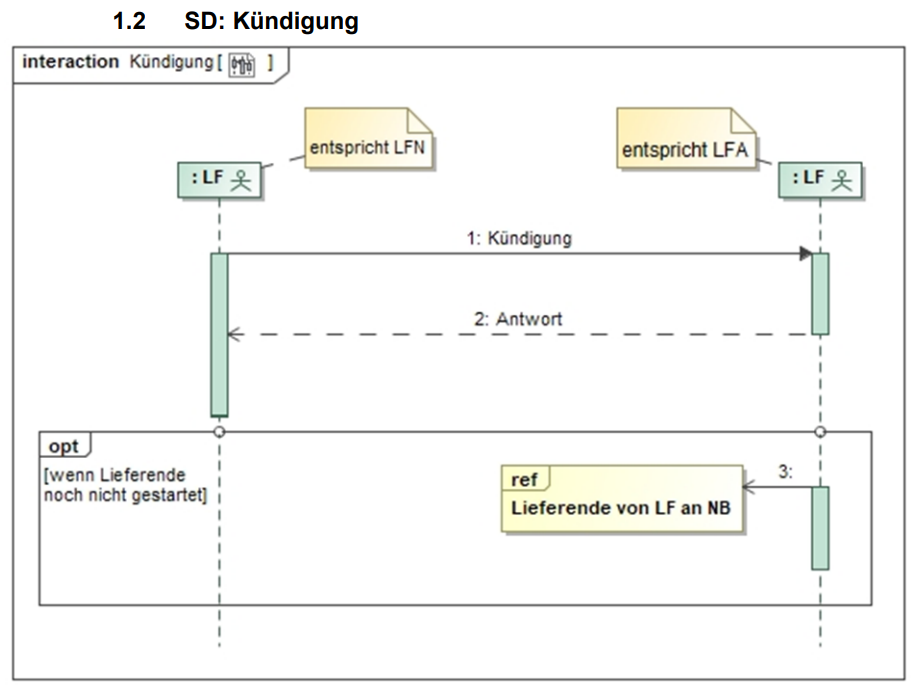
Communication takes place using defined data formats based on the UN/EDIFACT standard. Due to the diversity of use cases, there are specific message formats for different purposes. Examples include UTILMD (transmission of master data changes), MSCONS (transmission of meter readings) and INVOIC (transmission of network usage invoices).
Despite the differences in their terms of use, they are similar in structure. The definition of the message formats specifies which content may or must be included (see Figure 2). Both the request and the response contain mandatory fields that must be completed. Failure to do so contravenes regulatory requirements, resulting in a justified rejection.
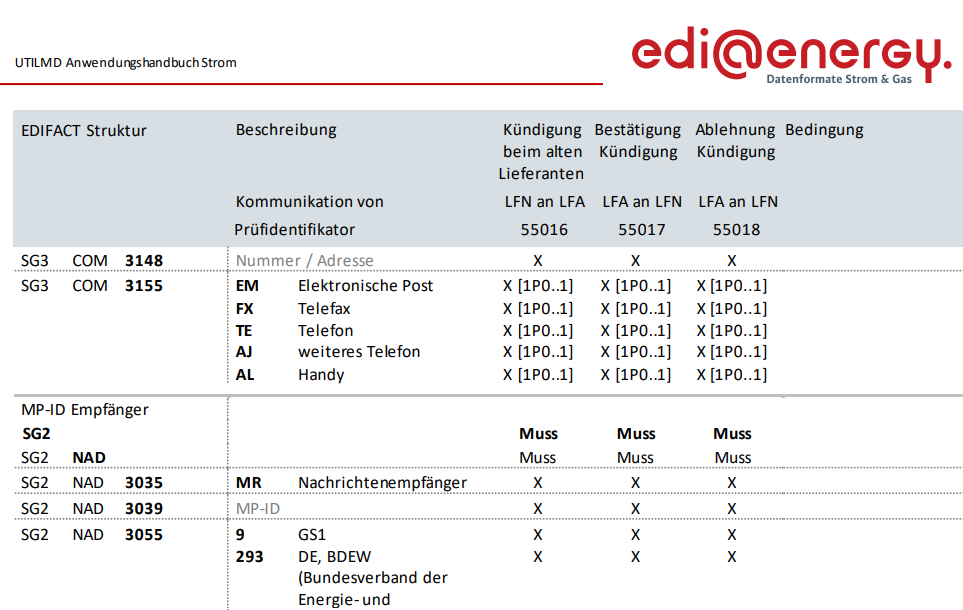
The data formats are subject to regular updates based on legal and regulatory decisions. Any resulting changes within complex process landscapes must therefore be thoroughly tested to ensure that the processes continue to function properly.
How can companies in the energy sector map their processes?
Energy suppliers in the German market therefore face the challenge of complying with regulatory requirements and responding to any changes in the most effective and timely manner. To meet these complex requirements, various solutions are used, including S/4HANA Utilities in conjunction with the SAP Market Communication Cloud. S/4HANA Utilities covers the regulatory process landscape and is updated by SAP at regular intervals.
In addition, communication processes are handled via the SAP Market Communication Cloud, which is why SAP regularly updates the regulatory processes on the cloud. This results in the separation of the processes into their business management component (mapped in S/4HANA Utilities) and their regulatory component (mapped in SAP Market Communication for Utilities). However, seamless interaction between both systems is necessary to ensure the smooth running of the processes.
As a comprehensive solution, S/4HANA Utilities meets the regulatory requirements of various market roles at both the process and message format levels. The current S/4HANA Utilities solutions are based on the APE (Application Process Engine) framework. The APE framework enables the efficient modelling, execution and monitoring of business processes, which results, among other things, from the use of SAP Fiori UI technology. Fiori technology enables the SAP system to be used on various end devices, such as tablets or mobile phones, thereby leading to the increased use of ‘Fiori apps’ instead of transactions in the GUI. Further key features of S/4HANA Utilities are covered in the blog post S/4HANA Utilities – from obligation to choice.
Conclusion
Die Utilities-Branche umfasst alle Tätigkeitsfelder der Versorgungswirtschaft. Die durch die Bundesnetzagentur regulierte Marktkommunikation resultiert in eindeutig definierte Anwendungsfälle und Datenformate, die in gewissem Maße einen Standard definieren. Diese Standardisierung der Marktkommunikationsprozesse wird von der SAP aufgegriffen und mit S/4HANA Utilities der Rahmen für eine jederzeit regulierungskonforme Abwicklung der Prozesse geboten.